All species › Cranes, rails and allies › Cranes › Demoiselle Crane
Demoiselle Crane | Grus virgo
Jufferkraanvogel | Grulla damisela
The smallest and slimmest crane, migrating through the east of the region between the steppes of Central Asia and its winter quarters in Sudan and Chad. Until the twentieth century a small, isolated population bred on the high plateaus of Morocco and Algeria; it has disappeared.
Voice
A high, raw trumpeting, krrik-krrik, shorter and shriller than the deep kroo-kroo of Common Crane and with a grating undertone. A passing flock calls incessantly.
Recording: He Wenjin — CC BY-NC-SA 4.0 · converted to mono · xeno-canto
Identification
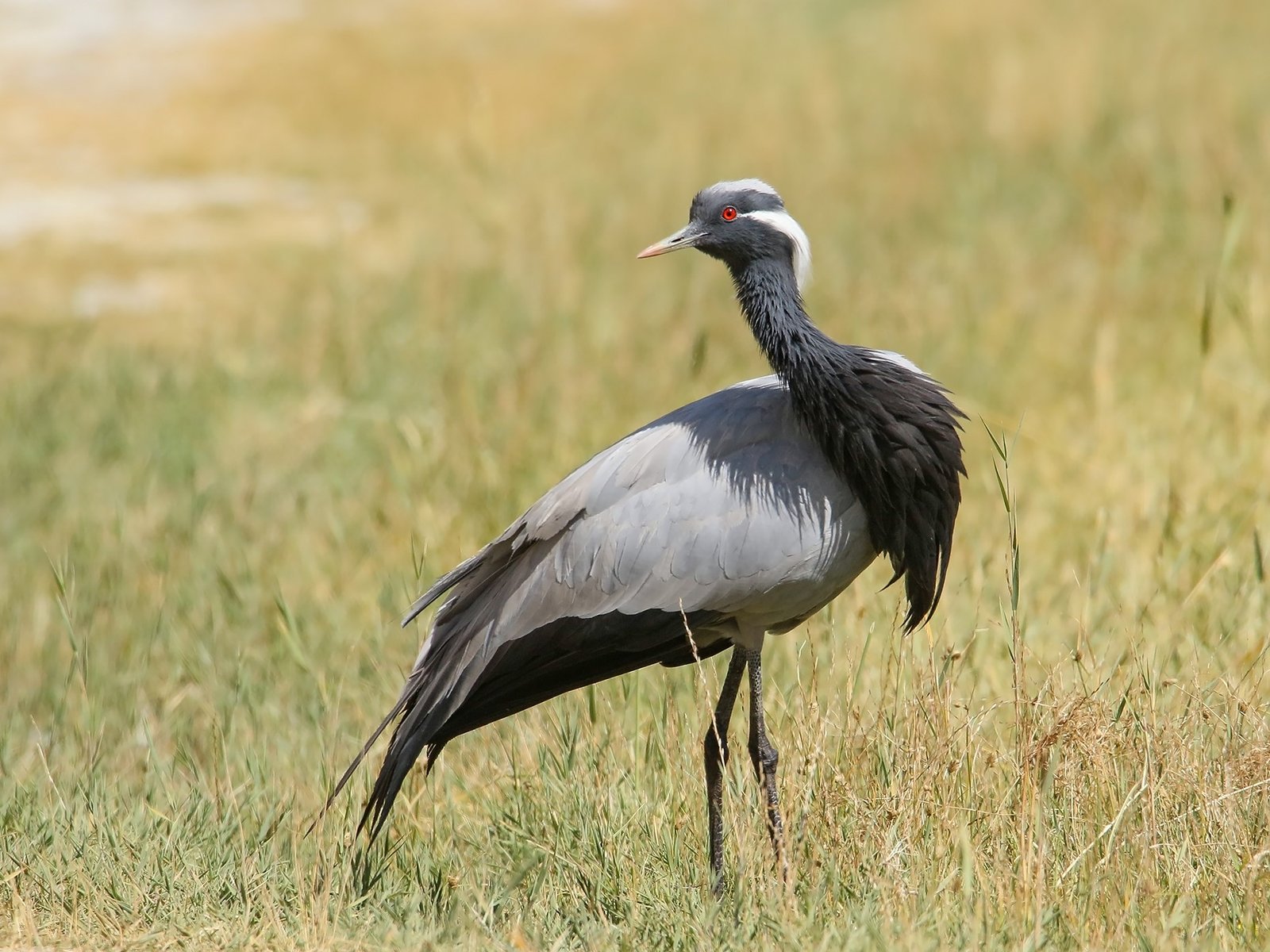
Clearly smaller and slimmer than Common Crane, with a pale grey body. Head and foreneck are black, and the black of the foreneck continues in a long plume over the breast. A long, narrow white plume extends back from behind the eye. The bill is short and the eye red. The grey tertials droop in a point over the tail. In flight it looks like a small Common Crane, but the black foreneck extends further and the head is finer. Young birds are duller grey, with grey ear tufts.
Confusion species
Common Crane (Grus grus) is larger and darker grey, with a short black throat, a white stripe down the side of the neck, a red crown patch and a full bustle of tertials. In mixed flocks in flight Demoiselle Crane is smaller, with faster wingbeats and a shorter, finer neck.
Habitat
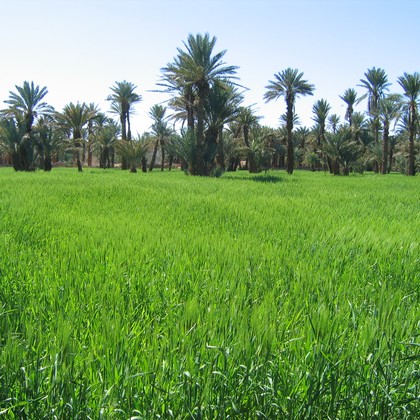
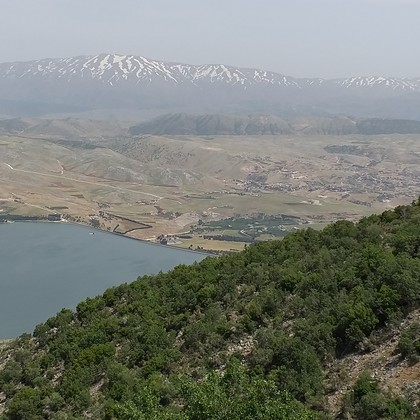
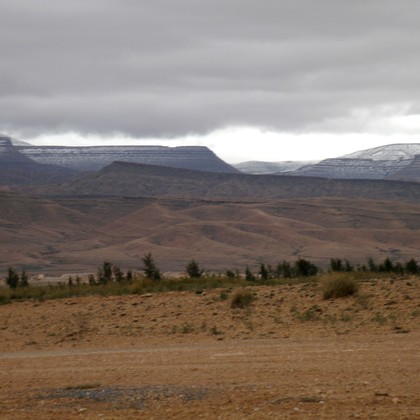
On passage over open country; rests on fields, stubble and steppe, and drinks and roosts at shallow lakes, reservoirs and sewage ponds. It crosses the desert largely in one go and lands only in bad weather or when exhausted.
Where the bird is most at home, classified by the habitats of North Africa and the Middle East.
Range and movements
Passage migrant through the east of the region: in Iraq, Kuwait, eastern and northern Saudi Arabia and the Gulf states, mainly in August and September and again in March and April; scarce in Oman and Yemen. In Israel, Jordan, Syria and Sinai a scarce migrant, usually in small groups. In Egypt scarce on passage along the Nile and the Red Sea. In north-west Africa a small population bred on the Algerian high plateaus until about 1944 and in the Middle Atlas of Morocco until the mid-1980s; now a rare vagrant there, as at Oran in 2016. Breeds from the Black Sea and Turkey through the steppes of Kazakhstan to Mongolia and north-east China; winters in Sudan, Chad, Ethiopia and India.
- Winter visitor (c. Oct–Mar)
- Passage (Mar–Apr, Oct–Nov)
- dark = core range, pale = thinly spread
How and when to look
The best chance is in late August and September in Kuwait or eastern Saudi Arabia, when flocks sometimes land on irrigation circles and at sewage ponds. In Israel there is the odd group among the Common Cranes in the Hula Valley or on passage at Eilat.
Conservation status
Not globally threatened and fairly numerous. The North African breeding population is extinct, probably through hunting, disturbance and the ploughing of steppe. On the migration routes through the Middle East cranes are still hunted and caught alive for the trade.
Scientific name
Grus virgo | (Linnaeus, 1758) (GBIF: Anthropoides virgo)
Linnaeus described the species in 1758 as Ardea Virgo; because it was later moved to another genus, the author and year stand in brackets. The genus Grus was introduced in 1760 by Brisson. Grus is the Latin word for 'crane'. virgo is Latin for 'maiden', the same idea as in the English name demoiselle crane. The specimen the first description was based on came from India.