All species › Passerines › Sylvia warblers › Cyprus Warbler
Cyprus Warbler | Curruca melanothorax
Cyprusgrasmus | Curruca chipriota
Cyprus Warbler breeds only on Cyprus but winters in the desert wadis of the southern Levant and Sinai, so that almost the entire world population is within this region in winter. A small, lively warbler of rocky slopes with low bushes, often unobtrusive among acacias in winter.
Voice
The call is a hard, dry chek and, when agitated, a short wooden chrrr, slower and drier than the rattle of Sardinian Warbler. The song is a short, stiff and monotonous phrase of grating and chirping; in winter quarters mostly the call is heard, but males already sing in February and March.
Recording: Alain Verneau — CC BY-NC-SA 4.0 · converted to mono · xeno-canto
Identification
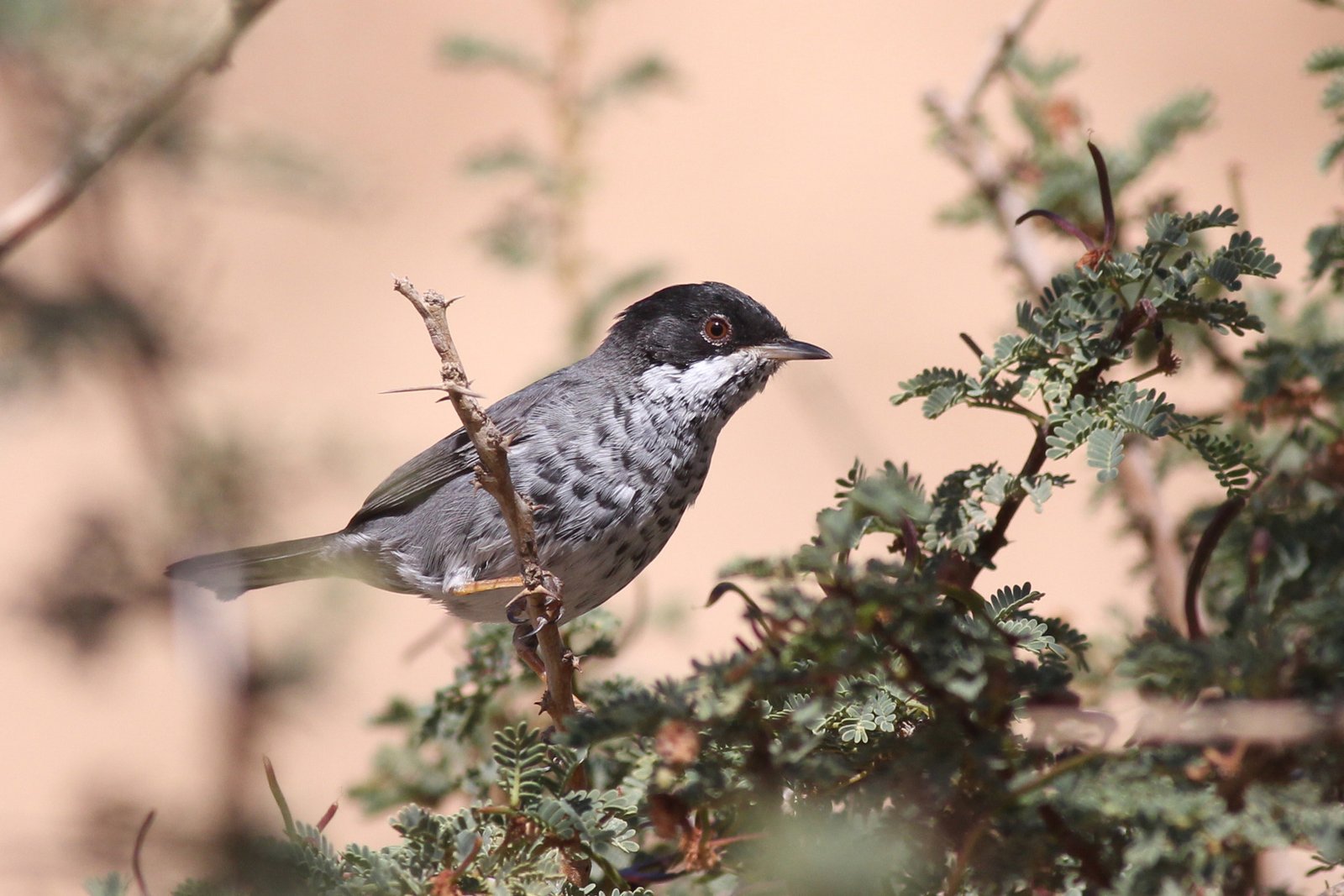
12.5–13.5 cm. Small and compact, with a long, often cocked tail. The male has a black head extending below the eye, a narrow white moustache and — the decisive feature — white underparts densely spotted and scaled black from throat to flanks. Eye-ring orange-red, mantle dark grey, tertials and greater coverts with narrow white fringes, tail dark with white outer feathers. In winter the spotting is partly veiled by fresh pale fringes. The female is grey-brown with spotting confined to throat and upper breast; young birds can be almost unspotted but keep the white tertial fringes.
Confusion species
Sardinian Warbler (Curruca melanocephala) has clean, unspotted underparts, a brighter red eye-ring and plain tertials. Rüppell's Warbler (Curruca ruppeli) has a solidly black throat with a broad white moustache in the male; it occurs only on passage, not in winter. Ménétriés's Warbler (Curruca mystacea) is paler with a duller black head and constantly moves its tail. Females can resemble female Sardinian but nearly always show some dark spots on the throat.
Habitat
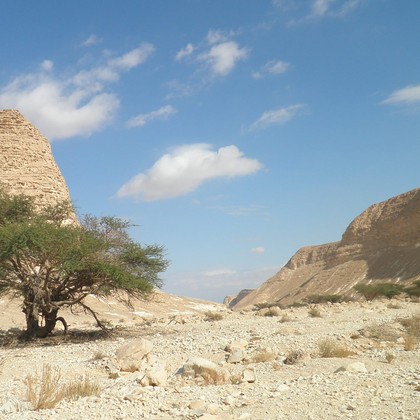
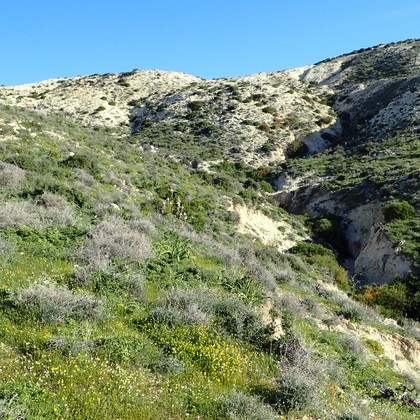
In winter in dry, rocky wadis and slopes with scattered acacias, Retama and saltbushes, in the desert and semi-desert of the Negev, the Arava and Sinai, down to the edges of the Dead Sea. Breeds on Cyprus in maquis and garrigue on slopes.
Where the bird is most at home, classified by the habitats of North Africa and the Middle East.

Range and movements
Winters mainly in southern Israel (Negev, Arava, Eilat mountains, Dead Sea area), in Jordan along the Dead Sea Rift to Wadi Araba, in Sinai and in eastern Egypt into the mountains along the Red Sea; possibly scarce in extreme north-west Saudi Arabia. A scarce passage migrant in Lebanon and Syria, otherwise a vagrant. Part of the population stays on Cyprus in winter. Outside the region the species breeds nowhere but Cyprus.
- Resident
- Summer visitor (c. Apr–Sep)
- Winter visitor (c. Oct–Mar)
- Passage (Mar–Apr, Oct–Nov)
- dark = core range, pale = thinly spread
How and when to look
Search the wadis of the Eilat mountains, Ein Gedi and the arid slopes along the Arava between November and February: a dry chek from an acacia gives the bird away. In Jordan the Dead Sea area and the low wadis of Dana reserve are good.
Conservation status
Not globally threatened. The breeding range is small but the species is common on Cyprus and benefits from abandoned fields reverting to scrub. Sardinian Warbler has expanded strongly on Cyprus in recent decades, and the two species compete locally.
Scientific name
Curruca melanothorax | (Tristram, 1872) (GBIF: Sylvia melanothorax)
Tristram described the species in 1872 as Sylvia melanothorax; because it was later moved to another genus, the author and year stand in brackets. The genus Curruca was introduced in 1802 by Bechstein. Curruca is Latin, the name of an unidentified small bird mentioned by the Roman poet Juvenal. melanothorax is Greek, from melas 'black' and thorax 'breast', after the black markings on the male's underparts. The specimen the first description was based on came from Ein Gedi, Dead Sea.