All species › Passerines › Waxbills › Cut-Throat Finch
Cut-Throat Finch | Amadina fasciata
Bandvink | Estrilda degollada
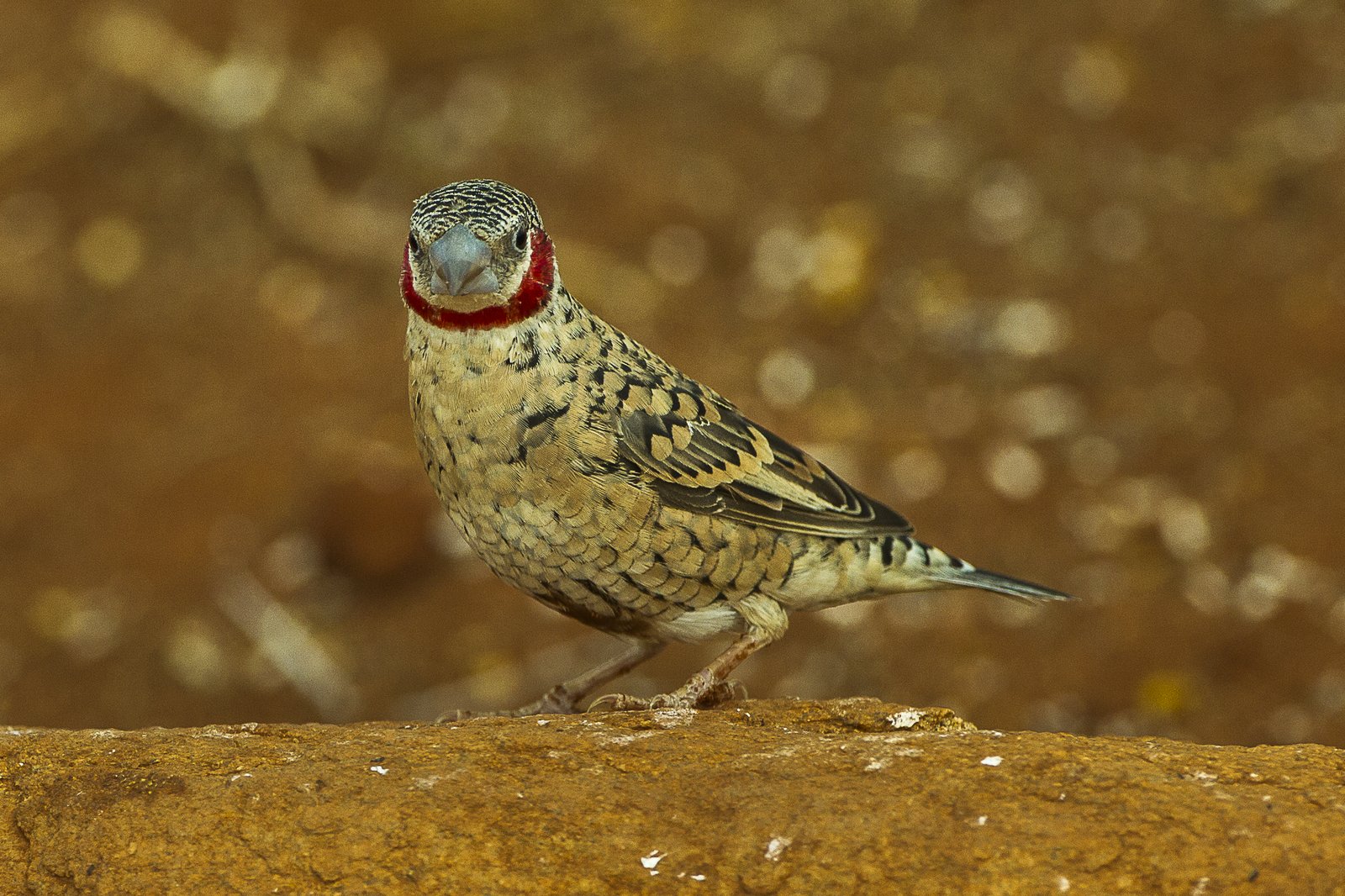
The Cut-Throat Finch owes its name to the crimson band that runs across the male's throat. It is a stocky, finely barred estrildid of the African savannas that turns up in the region only very exceptionally, as a wanderer from the Sahel or as an escaped cage bird.
Voice
A soft, thin eee-eee-eee and a dry chup in flight. The male's song is a quiet buzzing twitter with low humming notes.
Recording: Richard White — CC BY-NC-SA 4.0 · converted to mono · xeno-canto
Identification
12 cm, stocky, with a thick, pale horn-coloured bill. The plumage is pale brown to sandy with fine black barring and scaling on head, back and flanks; the wing coverts have pale terminal spots. The male has a striking crimson band across the throat from ear to ear and a chestnut patch in the centre of the belly. The female lacks the throat band and belly patch but has the same fine barring. Young males soon show a narrow, duller red throat band.
Confusion species
Female sparrows, such as House Sparrow (Passer domesticus) and Sudan Golden Sparrow (Passer luteus), lack the fine barring over the whole body. African Silverbill (Euodice cantans) is also finely barred, but smaller, with a silvery-blue bill and a long pointed black tail. The closely related Red-Headed Finch (Amadina erythrocephala) of southern Africa has a wholly red head in the male; it is a candidate as an escaped cage bird.
Habitat
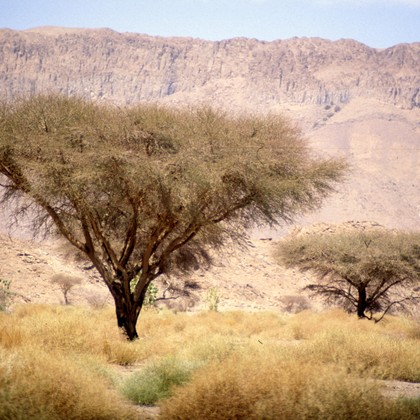
Natively dry acacia savanna and thorn scrub, often near water, villages and fields. Vagrants and escapes in the region are to be expected at water in vegetated wadis, in gardens, parks and field edges, often among sparrows or other estrildids.
Where the bird is most at home, classified by the habitats of North Africa and the Middle East.

Range and movements
In the region only scattered records. Birds in towns, parks and gardens, for example in the Gulf states and Israel, are generally regarded as escaped cage birds; birds at the southern edge of the Sahara and in southern Egypt may also be natural wanderers from the Sahel. There is no established population. Beyond the region across the savanna belt from Senegal and Mali through Niger, Chad and Sudan to Ethiopia, and south through East Africa to the north of southern Africa.
How and when to look
A Cut-Throat Finch in the region is a find that should be well documented, with photographs and attention to signs of captivity such as worn feathers or rings. The best chances are at gardens and watering places in the far south, such as in the Hoggar or southern Egypt, among flocks of silverbills and sparrows.
Conservation status
Not globally threatened and fairly common in Africa. Trapped for the cage-bird trade, in which the species has long been popular; that trade is also the likely origin of most birds seen in the region.
Scientific name
Amadina fasciata | (Gmelin, 1789)
Gmelin described the species in 1789 as Loxia fasciata; because it was later moved to another genus, the author and year stand in brackets. The genus Amadina was introduced in 1827 by Swainson. Amadina is a corrupted diminutive of Ammodramus, a genus of American sparrows; Swainson saw the Cut-throat Finch as a link between that genus and Estrilda. fasciata is Latin for 'banded' — for the male's red band across the throat and the fine barring of the plumage. The specimen the first description was based on came from Senegal (designated later).