All species › Waders, gulls and terns › Plovers and lapwings › Common Ringed Plover
Common Ringed Plover | Charadrius hiaticula
Bontbekplevier | Chorlitejo grande
A small, compact plover with an orange bill base and a black-and-white head and breast pattern, occurring in the region as a passage migrant and winter visitor along all coasts and on many inland waters. Large numbers migrate along the Red Sea, the Nile and straight across the Sahara to West and East Africa; it does not breed in the region.
Voice
A soft, melodious, rising too-eep, often in flight; when agitated a soft pyoo. The display call is a rolling, accelerating trill.
Recording: Stanislas Wroza — CC BY-NC-SA 4.0 · converted to mono · xeno-canto
Identification
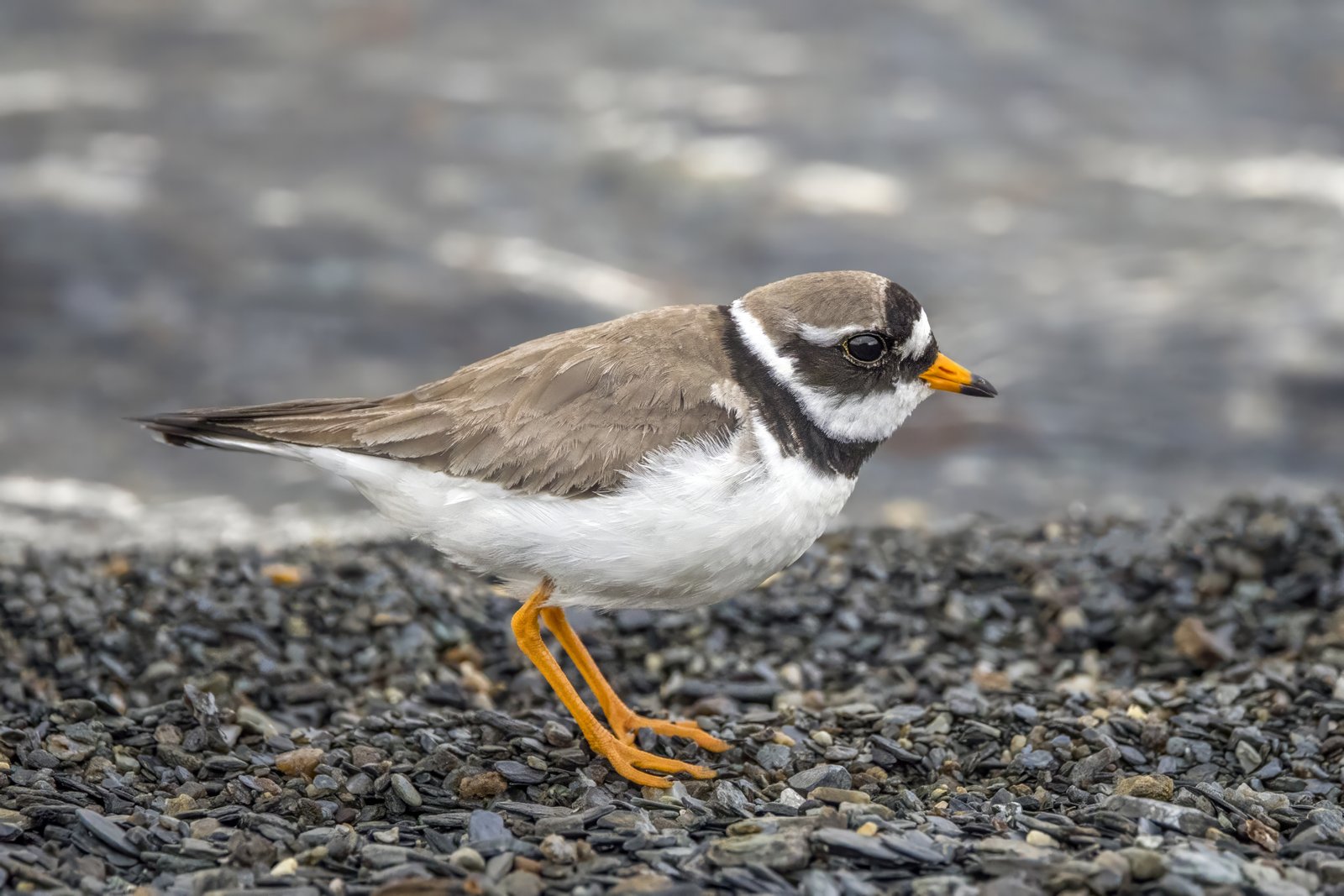
Brown upperparts and white underparts, with a broad black breast band, a black mask and a black band across the crown; white forehead patch, white spot behind the eye and a white collar. The short bill is orange with a black tip, the legs orange. In winter the black parts are browner and the bill mostly dark. Juveniles have a brown breast band, often narrow or broken in the middle, a dark bill and dull yellow-orange legs. In flight: a broad, conspicuous white wing bar.
Confusion species
Little Ringed Plover (Thinornis dubius) is smaller and slimmer, with a yellow eye-ring, an all-black bill, flesh-coloured legs and no wing bar. Kentish Plover (Anarhynchus alexandrinus) is paler sandy brown, with black patches only on the breast sides and black legs. Greater Sand-Plover (Anarhynchus leschenaultii) is larger and longer-legged, with a heavy black bill and no white collar.
Habitat
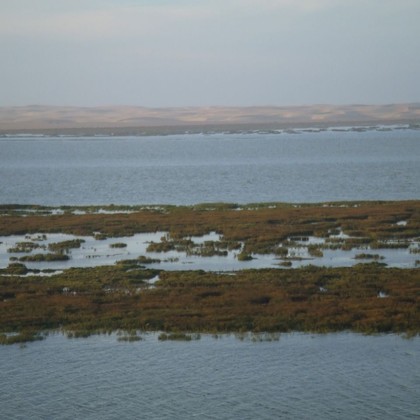
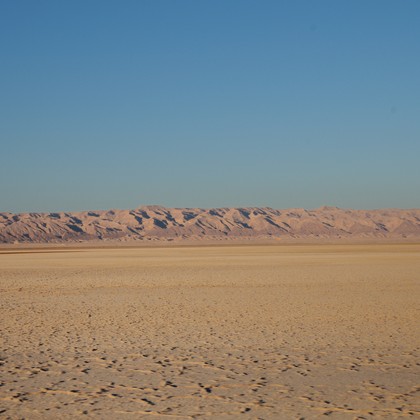
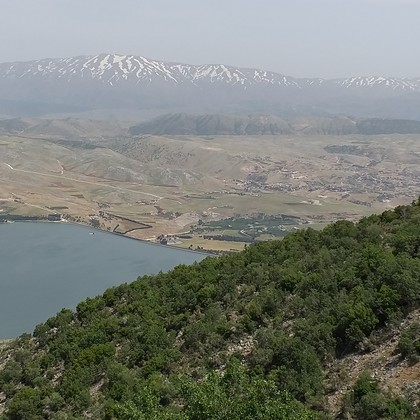
Sandy beaches, tidal flats, salt pans and coastal lagoons; on passage also the shores of lakes, reservoirs, rivers, sewage ponds and pools at oases. Feeds in typical plover fashion and gathers with other small waders at high-tide roosts.
Where the bird is most at home, classified by the habitats of North Africa and the Middle East.
Range and movements
On passage and in winter along almost all coasts: the Atlantic coast of Morocco to Dakhla, the Mediterranean coast from Algeria to Egypt with the Nile Delta and Bardawil, both shores of the Red Sea, the Gulf of Aden and Socotra, the coast of Oman and the Persian Gulf from Kuwait to the Emirates. Inland on passage along the Nile, at oases and reservoirs in the Sahara and Arabia, and in Iraq, Israel and Jordan. Does not breed in the region. Breeds from Arctic Canada and Greenland through western Europe to north-east Siberia; winters from western Europe and Africa to South Africa and south-west Asia. Especially in the east of the region the birds belong to the small, dark subspecies tundrae.
- Resident
- Winter visitor (c. Oct–Mar)
- Passage (Mar–Apr, Oct–Nov)
- dark = core range, pale = thinly spread
How and when to look
Eilat (salt pans and the KM20 pools) and the Nile Valley are excellent in April–May and September; in winter it can be found on beaches and mudflats everywhere, such as Barr al Hikman and the Moroccan Atlantic coast. Where possible compare it directly with Little Ringed and Kentish Plovers on the same pool.
Conservation status
Not globally threatened, although some breeding populations in Europe have declined through disturbance of beaches. In the region coastal development, land reclamation and beach recreation threaten its roosting and feeding sites.
Scientific name
Charadrius hiaticula | Linnaeus, 1758
Linnaeus described the species in 1758 and placed it straight away in the genus where it still stands. He introduced the genus Charadrius in that same work. Charadrius is Late Latin, from Ancient Greek kharadrios, a plain-coloured nocturnal bird of ravines and river valleys, from kharadra 'ravine'. hiaticula is late Medieval Latin for a plover. The specimen the first description was based on came from Sweden.