All species › Ostriches › Ostriches › Common Ostrich
Common Ostrich | Struthio camelus
Afrikaanse struisvogel | Avestruz común
The largest bird in the world, a flightless runner that once ranged across the whole Sahara, the Arabian deserts and the Syrian steppe. Within the region it was exterminated almost everywhere in the nineteenth and twentieth centuries; the Arabian form S. c. syriacus is extinct. What lives here now is the North African or Red-necked Ostrich (S. c. camelus), brought back to a handful of reserves in Morocco, Tunisia and Saudi Arabia.
Voice
In the breeding season the male gives a deep, driving boom, boo-boo-boooh, with inflated neck, mainly at night and in the early morning; it carries far and resembles a lion's roar. When threatened both sexes hiss and growl with the bill open.
Recording: Michael Chiappone — CC BY-NC-SA 4.0 · converted to mono · xeno-canto
Identification
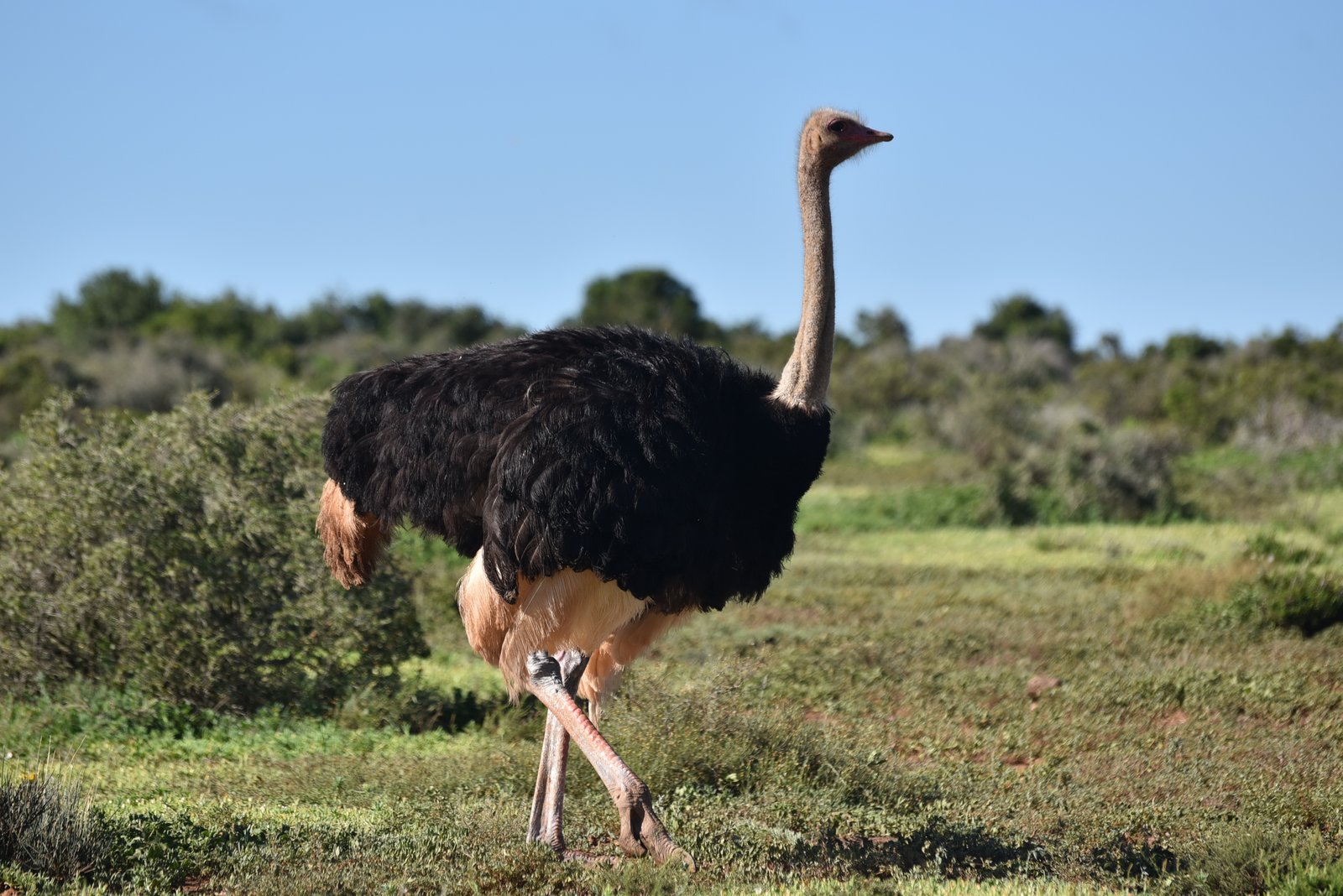
A flightless bird 175 to 275 cm tall, with a long, largely bare neck, a small flat head with very large eyes, and long bare legs with two toes. The male is black with white flight feathers and white tail plumes; in the North African form the neck and legs are pink to fleshy red, brighter when breeding, and there is a bare patch on the crown. Females and juveniles are plain grey-brown with dirty-white wing edges. Chicks are buff with dark spiky down tufts.
Confusion species
No confusion is possible within the region: no other bird approaches this size. Released or escaped farm birds may belong to the southern forms, with grey or blue-grey neck and legs; the Somali Ostrich (Struthio molybdophanes), with blue-grey neck and legs, lives only in the Horn of Africa.
Habitat
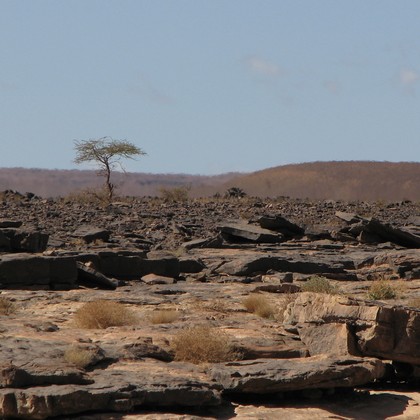
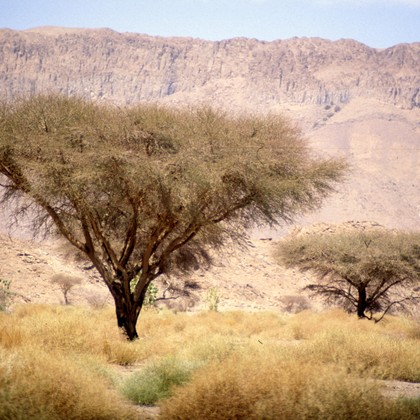
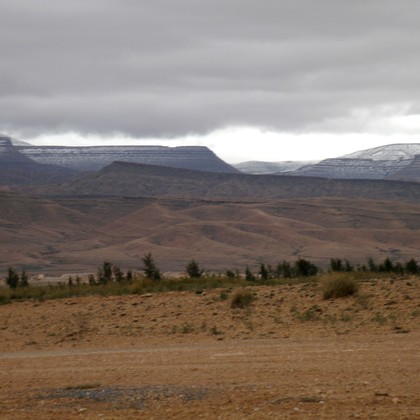
Open, flat stone and gravel desert, grassy semi-desert and acacia steppe with long views. In the Tunisian reserves Acacia raddiana (an umbrella acacia) is scattered over grassy steppe; Mahazat as-Sayd in Saudi Arabia is a fenced gravel plain with grasses and low shrubs. It eats plants, seeds and fruit, supplemented by insects and small animals, and can go long without drinking.
Where the bird is most at home, classified by the habitats of North Africa and the Middle East.
Range and movements
As a wild bird almost gone from the region. Morocco: reintroduced with birds from Chad in enclosures in Souss-Massa National Park. Tunisia: exterminated in 1887, back since 2014 in Dghoumès and Sidi Toui national parks and Orbata faunal reserve, after earlier releases at Bou Hedma. Saudi Arabia: birds of Sudanese origin bred from 1988–89 and released into the fenced Mahazat as-Sayd reserve, with some 90 to 100 birds. Israel: a release in the Negev from Hai-Bar Yotvata failed. No certain birds remain in Algeria, Libya, Egypt, Jordan or the rest of Arabia; reports from the far south-east of Egypt are unconfirmed. Beyond the region in the Sahel from Mauritania and Senegal east to Sudan and Ethiopia, and with other forms in East and southern Africa.
- Winter visitor (c. Oct–Mar)
- Passage (Mar–Apr, Oct–Nov)
- dark = core range, pale = thinly spread
How and when to look
In the region ostriches are seen almost only within the reserves themselves. At Souss-Massa and in the Tunisian parks the enclosures are visited with a guide or ranger; ask the park management beforehand. A wild ostrich outside these sites, in the Sahara or Arabia, is an exceptional record: note the colour of neck and legs, as escaped farm birds are more likely.
Conservation status
Not globally threatened, but the North African form has vanished from most of its range through hunting, off-road vehicles and the demand for feathers and eggs; it is listed on CITES Appendix I. The Arabian form died out in the mid-twentieth century. Its survival in the region depends on breeding programmes and fenced reserves.
Scientific name
Struthio camelus | Linnaeus, 1758
Linnaeus described the species in 1758 and placed it straight away in the genus where it still stands. He introduced the genus Struthio in that same work. Struthio is Latin for 'ostrich', from the Greek strouthion, itself derived from strouthokamelos, literally 'camel-sparrow' — an ancient Greek name for the ostrich. camelus is Latin for 'camel'; the Greeks called the ostrich strouthokamelos, 'camel-sparrow', for its long neck, two-toed feet and desert life, features reminiscent of a camel. The specimen the first description was based on came from Sennar, Sudan.