All species › Passerines › Grasshopper warblers › Common Grasshopper-Warbler
Common Grasshopper-Warbler | Locustella naevia
Sprinkhaanzanger | Buscarla pintoja
The Common Grasshopper-Warbler is a small, streaked and extremely skulking warbler that passes through the region mainly as a migrant. In the west it migrates through the Maghreb to West Africa; in the east the pale form straminea passes through Iraq and the Gulf states to India.
Voice
The song is a high, dry, mechanical reel on one pitch, like a sewing machine or a grasshopper: srrrrrrrrrrrr, sometimes for minutes without a break; as the bird turns its head the sound swells and fades. Higher, drier and faster than Savi's Warbler. Migrants occasionally sing in spring, mainly at dusk. Call: a sharp chik.
Recording: MarekJas — CC BY-NC-SA 4.0 · shortened to the first 60 s, mono · xeno-canto
Identification
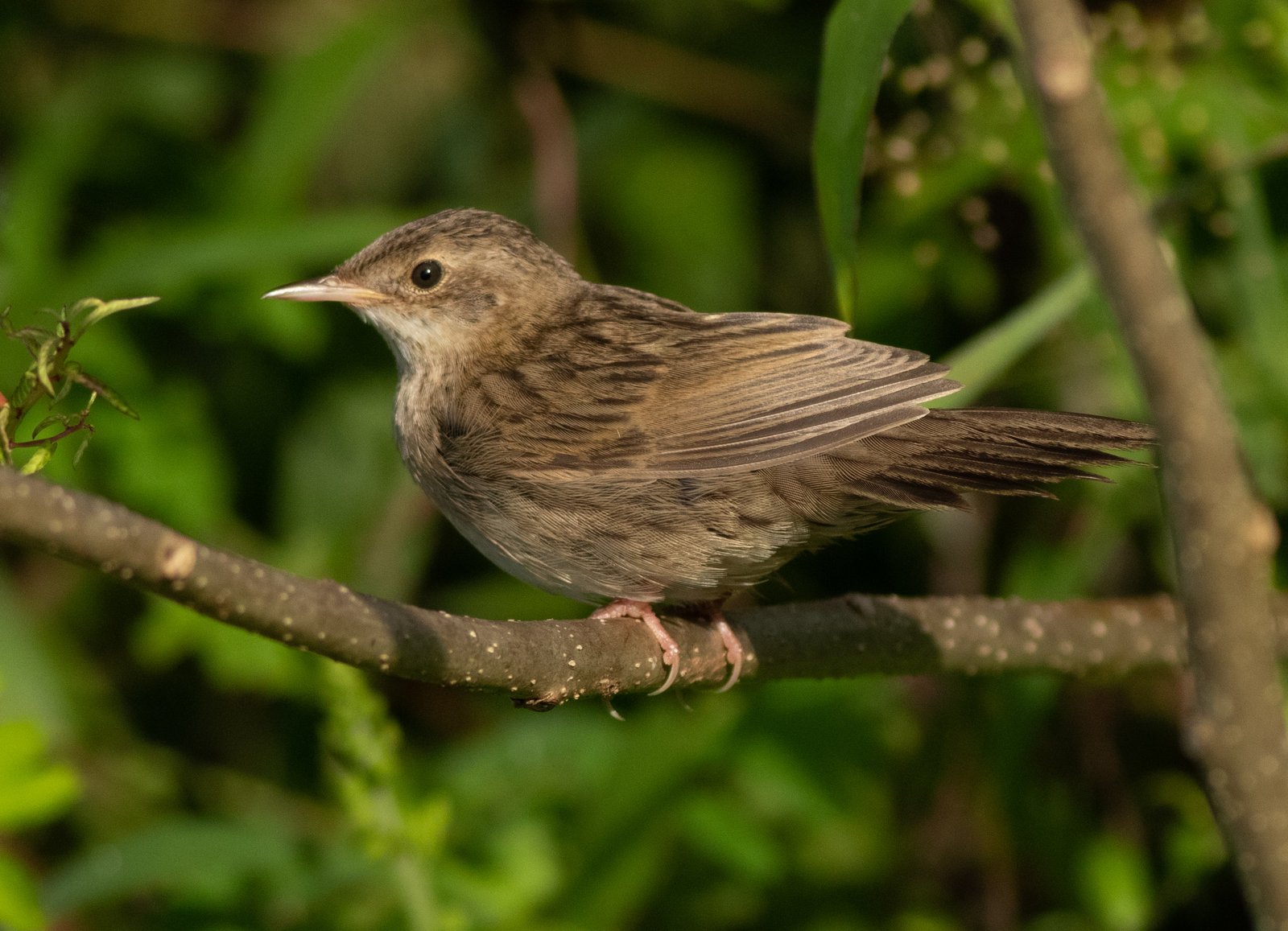
12–14 cm. Olive-brown to olive-grey above with fine dark streaks on crown, mantle and scapulars, and off-white to buff below, sometimes with a few fine streaks on the lower throat. The long undertail coverts are clearly dark-streaked. The tail is long, broad and rounded, the supercilium faint, the legs pale pink. The eastern form straminea is paler and greyer, with finer streaking. Walks and climbs mouse-like through low vegetation and rarely flies far.
Confusion species
Savi's Warbler (Locustella luscinioides) is plain rufous-brown without streaking and has unstreaked undertail coverts. River Warbler (Locustella fluviatilis) is larger, plain brown above, with a spotted breast and scaled undertail coverts. Sedge Warbler (Acrocephalus schoenobaenus) has a broad cream supercilium, a dark crown and a rufous rump. Pallas's Grasshopper-Warbler (Locustella certhiola) and Lanceolated Warbler (Locustella lanceolata) are potential vagrants in the east: the former has a rusty rump and white tail tips, the latter sharp dark streaks on breast and flanks.
Habitat
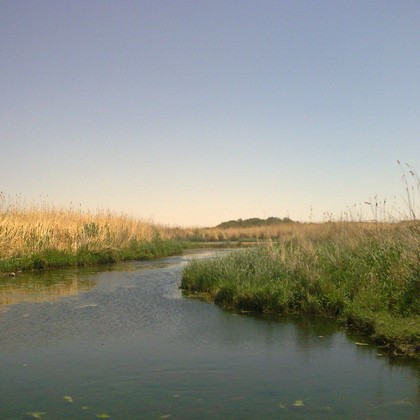
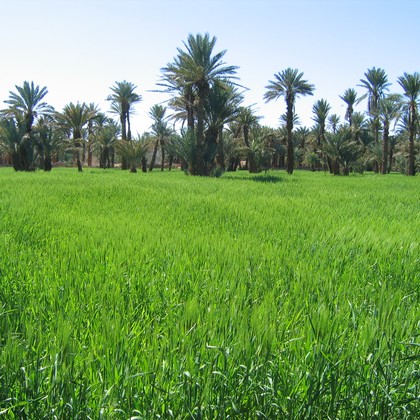
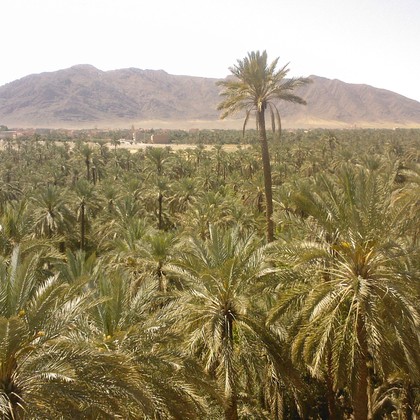
On passage in low, dense vegetation: tall herbage and reeds at marsh edges, wet fields and irrigated farmland with alfalfa and cereals, dense growth in oases, gardens and parks. Avoids open ground and tall trees. Eats insects and spiders, taken low in vegetation or on the ground.
Where the bird is most at home, classified by the habitats of North Africa and the Middle East.
Range and movements
Passage migrant. In the west a regular migrant through Morocco, mainly from late February to April along the Atlantic coast and in the northern plains, scarcer in autumn; scarce in Algeria, Tunisia and Libya. A few birds are also seen in winter in Morocco. In Egypt, Israel, Jordan, Lebanon and Syria a scarce migrant. In the east the form straminea passes through Iraq, Kuwait, eastern Saudi Arabia, Bahrain, Qatar, the United Arab Emirates and Oman, mainly in autumn (August – October), more scarcely in spring. Breeds from the British Isles and northern Spain east to western Siberia and Central Asia; winters in West Africa south of the Sahara and, for the eastern form, in the Indian subcontinent.
- Summer visitor (c. Apr–Sep)
- Winter visitor (c. Oct–Mar)
- Passage (Mar–Apr, Oct–Nov)
- dark = core range, pale = thinly spread
How and when to look
In March and April in reed edges and wet tall herbage along the Moroccan Atlantic coast, such as at Merja Zerga and Oued Massa, or in the green parks and alfalfa fields of the Emirates in autumn. Hard to see: wait by a patch of herbage until it briefly climbs a stem, or watch for a small, streaked bird that flits away low and vanishes into cover.
Conservation status
Not globally threatened. Declined in parts of its European breeding range; on passage it depends on wet herbage and green stopover sites, which are under pressure in the region from drought and land reclamation.
Scientific name
Locustella naevia | (Boddaert, 1783)
Boddaert described the species in 1783 as Motacilla naevia; because it was later moved to another genus, the author and year stand in brackets. The genus Locustella was introduced in 1829 by Kaup. Locustella is Latin, a diminutive of locusta 'grasshopper'. naevia is Latin for 'spotted', after the marked plumage. The specimen the first description was based on came from Bologna, Italy.