All species › Passerines › Finches › Common Chaffinch
Common Chaffinch | Fringilla coelebs
Vink | Pinzón vulgar
The Common Chaffinch is among the most numerous breeding birds in Europe; in the region it breeds only in the woodlands of the Levant and the Kurdish mountains. In winter large numbers of European Chaffinches reach North Africa and the eastern Mediterranean, where in the Maghreb they occur alongside the African Chaffinch.
Voice
The song is a short, accelerating and descending phrase ending in a flourish, chip-chip-chip-cherrewee-choo, in the Levant from February. The call is a clear pink, in flight a soft yoop; in the breeding season also a monotonous hweet.
Recording: András Schmidt — CC BY-NC-SA 4.0 · converted to mono · xeno-canto
Identification
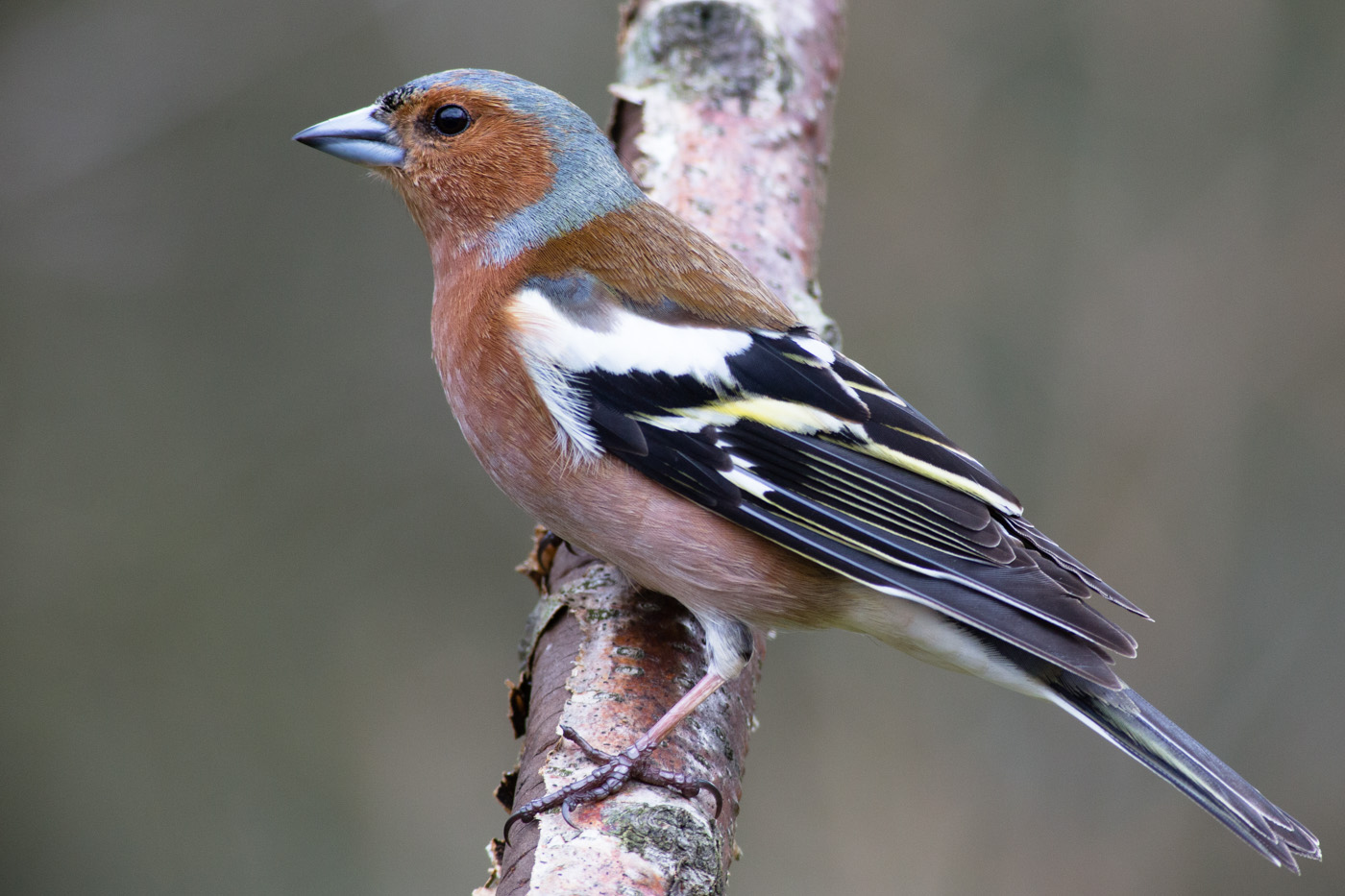
14–16 cm. Both sexes show two broad white wingbars, white outer tail feathers and a greenish rump. The male has a blue-grey crown and nape, a chestnut-brown mantle and a pink to brick-red cheek and breast; in winter this is muted by brown feather fringes. The female is plain olive-brown with a greyish nape but has the same wing pattern. The Levant breeders (syriaca) are slightly paler below than European birds.
Confusion species
African Chaffinch (Fringilla spodiogenys) has a moss-green rather than chestnut-brown back, a pale salmon-pink breast, a broader white wingbar and a broken white eye-ring; females are trickier and are best told by the greyer head and greener back. Brambling (Fringilla montifringilla) has an orange breast and shoulder and a white rump. Female Common Chaffinches may be mistaken for House Sparrow (Passer domesticus) but have an unstreaked back and the double white wingbar.
Habitat
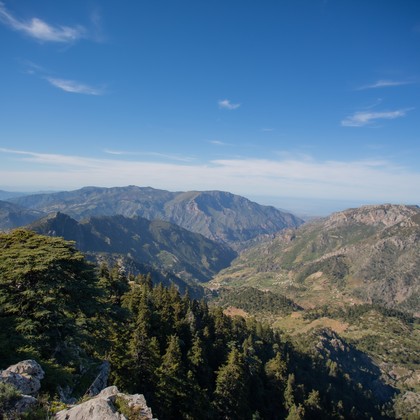
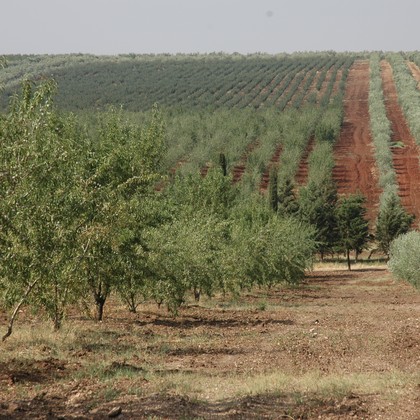
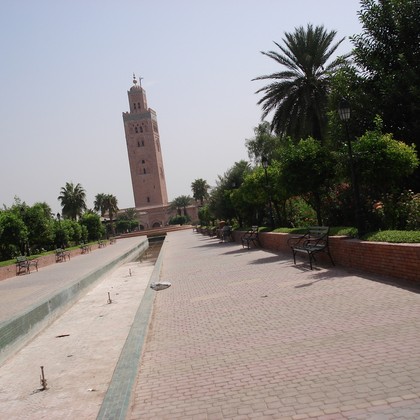
Breeds in oak, pine and cedar woodland, orchards and parks in hills and mountains. In winter in olive groves, fields with trees, tamarisk-lined banks, town parks and gardens, also in the Nile Delta, often in flocks on the ground.
Where the bird is most at home, classified by the habitats of North Africa and the Middle East.
Range and movements
Breeds in northern and central Israel (Galilee, Carmel, Hermon), in the mountains of Lebanon and Syria, in northern Jordan and in the Kurdish mountains of northern Iraq. A common winter visitor to the Levant and Iraq; in Egypt mainly in the Nile Delta, the Nile Valley and Sinai. In the Maghreb many European Chaffinches winter in northern Morocco, Algeria and Tunisia, east into Libya. Scarce in Kuwait and northern Saudi Arabia, a vagrant to Bahrain, Qatar, the United Arab Emirates and Oman. Beyond the region it breeds across almost all of Europe and western Siberia, south to Asia Minor, the Caucasus and Iran.
- Resident
- Winter visitor (c. Oct–Mar)
- Passage (Mar–Apr, Oct–Nov)
- dark = core range, pale = thinly spread
How and when to look
In winter in Morocco and Tunisia it pays to check finch flocks in olive groves: Common and African Chaffinches then feed side by side, and the back colour and breast of the males show the difference at once.
Conservation status
Not globally threatened and very numerous. In the Levant the breeding population depends on woodland under pressure from felling, fire and urban growth; locally Chaffinches are netted in winter.
Scientific name
Fringilla coelebs | Linnaeus, 1758
Linnaeus described the species in 1758 and placed it straight away in the genus where it still stands. He introduced the genus Fringilla in that same work. Fringilla is the Latin word for 'finch'. coelebs is Latin for 'unmarried, single': in Sweden it was mainly the females that moved south in winter, leaving the males behind. The specimen the first description was based on came from Sweden.