All species › Gannets and cormorants › Gannets › Brown Booby
Brown Booby | Sula leucogaster
Bruine gent | Piquero pardo
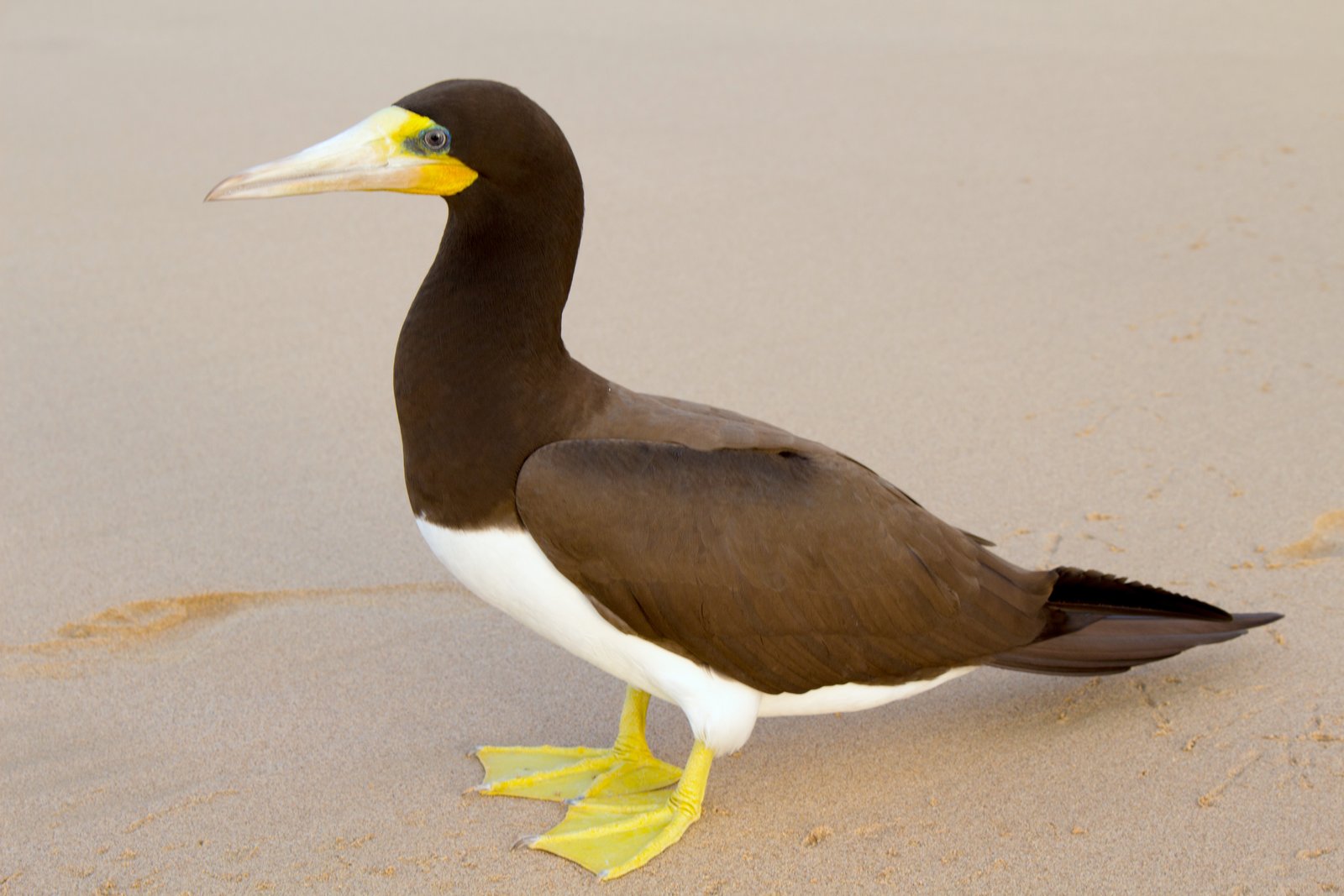
The booby of the Red Sea: a chocolate-brown plunge-diver with a sharply demarcated white belly, breeding on coral islets and often hunting close inshore over reefs. In the Gulf of Aqaba it can be seen year-round at Eilat and Aqaba, often resting on buoys and fish-farm cages.
Voice
Usually silent away from the colony. The male gives a hoarse, high whistle, the female a loud honking and quacking kwak-kwak.
Recording: JAYRSON ARAUJO DE OLIVEIRA — CC BY-NC-SA 4.0 · converted to mono · xeno-canto
Identification
Medium-sized, with a long, pointed tail, a conical yellow bill and yellowish-green feet. Head, neck, breast and upperparts are uniform dark chocolate-brown, sharply cut off from the white belly; the underwing is white with a broad brown border. In the Red Sea and Indian Ocean form, the male has blue-grey bare skin around the eye and at the bill base, the female yellow; the female is also larger. Juveniles are duller brown, with a dingy brown-mottled belly that is still clearly paler than the breast, and a grey bill. Flies low over the water with quick beats and short glides and dives at a slant or from low height.
Confusion species
Juvenile Masked Boobies (Sula dactylatra) have a brown head but a white collar, white underparts and a brown back with pale fringes. Brown-morph Red-Footed Boobies (Sula sula) are uniformly brown without a pale belly and have red or greyish-pink feet. At a distance a Brown Booby may recall a perched Great Cormorant (Phalacrocorax carbo) or Socotra Cormorant (Phalacrocorax nigrogularis), but these have a hooked bill and fly with neck outstretched and a short tail.
Habitat
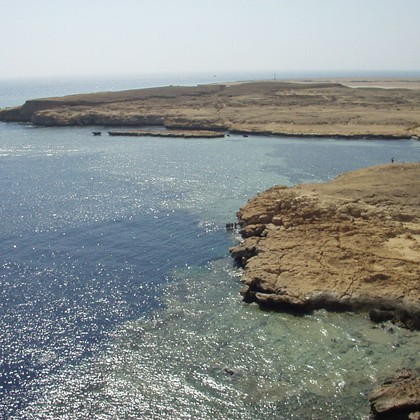
Warm coastal waters, coral reefs, bays and harbours, less far offshore than other boobies. Breeds on the ground on bare or sparsely vegetated islets and rocks. Likes to rest on buoys, wrecks, posts, jetties and fish-farm cages, and sometimes fishes behind boats.
Where the bird is most at home, classified by the habitats of North Africa and the Middle East.

Range and movements
Red Sea: breeds on islands along the whole sea, for example off the southern coast of Egypt, on the islands off the Saudi coast to the Farasan archipelago and off the Yemeni Tihama; disperses along the coast in and outside the breeding season, north into the Gulf of Suez. Gulf of Aqaba: year-round in small numbers at Eilat (Israel) and Aqaba (Jordan), having increased in recent decades. Gulf of Aden: breeds off the Yemeni coast; also around Socotra. Oman: regular visitor along the Arabian Sea coast, especially in Dhofar and around Masirah, scarcer in the Gulf of Oman. United Arab Emirates: rare, eighteen sightings between 1986 and 2022, mainly on the east coast; a vagrant elsewhere in the Persian Gulf. Atlantic: a rare wanderer from the Cape Verde colonies to Morocco, with sightings at Cap Ghir in 2020. Also breeds throughout the tropical oceans.
- Resident
- Summer visitor (c. Apr–Sep)
- Winter visitor (c. Oct–Mar)
- Passage (Mar–Apr, Oct–Nov)
- dark = core range, pale = thinly spread
How and when to look
From the beach or promenade at Eilat and Aqaba, and from boats over the coral reefs, they are often seen resting on buoys and lines. On the ferry from Jizan to the Farasan Islands they are common, as they are along the coast of Dhofar in autumn.
Conservation status
Not globally threatened, although the population is declining locally. In the Red Sea the colonies suffer from disturbance, egg collecting, rats and coastal development; at sea bycatch and oil pollution play a part. Many breeding islands lie in protected areas, such as the Farasan Islands and Wadi el-Gemal National Park.
Scientific name
Sula leucogaster | (Boddaert, 1783)
Boddaert described the species in 1783 as Pelecanus Leucogaster; because it was later moved to another genus, the author and year stand in brackets. The genus Sula was introduced in 1760 by Brisson. Sula goes back to súla, the Old Norse and Icelandic word for the gannet; the name passed to the boobies. leucogaster is Greek, from leukos 'white' and gastēr 'belly', after the white underparts. The specimen the first description was based on came from Cayenne, French Guiana.