All species › Waterfowl › Ducks, geese and swans › Brant
Brant | Branta bernicla
Rotgans | Barnacla carinegra
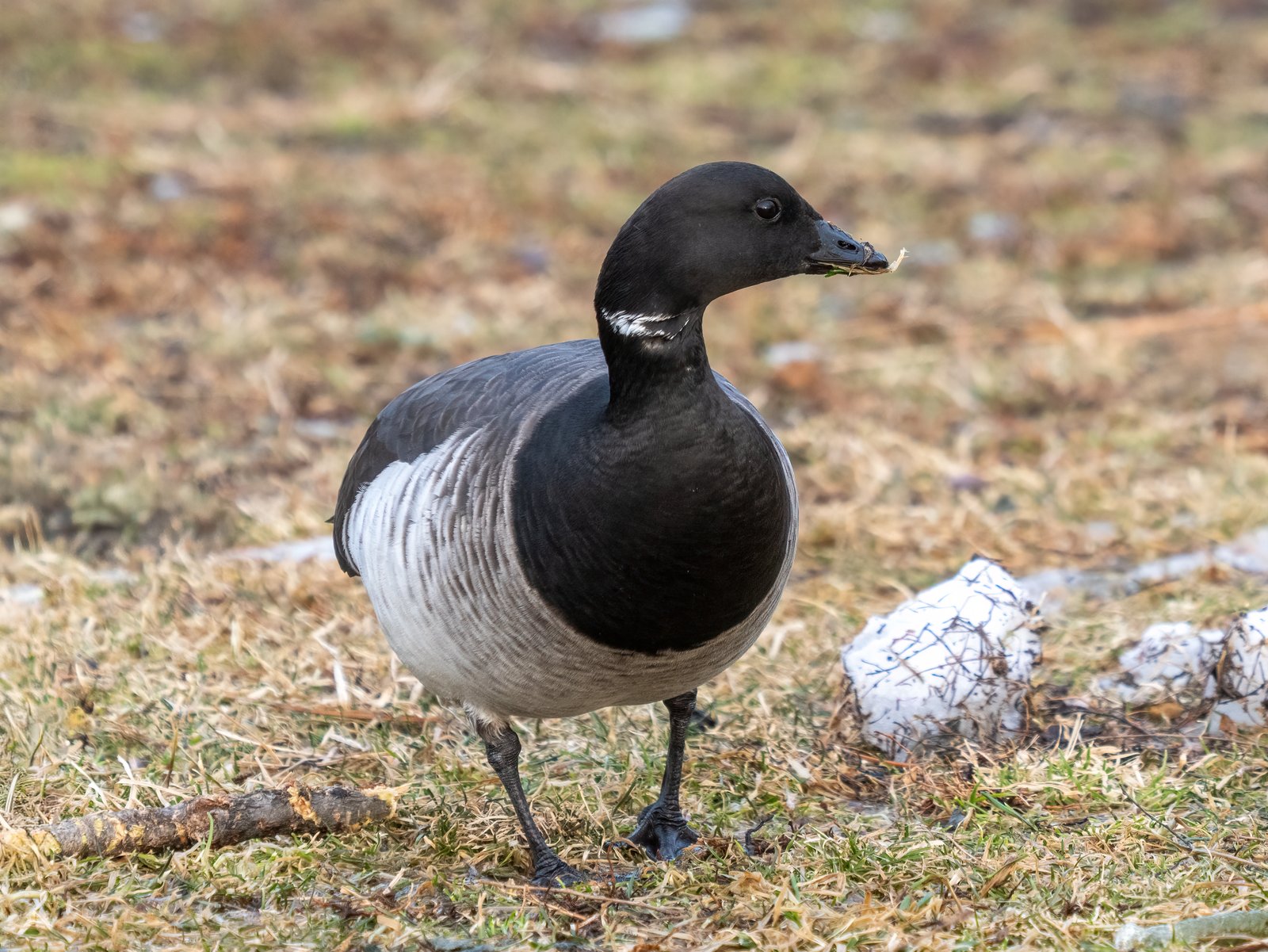
A small, dark sea goose with a black head and neck and a narrow white neck patch. Brant winters on the coasts of north-west Europe and reaches the region only as a rare vagrant, almost always on the Atlantic coast of Morocco.
Voice
A soft, rolling, guttural rrot or rronk, building into a constant murmur in flocks. A lone bird in the region is usually silent.
Recording: Sjouke Scholten — CC BY-NC-SA 4.0 · converted to mono · xeno-canto
Identification
Small and compact, barely larger than a Mallard, with a short black bill and black legs. Head, neck and breast are black, with a small white patch or half-collar on each side of the neck. The upperparts are dark greyish brown, the undertail coverts and rear flanks bright white. The dark-bellied form (bernicla) has a dark belly hardly contrasting with the breast; the pale-bellied form (hrota), which has been recorded in Morocco, has a pale belly sharply demarcated from the black breast. Juveniles lack the neck patch and show white fringes to the wing coverts. Flight is fast, in irregular lines low over the water.
Confusion species
Barnacle Goose (Branta leucopsis) has a white face and is larger and paler grey above. Red-breasted Goose (Branta ruficollis) has a rusty-red neck and breast and white lines on head and flank. At distance a Brant can vanish among ducks; look for the black forequarters and white rear end.
Habitat
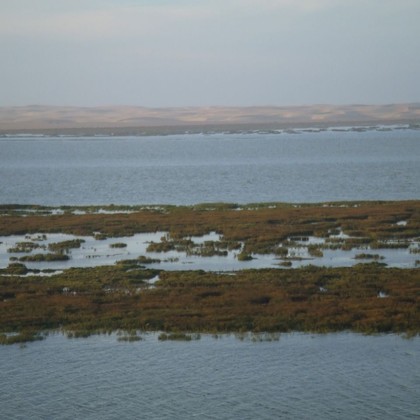
In its winter quarters, tidal flats, lagoons, saltmarshes and coastal grassland with eelgrass, green algae and short turf. In the region seen on lagoons, estuaries and bare coastal flats, sometimes among ducks or waders.
Where the bird is most at home, classified by the habitats of North Africa and the Middle East.
Range and movements
In Morocco a rare vagrant, with a dozen records up to 2009 and several more since, among them at Merja Zerga (five birds in January 2015), Oualidia and Essaouira, mainly in December and January. Exceptional elsewhere in North Africa and the Middle East. Breeds on the Arctic tundra around the pole and winters on the coasts of western Europe, eastern Asia and North America.
How and when to look
The best chance is in winter along Morocco's Atlantic coast, from Merja Zerga to Essaouira. Check tidal flats and lagoons for a dark, duck-sized goose with a white rear. Note the belly colour: it often reveals the origin (Atlantic or Siberian population).
Conservation status
Rare vagrant to Morocco, with about twelve records to 2009 and several further winter reports since; at most exceptional elsewhere in the region. Not globally threatened, although numbers fluctuate strongly with breeding success on the tundra.
Scientific name
Branta bernicla | (Linnaeus, 1758)
Linnaeus described the species in 1758 as Anas Bernicla; because it was later moved to another genus, the author and year stand in brackets. The genus Branta was introduced in 1769 by Scopoli. Branta is a Latinised form of Old Norse brandgás, 'burnt goose', that is, black goose. bernicla is Medieval Latin for 'barnacle', from the old belief that these geese grew from barnacles. The specimen the first description was based on came from Sweden.