All species › Waders, gulls and terns › Gulls and terns › Black Tern
Black Tern | Chlidonias niger
Zwarte stern | Fumarel común
A dark marsh tern that in the region appears almost only on migration, mainly along the Atlantic and Mediterranean coasts of the Maghreb and Libya. It becomes scarce quickly to the east, and in Arabia it is a rare visitor.

Voice
A short, sharp kik or kyek; flocks give a dry chatter; less rasping than Whiskered Tern.
Recording: Ricardo Hevia — CC BY-NC-SA 4.0 · converted to mono · xeno-canto
Identification
Small and slender, with fairly long, narrow wings, a slightly forked tail, a fine black bill and dark red legs. In summer plumage head and body are black, the wings, rump and tail dark slate-grey, the undertail coverts white and the underwings pale grey. In winter plumage grey above and white below, with a black rear crown and ear spot forming a small cap, and a characteristic dark patch on the breast side. Juveniles have a brownish saddle and dark leading edges to the wings. Flight light and fluttering, picking prey from the water.
Confusion species
White-winged Tern (Chlidonias leucopterus) has white forewings, a white rump and black underwing coverts in summer plumage, and in winter plumage lacks the breast patch. Whiskered Tern (Chlidonias hybrida) is larger and paler grey, with a white cheek in summer plumage and no breast patch in winter plumage.
Habitat
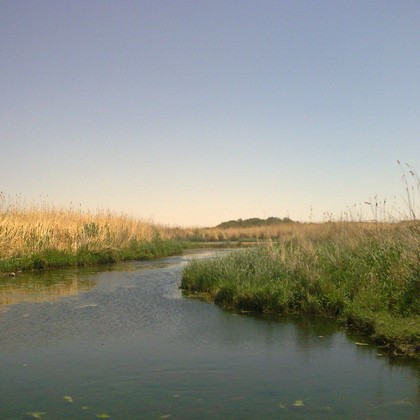
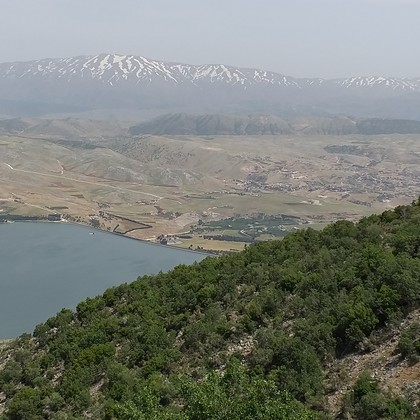
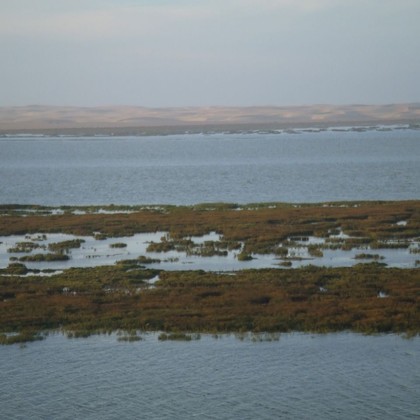
On migration coastal lagoons, salt pans, estuaries and inshore waters, but also freshwater lakes, reservoirs and fish ponds. In Europe it breeds in freshwater marshes with floating vegetation.
Where the bird is most at home, classified by the habitats of North Africa and the Middle East.
Range and movements
A fairly common to scarce migrant along the coast of Morocco and Western Sahara, in northern Algeria, Tunisia and Libya, in May and from August to October; in late summer sometimes in large flocks at sea off the Atlantic coast. Scarce in Egypt, Israel and the Levant, irregular in Iraq. Rare in Arabia, with scattered records from Saudi Arabia, Kuwait, Bahrain, the Emirates and Oman, among others. It formerly bred in small numbers in northern Morocco and Algeria, but not recently. Beyond the region it breeds in Europe, western and Central Asia and North America; European birds winter mainly at sea off West Africa.
- Resident
- Summer visitor (c. Apr–Sep)
- Winter visitor (c. Oct–Mar)
- Passage (Mar–Apr, Oct–Nov)
- dark = core range, pale = thinly spread
How and when to look
The best chance is in May and August–September at the lagoons and salt pans of Tunisia and on Morocco's Atlantic coast, for example at Merja Zerga, Oualidia and the mouth of the Oued Massa. Seawatching points on the Strait of Gibraltar sometimes show flocks at sea in late summer.
Conservation status
Not globally threatened, but strongly declined in Europe through loss of breeding marshes. In the region the birds are migrants, which benefit from the protection of coastal lagoons and fish ponds along the route.
Scientific name
Chlidonias niger | (Linnaeus, 1758)
Linnaeus described the species in 1758 as Sterna nigra; because it was later moved to another genus, the author and year stand in brackets. The genus Chlidonias was introduced in 1822 by Rafinesque. Chlidonias is from Ancient Greek khelidonios 'swallow-like', from khelidon 'swallow'. niger is Latin for 'shining black'. The specimen the first description was based on came from near Uppsala, Sweden.