All species › Birds of prey › Hawks, eagles and kites › Bearded Vulture
Bearded Vulture | Gypaetus barbatus
Lammergier | Quebrantahuesos
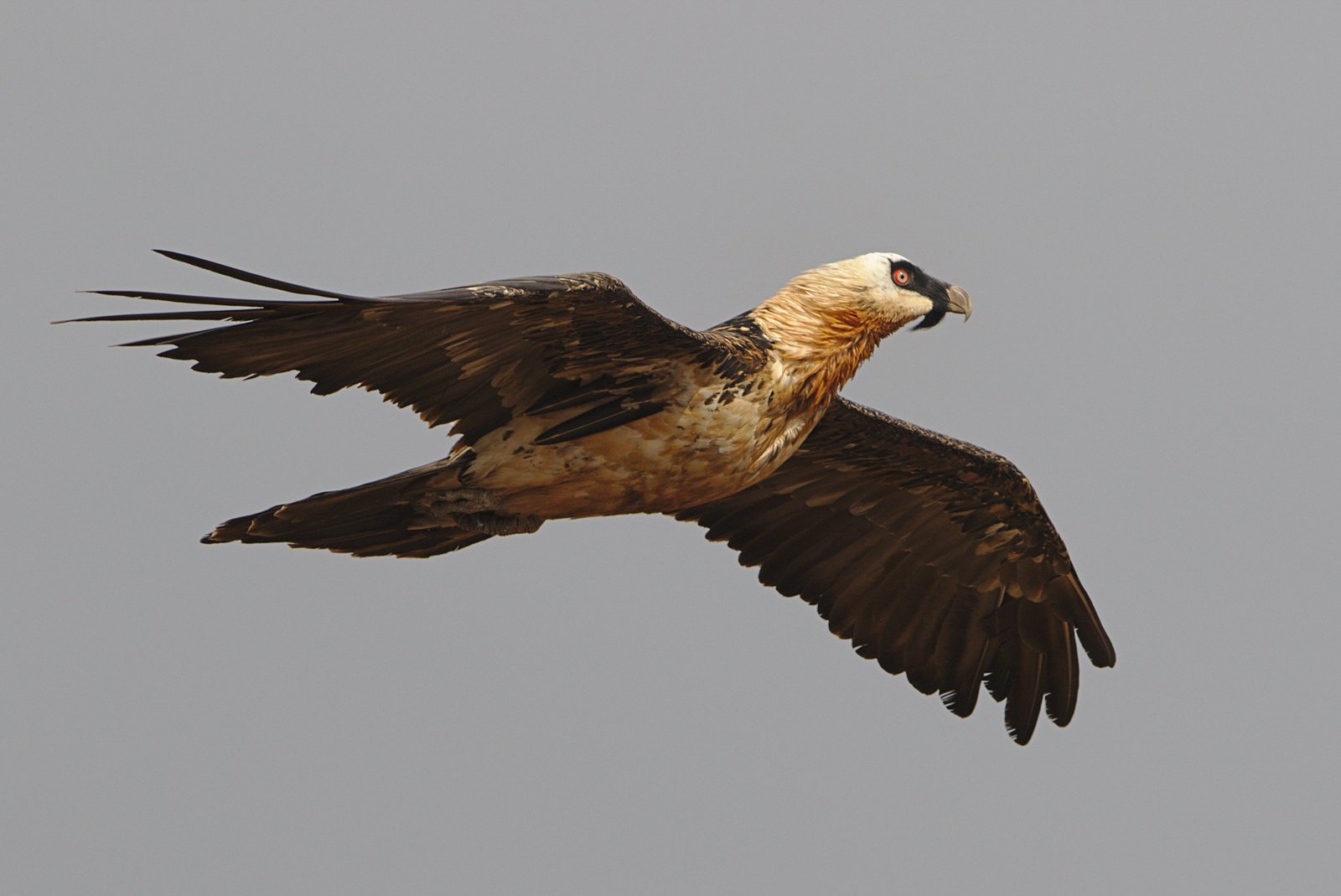
The Bearded Vulture is a huge mountain vulture with long, narrow wings and a long wedge-shaped tail, which drops the bones of carcasses from a height onto rock slabs to break them. In the region it has become rare: a remnant in the High Atlas and a small population in the highlands of Yemen and south-western Saudi Arabia.
Voice
Almost always silent. In display and at the nest a high, shrill whistle, feeeeh, and a soft rolling twitter; young beg with a thin piping.
Recording: Thomas SIGNEAU — CC BY-SA 4.0 · converted to mono · xeno-canto
Identification
100–115 cm, wingspan 250–285 cm. The adult has dark slate-grey upperparts with pale shaft streaks and a creamy-white to rusty-orange head and underparts; the orange tone comes from bathing in iron-rich mud. A black mask runs from the eye to a bristly beard below the bill; the eye has a red ring. In flight falcon-like in shape, with narrow, pointed wings and a long wedge-shaped tail, gliding on flat wings along the slopes. The juvenile is wholly dark brownish-grey with a blackish head and takes five to six years to reach adult plumage; immatures show a paler body and dark head.
Confusion species
With its long wedge-shaped tail and narrow wings it is hardly to be confused with any other vulture. The dark juvenile can recall a young Egyptian Vulture (Neophron percnopterus) at long range, but that is half the size, with a shorter wedge tail and a slender bill. Griffon Vulture (Gyps fulvus) and Cinereous Vulture (Aegypius monachus) have broad, fingered wings and a short tail. In the Arabian mountains Verreaux's Eagle (Aquila verreauxii) also occurs, black with a white back and a much shorter tail.
Habitat
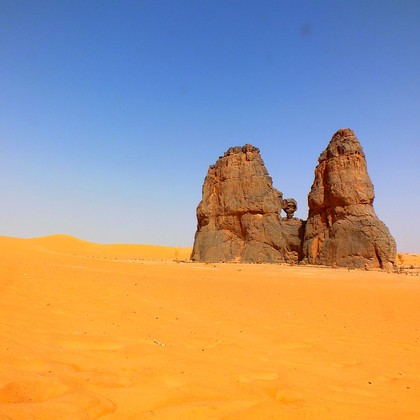
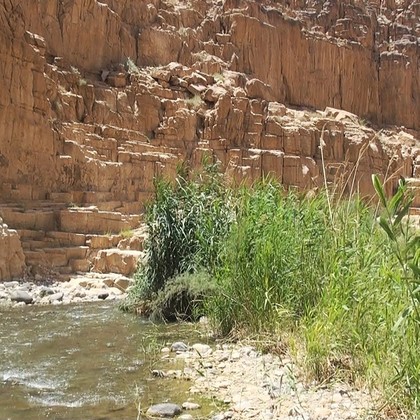
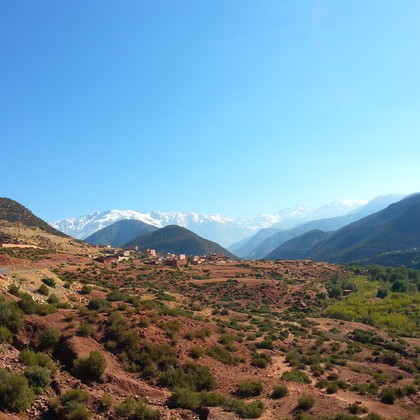
Rugged high mountains with deep gorges and tall cliffs, in Arabia also steep escarpments and mountain plateaus with terracing and livestock, mostly above 1500 m. The nest is in a cavity or under an overhang on a cliff. The diet is largely bones and marrow from dead livestock and wild animals; large bones are smashed on a regular rock slab.
Where the bird is most at home, classified by the habitats of North Africa and the Middle East.
Range and movements
In Morocco a few pairs remain in the High Atlas, among others around Oukaïmeden and Toubkal; virtually or entirely gone from Algeria and Tunisia. In Arabia a small, scarce population in the highlands of Yemen and in the Asir and Hejaz mountains of Saudi Arabia. Extinct as a breeder in Sinai, Israel and Jordan, where at most a wandering bird turns up. Beyond the region in Iberia, the Alps (reintroduced), Crete, Turkey and the Caucasus east to Central Asia and the Himalayas, and in East and southern Africa.
- Resident
- Summer visitor (c. Apr–Sep)
- Winter visitor (c. Oct–Mar)
- Passage (Mar–Apr, Oct–Nov)
- dark = core range, pale = thinly spread
How and when to look
In the High Atlas scan the gorges and slopes around Oukaïmeden and the Tizi n'Tichka on a clear morning, when the bird patrols low along the cliffs. In Yemen and the Asir mountains watch above escarpments and mountain villages with livestock; the long wedge tail stands out even at great range.
Conservation status
Near Threatened. The species is declining worldwide and is on the brink of disappearing from North Africa. The main causes are poisoned bait, shooting, disturbance of nest sites and the loss of traditional livestock farming and hence of carcasses; in Arabia also collisions with power lines.
Scientific name
Gypaetus barbatus | (Linnaeus, 1758)
Linnaeus described the species in 1758 as Vultur barbatus; because it was later moved to another genus, the author and year stand in brackets. The genus Gypaetus was introduced in 1784 by Storr. Gypaetus comes from Greek gupaietos, the classical authors' name for this bird, formed from gups 'vulture' and aetos 'eagle'. barbatus is Latin for 'bearded', from barba 'beard', after the black bristles below the bill. The specimen the first description was based on came from Santa Cruz, near Oran, Algeria.