All species › Kingfishers, bee-eaters and rollers › Bee-eaters › Asian Green Bee-Eater
Asian Green Bee-Eater | Merops orientalis
Aziatische kleine groene bijeneter | Abejaruco esmeralda asiático
The Asian counterpart of Arabian Green Bee-Eater, breeding from southern Iran to South-East Asia. It is not an established resident in the region: the nearest birds, of the pale subspecies beludschicus, live just across the border in southern Iran, and certain records within the region are scarce.

Voice
A dry, high, rolling tree-tree-tree or quick tit-tit-tit, similar to Arabian Green Bee-Eater; the vocal differences between the three small green bee-eaters are subtle and a recording helps identification.
Recording: Jairam Vijayan — CC BY-SA 4.0 · converted to mono · xeno-canto
Identification
The body is 16–18 cm, with central tail feathers projecting about 7 cm, clearly longer than in Arabian Green Bee-Eater. The western form beludschicus is pale grass green, with a green crown lacking rufous, a narrow black eye-stripe, pale blue cheeks and a blue-green throat above a narrow black breast band. In flight the wings show an ochre glow with a dark trailing edge. Juveniles lack streamers and breast band.
Confusion species
Arabian Green Bee-Eater (Merops cyanophrys) is almost always the right answer in Arabia: shorter streamers of about 2 cm and a far brighter blue forehead, supercilium and throat. African Green Bee-eater (Merops viridissimus) lives only in the Nile Valley and has even longer streamers. Blue-cheeked Bee-Eater (Merops persicus) is much larger, with a yellow chin and rufous throat. An odd small green bee-eater in the east should be well photographed, preferably with a sound recording.
Habitat
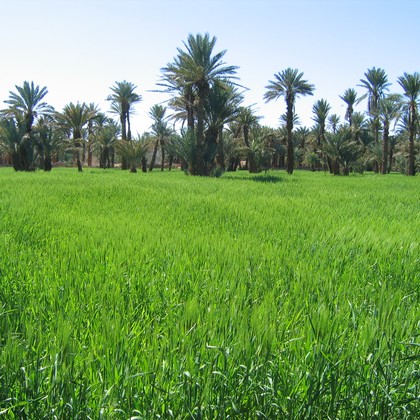
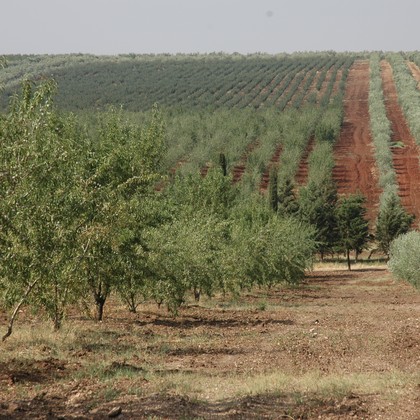
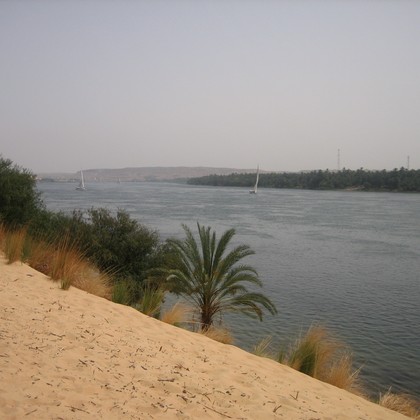
Open farmland with scattered trees, palm groves, field edges, banks of rivers and canals, and dry scrub; hunts from low branches and wires.
Where the bird is most at home, classified by the habitats of North Africa and the Middle East.
Range and movements
Not an established breeder in the region. The westernmost breeding birds (beludschicus) live in southern Iran, from Khuzestan and the Gulf coast eastwards, so visitors to south-east Iraq (around Basra and the marshes) and the far side of the Gulf are conceivable, but certain records are scarce. Reports under this name from Israel, Jordan, Saudi Arabia, Oman and the Emirates largely refer to Arabian Green Bee-Eater, which was included in this species until 2021. Outside the region it breeds from Iran and Pakistan through India and Sri Lanka to South-East Asia.
How and when to look
If you see a small green bee-eater with long streamers and little blue on the face in the eastern Gulf or southern Iraq, photograph it side-on and record its call: only then can it be separated from Arabian Green Bee-Eater.
Conservation status
Not globally threatened and common in South Asia. Its status in the region is uncertain; records are best submitted to the national rarities committees.
Scientific name
Merops orientalis | Latham, 1801
Latham described the species in 1801 and placed it straight away in the genus where it still stands. The genus Merops was introduced in 1758 by Linnaeus. Merops is Greek and means 'bee-eater'. orientalis is Latin for 'eastern'. The specimen the first description was based on came from Maharashtra, India.