All species › Passerines › Chats and flycatchers › Arabian Wheatear
Arabian Wheatear | Oenanthe lugentoides
Arabische tapuit | Collalba árabe
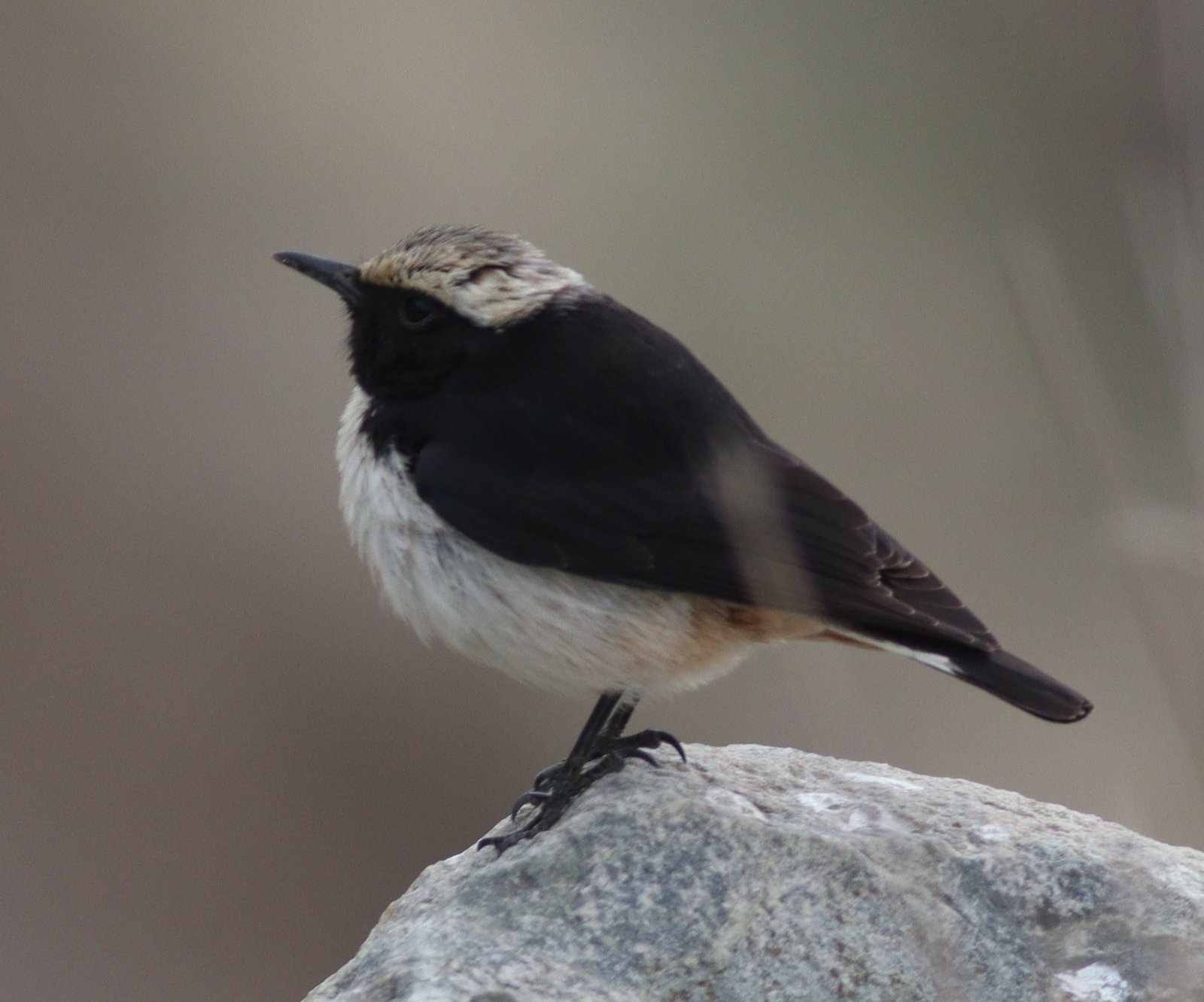
Arabian Wheatear is a black-and-white wheatear of the south-west Arabian highlands, found only in the mountains of south-western Saudi Arabia, Yemen and Dhofar. It is closely related to Mourning Wheatear and was long regarded as a form of it, but has a dark crown and lives in a quite different landscape: terraces, juniper woodland and mountain villages.
Voice
The song is a short, clear phrase of whistles with some scratchy notes, from a boulder, a wall or a tree. The call is a hard chak.
Recording: bert de bruin — CC BY-NC-SA 4.0 · converted to mono · xeno-canto
Identification
15–16 cm. Built like a Mourning Wheatear. The male has a black face, throat, upper breast, mantle and wings; the crown is dark, grey-brown to blackish with fine pale streaks, but never pure white. Belly and rump white, undertail-coverts orange-buff. The tail is white with black central feathers and a black terminal band (inverted T). The nominate female is grey-brown with a darkly streaked throat and the same tail pattern; in Dhofar (form boscaweni) the female is more like the male.
Confusion species
Mourning Wheatear (Oenanthe lugens) has a pure white crown and does not live in the south-west Arabian highlands; Hooded Wheatear (Oenanthe monacha) also has a white crown. The male Pied Wheatear (Oenanthe pleschanka), a passage migrant and scarce winter visitor in south-west Arabia, has a white crown and white undertail. Buff-breasted Wheatear (Oenanthe bottae), which lives in the same highlands, is brown with a rusty-buff breast and no black. Females resemble female Northern Wheatear (Oenanthe oenanthe) and Pied Wheatear, but the streaked throat and the orange-buff under the tail help.
Habitat
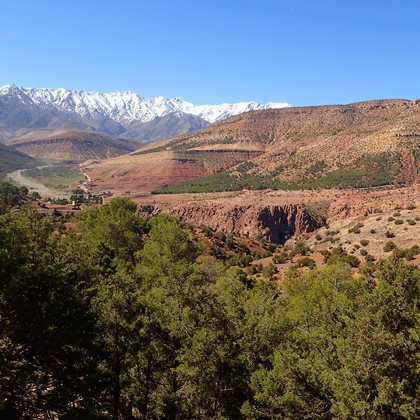
Rocky slopes, gorges and ravines with shrubs and juniper woodland, terraced fields with stone walls, orchards and villages in the high mountains, mostly between about 1,500 and 3,000 m; in Dhofar also lower, on rocky, vegetated slopes. Nests in holes in terrace walls and rock crevices.
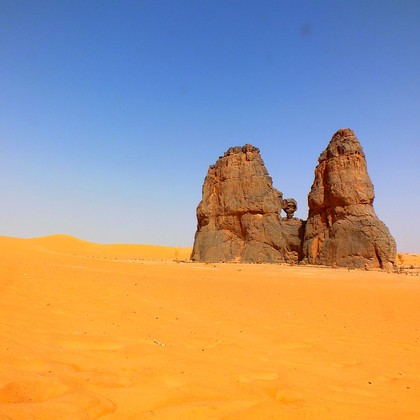
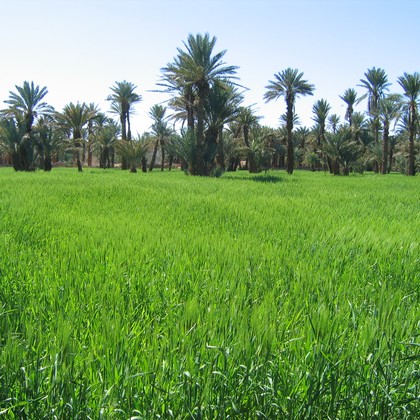
Where the bird is most at home, classified by the habitats of North Africa and the Middle East.
Range and movements
Endemic to south-west Arabia: the Hejaz and Asir mountains of Saudi Arabia, from about Taif southwards, locally also in the hills of the Tihama, and the western highlands of Yemen; further east in southern Yemen and in the mountains of Dhofar in southern Oman (form boscaweni). Does not occur outside the region.
- Resident
- Summer visitor (c. Apr–Sep)
- Winter visitor (c. Oct–Mar)
- Passage (Mar–Apr, Oct–Nov)
- dark = core range, pale = thinly spread
How and when to look
In Saudi Arabia easily seen around Abha, on the Jebel Souda plateau and in the Raydah forest; in Yemen in the highlands around Sana'a and Taiz. It often breeds close to houses and terraces and then perches conspicuously on walls.
Conservation status
Not globally threatened. Fairly common in its small range, but possibly declined somewhat in the Asir; building development and the loss of terraces and juniper woodland are local threats.
Scientific name
Oenanthe lugentoides | (Seebohm, 1881)
Seebohm described the species in 1881 as Saxicola lugentoides; because it was later moved to another genus, the author and year stand in brackets. The genus Oenanthe was introduced in 1816 by Vieillot. Oenanthe was used by Aristotle for a bird that can no longer be identified; the word comes from the Greek oinos, oinoē 'wine, vine' and anthos 'flower, bloom'. lugentoides means 'resembling lugens' (the Mourning Wheatear), from Latin lugens 'mourning' and Greek -oidēs 'resembling'. The specimen the first description was based on came from Yemen.