All species › Passerines › Sylvia warblers › Arabian Warbler
Arabian Warbler | Curruca leucomelaena
Arabische zwartkop | Curruca árabe
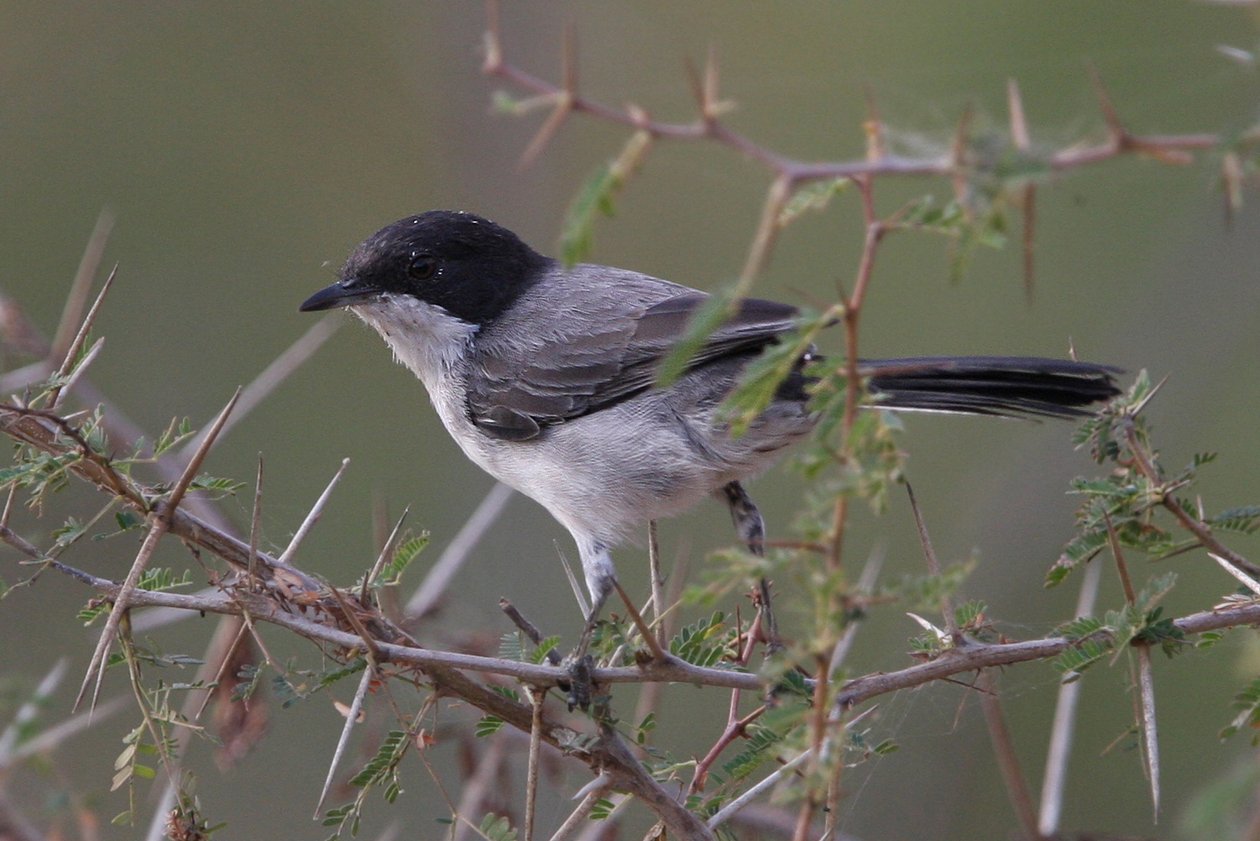
The Arabian Warbler is a large, dark-headed warbler of the acacia scrub around the Red Sea, from the Arava in Israel and Jordan to Yemen and Dhofar. With its long, white-edged tail, which it moves up and down and sideways like a shrike, and its thrush-like song, it is one of the characteristic species of the acacia wadis.
Voice
The song is a short, flowing, bubbling phrase of two to three seconds with a thrush-like, fluty quality, given from the top of an acacia or from cover; more melodious than most warblers and without their scratchy notes. The call is a soft chak, in a series when alarmed.
Recording: Stanislas Wroza — CC BY-NC-SA 4.0 · converted to mono · xeno-canto
Identification
14.5–15 cm. Large, with a heavy bill, short, rounded wings with hardly any primary projection and a long black tail with white sides. The male has a dull black hood extending below the eye, merging without a sharp border into the grey-brown mantle; the throat is white, the rest of the underparts off-white to pale grey with a buffy tinge on the flanks. The eye is dark with a narrow white eye-ring. The female has a dark brownish-grey hood and is somewhat browner. The undertail-coverts are dark with white fringes. The form negevensis in the Arava is slightly paler than Arabian birds.
Confusion species
The male Eastern Orphean Warbler (Curruca crassirostris) is similar, but has a pale iris, longer wings with clear primary projection, a more sharply defined hood and a shorter tail that it does not wave; it migrates through the Arabian Warbler's habitat. Yemen Warbler (Curruca buryi) has no dark hood and ochre-brown undertail-coverts. Sardinian Warbler (Curruca melanocephala) and Ménétriés's Warbler (Curruca mystacea) are much smaller, with a red eye-ring.
Habitat
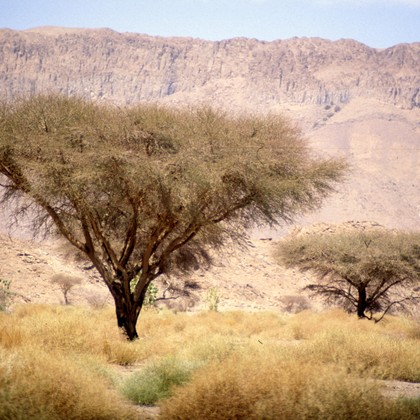
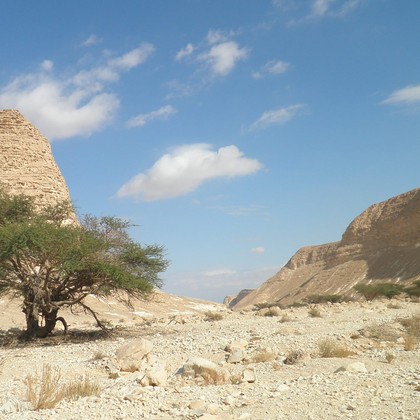
Acacia scrub and open acacia woodland in hot, dry lowlands and wadis: in the Arava almost exclusively in large acacias (Vachellia tortilis and V. raddiana), in Arabia in the acacia plains of the Tihama, the wadis at the foot of the Asir mountains and in Dhofar in dry acacia scrub. Forages quietly in the canopy for insects, moving its tail.
Where the bird is most at home, classified by the habitats of North Africa and the Middle East.
Range and movements
In Israel and Jordan the form negevensis in the Arava and the southern Dead Sea depression, a small, isolated population. The nominate form in western Saudi Arabia, from the north-west (Hejaz) south along the Tihama and the foot of the Asir mountains, in western and southern Yemen and in Dhofar in southern Oman. In south-east Egypt (Gebel Elba) the form blanfordi, which also occurs in Sudan and Eritrea. Beyond the region also somaliensis in Djibouti and northern Somalia. Resident.
- Resident
- Summer visitor (c. Apr–Sep)
- Winter visitor (c. Oct–Mar)
- Passage (Mar–Apr, Oct–Nov)
- dark = core range, pale = thinly spread
How and when to look
In Israel in the large acacias of the southern Arava north of Eilat; early in the morning the male sings from the top of an acacia. In Oman it can be seen in the acacia wadis of Dhofar, in Saudi Arabia in the Tihama and the low wadis around Jizan.
Conservation status
Not globally threatened, although numbers are probably slowly declining. The small population in the Arava is vulnerable to the die-back of acacias as groundwater levels fall, agricultural expansion and drought; in Arabia the cutting of acacias for charcoal and overgrazing of wadis are factors.
Scientific name
Curruca leucomelaena | Hemprich & Ehrenberg, 1833 (GBIF: Sylvia leucomelaena)
Hemprich & Ehrenberg described the species in 1833 and placed it straight away in the genus where it still stands. The genus Curruca was introduced in 1802 by Bechstein. Curruca is Latin, the name of an unidentified small bird mentioned by the Roman poet Juvenal. leucomelaena is Greek, from leukos 'white' and melas 'black', after the black-and-white plumage. The specimen the first description was based on came from Midyan, Saudi Arabia.