All species › Passerines › Larks › Arabian Lark
Arabian Lark | Eremalauda eremodites
Arabische leeuwerik | Alondra árabe
Arabian Lark is a stocky, sandy, heavy-billed lark of the desert plains of Arabia, Sinai and the Syrian Desert. It was long treated as a subspecies of Dunn's Lark and has been regarded as a separate species since 2016. It is nomadic and follows the rain: where grass springs up after a wet winter it sometimes appears in numbers and breeds, only to all but vanish again in dry years. Not to be confused with the much larger, long-billed Greater Hoopoe-Lark.
Voice
The song, given in a high, undulating song flight or from the ground, consists of short, pleasant phrases of twittering, fluty and trilling notes, sometimes with mimicry. The call is a soft, rolling prrt.
Recording: Mischa Keijmel — CC BY-NC-SA 4.0 · shortened to the first 60 s, mono · xeno-canto
Identification
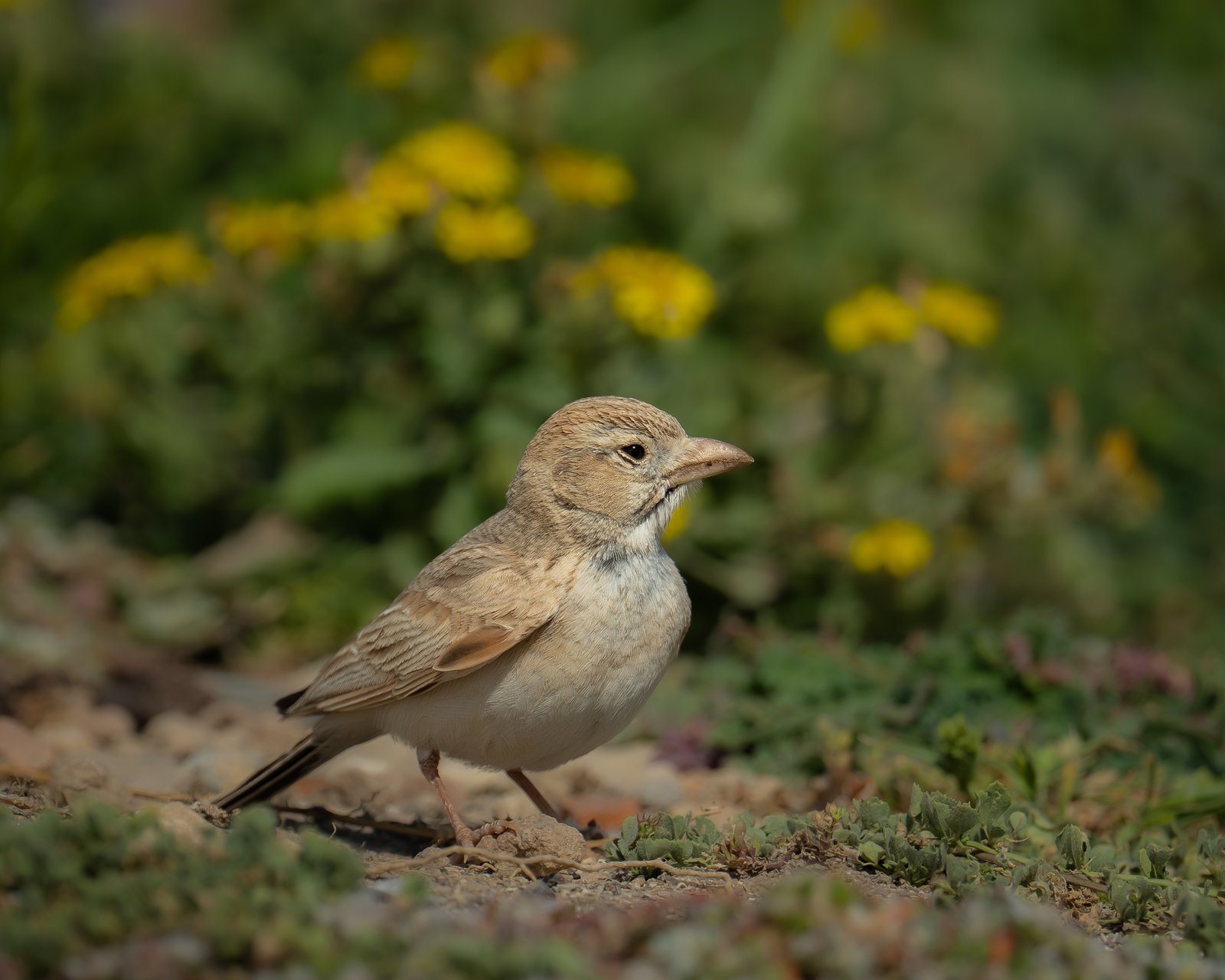
14–15 cm, stocky and large-headed, with a heavy, pale pinkish-horn conical bill that is slightly longer than in Dunn's Lark, and a fairly short tail. Upperparts sandy with a greyish cast to the nape and upper mantle; crown and nape densely streaked dark grey-brown to blackish. The face is pale, with a white eye-ring, a dark line behind the eye and a prominent dark tear-drop mark below the eye. Underparts whitish with a buff wash and fine streaks on the breast sides. The tail is largely blackish with sandy central feathers and looks dark in flight. The long tertials almost cover the primaries. Sexes alike; males clearly longer-winged. In worn plumage in spring greyer sandy in tone with more contrasting streaks.
Confusion species
Dunn's Lark (Eremalauda dunni) lives only west of the Gulf of Suez; it is more rufous in tone, has rufous rather than dark grey streaks on the crown and nape, a shorter, stubbier bill and shorter wings. Bar-tailed Lark (Ammomanes cinctura) has a much smaller bill, unstreaked upperparts and a rufous tail with a sharp black terminal band. Desert Lark (Ammomanes deserti) is larger, unstreaked and lives on rocky slopes. Greater Short-toed Lark (Calandrella brachydactyla) and Mediterranean Short-toed Lark (Alaudala rufescens) have a much finer bill and a paler tail with white sides. Female Black-crowned Sparrow-Lark (Eremopterix nigriceps) is smaller, with a shorter tail and no streaked crown.
Habitat
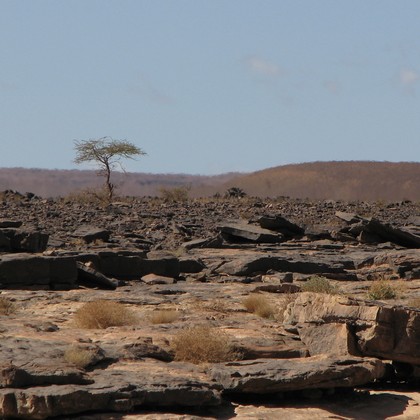
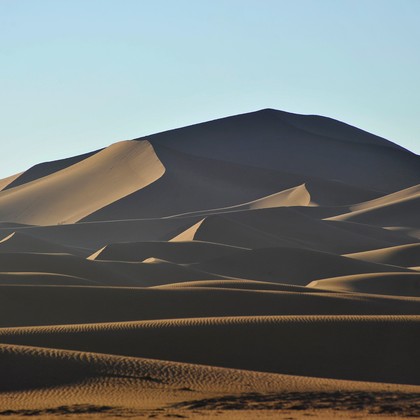
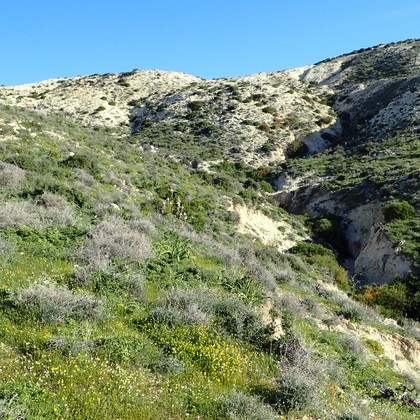
Flat, open gravel and sand plains and broad, shallow wadi beds with scattered grass tufts and low shrubs, especially where rain has recently fallen. Avoids rocky terrain and high dunes.
Where the bird is most at home, classified by the habitats of North Africa and the Middle East.
Range and movements
Its core range is Saudi Arabia, especially the interior plains of Najd, the edges of the Nafud and Dahna and the northern gravel plains, where numbers fluctuate strongly with rainfall. In Kuwait it is a scarce resident that breeds, mainly in the fenced reserves in the west. In Jordan it lives in the eastern desert (badia), in Syria in the Syrian Desert, and in Iraq probably in the western and southern desert, though data there are scarce. In Israel and Sinai (Egypt) it is an irregular breeder, with influxes into the Negev and Arava after wet winters and hardly any records in dry years; vagrants have been recorded on the Israeli coast and in Lebanon (1962). In Oman and Yemen it occurs locally and scarcely on the interior desert plains; from the United Arab Emirates, Qatar and Bahrain there are at most a few records. It does not occur west of the Gulf of Suez. The species is endemic to the Middle East.
- Resident
- Summer visitor (c. Apr–Sep)
- dark = core range, pale = thinly spread
How and when to look
Look for it after a wet winter on grassy gravel and sand plains, for example on the plains around Riyadh, in the reserves of Kuwait or in the southern Arava. Drive slowly and stop where there are grass tufts; the birds walk unobtrusively and only stand out by their heavy bill and dark tail when they fly up. In spring watch for birds singing high in the air.
Conservation status
Not threatened. Because of its nomadic habits, numbers and trend are poorly known and fluctuate strongly from year to year. Overgrazing and conversion of desert plains to farmland can limit breeding success after rain.
Scientific name
Eremalauda eremodites | (Meinertzhagen, 1923) (GBIF: Eremalauda dunni)
Meinertzhagen described the species in 1923 as Pyrrhulauda eremodites; because it was later moved to another genus, the author and year stand in brackets. The genus Eremalauda was introduced in 1926 by Sclater. Eremalauda combines Greek erēmos 'desert' with Latin alauda 'lark'. eremodites is Greek and likewise begins with erēmos 'desert'; the second part is connected with hodites 'traveller'. The specimen the first description was based on came from Sheikh Othman, Yemen.