All species › Passerines › Chats and flycatchers › African Stonechat
African Stonechat | Saxicola torquatus
Afrikaanse roodborsttapuit | Tarabilla común
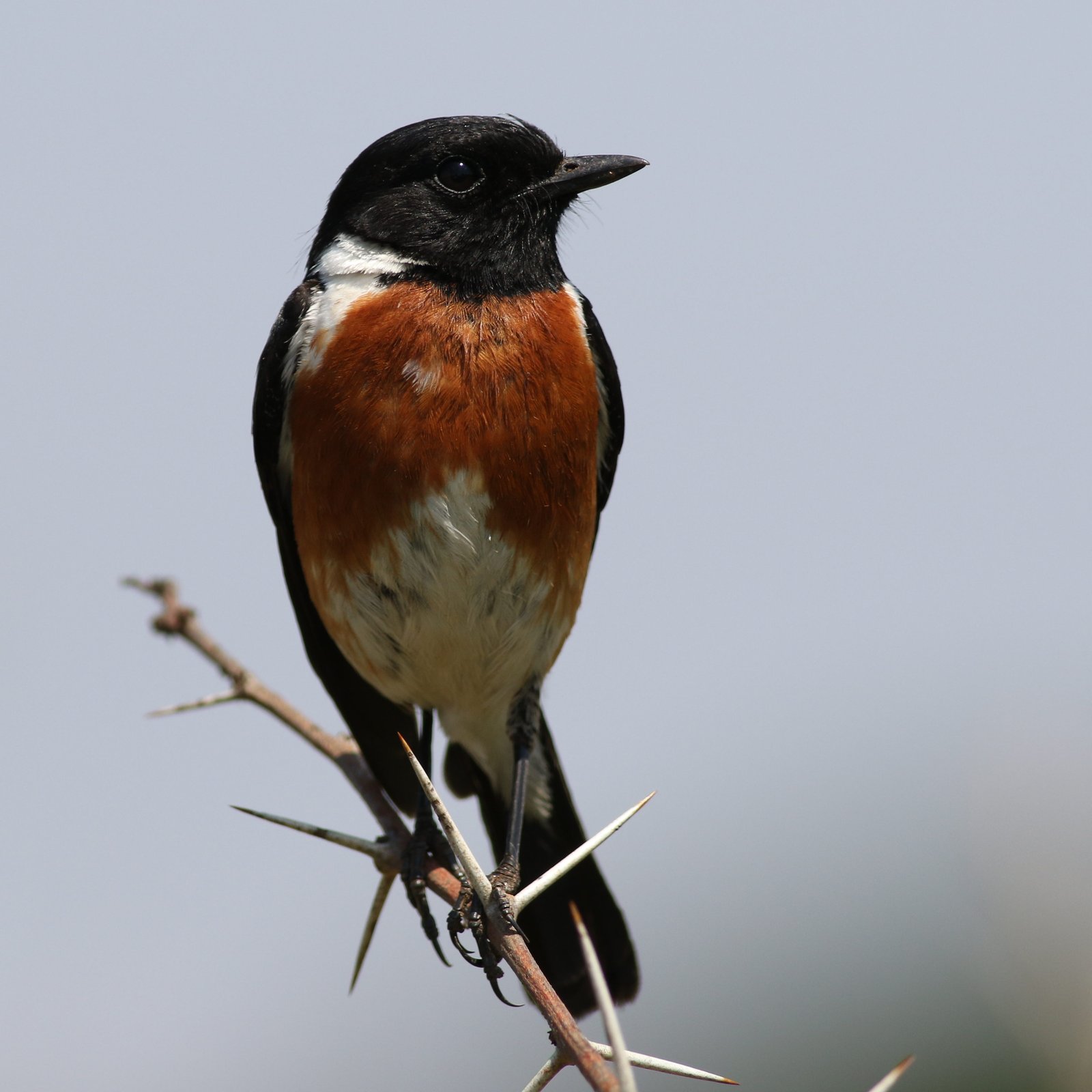
The African Stonechat is the stonechat of sub-Saharan Africa and the highlands of south-west Arabia. In the region only the form felix occurs, a resident of the mountain meadows and terraces of Asir and Yemen. Like its relatives it perches upright on a stem, bush or stone and nervously flicks its tail and wings.
Voice
The call is a hard weet-chak-chak, like two pebbles knocked together. The song is a short, high, scratchy phrase of whistles, often from a perch or in a short song flight.
Recording: Bram Piot — CC BY-NC-SA 4.0 · converted to mono · xeno-canto
Identification
12–13 cm. The male has a black head, throat and upperparts with rufous fringes, a large white neck patch, a white wing-bar and a white rump. The breast is deep chestnut, but in felix restricted to a patch on the upper breast; belly and flanks are white. The female is brown with dark streaks above, a dark head without a clear supercilium, a smaller white wing patch and a warm orange-brown breast. Juveniles are spotted.
Confusion species
European Stonechat (Saxicola rubicola) and Siberian Stonechat (Saxicola maurus) occur within its range only as scarce winter visitors or migrants. European Stonechat has more orange on breast and flanks and a smaller white rump; Siberian Stonechat is paler, with a large unstreaked pale rump and in the male much white on the belly. In winter they are often best separated by habitat: African Stonechat stays in the highlands, winter visitors mostly in the lowlands. Whinchat (Saxicola rubetra) has a broad pale supercilium.
Habitat
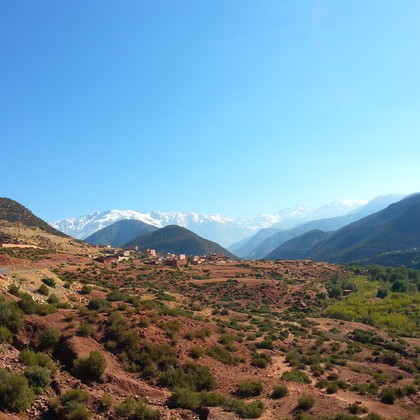
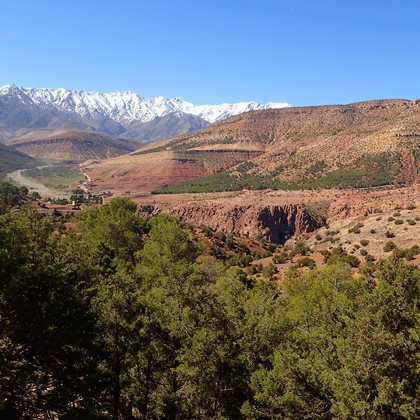
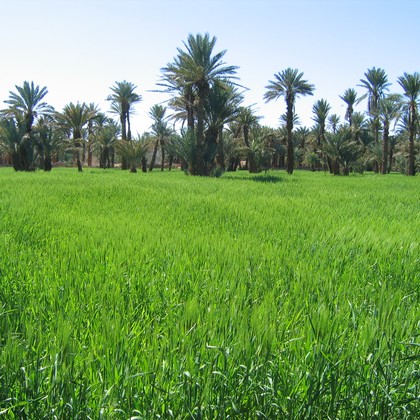
Mountain meadows, grassland with bushes and juniper, terraced fields, roadsides and the edges of montane forest, mostly above 1,500 m; outside the breeding season sometimes in lower valleys and fields.
Where the bird is most at home, classified by the habitats of North Africa and the Middle East.
Range and movements
In the region only in south-west Arabia: in the Asir highlands of Saudi Arabia, including around Abha and on the Raydah escarpment, and south through the mountains of Yemen. Records elsewhere in Arabia almost always refer to wintering birds of related species. Beyond the region the species occurs over much of sub-Saharan Africa and on Madagascar, in many forms.
- Resident
- Summer visitor (c. Apr–Sep)
- Winter visitor (c. Oct–Mar)
- Passage (Mar–Apr, Oct–Nov)
- dark = core range, pale = thinly spread
How and when to look
In Saudi Arabia look for it in the highlands around Abha, such as the Talea valley and at the Raydah escarpment, where it perches on bushes and fence posts along the terraces; in winter European Stonechats are also possible here, so check for the restricted chestnut breast patch.
Conservation status
Not globally threatened. Locally common in suitable highland in south-west Arabia; little is known about numbers and trends in Yemen. Stonechat taxonomy is in flux: felix is sometimes placed in a species of its own or in another group.
Scientific name
Saxicola torquatus | (Linnaeus, 1766)
Linnaeus described the species in 1766 as Muscicapa torquata; because it was later moved to another genus, the author and year stand in brackets. The genus Saxicola was introduced in 1802 by Bechstein. Saxicola is Latin, from saxum 'stone, rock' and -cola 'dweller', from colere 'to inhabit': 'rock dweller', after the open stony ground these birds keep to. torquatus is Latin for 'collared', from torques, 'necklace' — for the male's white neck patches. The specimen the first description was based on came from Cape of Good Hope.