All species › Passerines › Tyrant flycatchers and allies › Yellow Tyrannulet
Position in the tree Birds Aves › Birds with a flexible palate Neognathae › All other modern birds Neoaves › Landbirds Telluraves › Falcons, parrots and passerines Australaves › Falcons and passerines Eufalconimorphae › Parrots and passerines Psittacopasserae
Yellow Tyrannulet | Capsiempis flaveola
Gele looftiran | Mosquerito amarillo
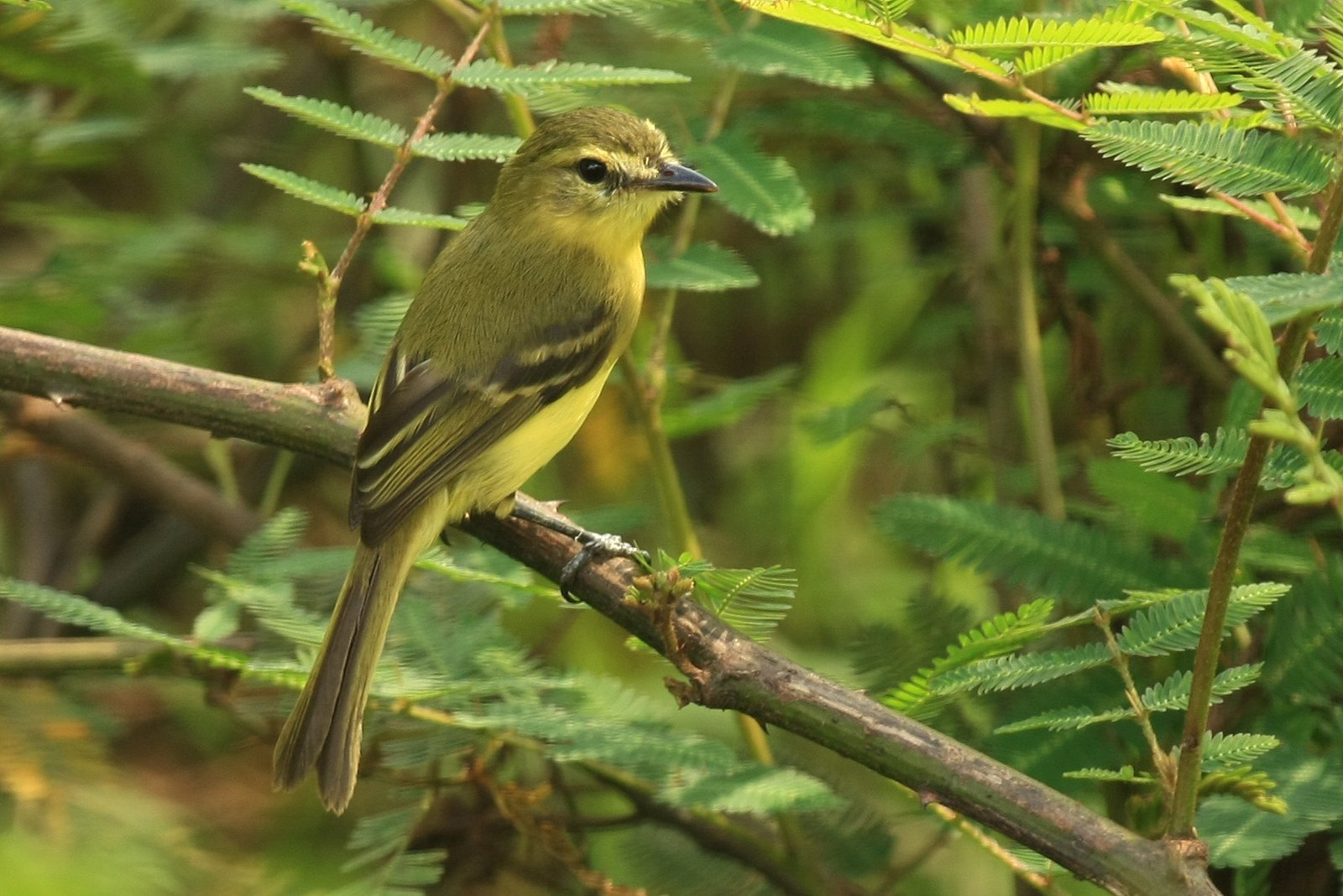
The Yellow Tyrannulet is a small, bright yellow tyrant flycatcher with a fairly long tail, living in scrub, forest edges and young secondary growth. Pairs usually stay low to mid-level in dense foliage and often give themselves away by their lively calls. In the guide area it lives from Nicaragua to Panama.
Voice
Lively, rapid series of short, rather shrill notes, often given simultaneously by both birds of a pair. Also short, dry calls.
Recording: Juan Freile — CC BY-NC-SA 4.0 · converted to mono · xeno-canto
Identification
11 cm, with a fairly long, narrow tail that is often slightly cocked, and a small dark bill. Upperparts olive-green. A distinct yellow supercilium and a narrow yellow eye-ring. Wings dark with two yellowish wing-bars and yellow edges to the flight feathers. Underparts entirely bright yellow, with an olive wash on the sides of the breast. Male and female are alike.
Confusion species
Panama Tyrannulet Phylloscartes flavovirens lives high in the canopy of humid forest and has a less bright yellow head without a distinct supercilium. Yellow-crowned Tyrannulet Tyrannulus elatus has a grey head with a dark crown, a shorter tail and a stubby bill. Yellow-bellied Tyrannulet Ornithion semiflavum has a shorter tail, a grey crown and a white supercilium. Yellowish Flycatcher Empidonax flavescens is larger, lives in montane forest and has a conspicuous pale eye-ring and no yellow supercilium.
Habitat
Scrub, forest edges, young and older secondary growth, riverbanks and shrubby overgrown areas in the lowlands and foothills, locally to about 1200 m; rarely in the interior of tall forest. It forages in pairs or small family groups for small insects among the foliage.
Where the bird is most at home, classified by the vegetation units of Mexico and Central America.





Range and movements
Caribbean slope of southern Nicaragua and Costa Rica, in Costa Rica also locally on the Pacific slope, and in Panama on both slopes. Outside the guide area widespread in South America, from Colombia and Venezuela to north-eastern Argentina.
- Resident
- dark = core range, pale = thinly spread
How and when to look
Look mainly in rank scrub and at forest edges in the lowlands, where pairs can be tracked by their calls. The cocked tail and the yellow supercilium are the best field marks.
Conservation status
Not threatened. Widespread and locally common; it benefits from scrub and secondary growth and is therefore little affected by partial deforestation.
Scientific name
Capsiempis flaveola | (Lichtenstein, 1823)
Lichtenstein described the species in 1823 as M[uscicapa] flaveola; because it was later moved to another genus, the author and year stand in brackets. The genus Capsiempis was introduced in 1860 by Cabanis & Heine. Capsiempis is probably Greek, from kaptō 'to gulp down, snap up' and empis 'gnat': 'gnat-snapper'. flaveola is Latin for 'yellowish', diminutive of flavus 'yellow', after the yellow plumage. The specimen the first description was based on came from Bahia, Brazil.