All species › Passerines › Finches, euphonias and allies › Yellow-throated Euphonia
Position in the tree Birds Aves › Birds with a flexible palate Neognathae › All other modern birds Neoaves › Landbirds Telluraves › Falcons, parrots and passerines Australaves › Falcons and passerines Eufalconimorphae › Parrots and passerines Psittacopasserae
Yellow-throated Euphonia | Euphonia hirundinacea
Geelkeelorganist | Eufonia garganta amarilla
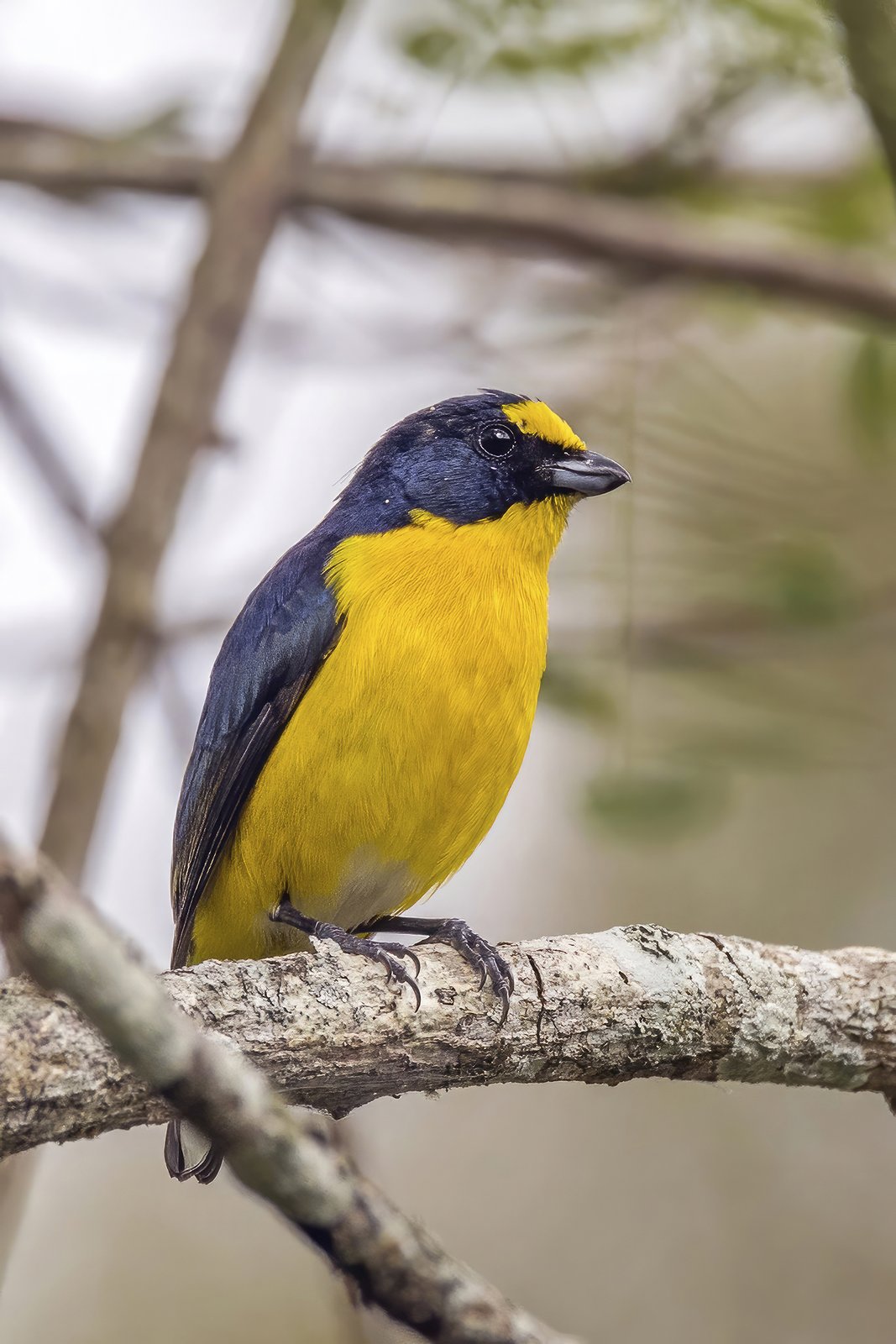
The Yellow-throated Euphonia is the most widespread euphonia in the northern part of the guide area. The male is blue-black above and entirely yellow below, with a yellow throat. It lives along forest edges, in secondary forest, plantations and gardens, and is often one of the first euphonias a visitor to the lowlands sees. The populations of western Mexico are now treated as a separate species, West Mexican Euphonia.
Voice
The call is a clear, whistled dee-deet or bee-beet, often the first clue to the species. The song is a varied, rapid chatter of chirps, whistles and rasping notes, sometimes with imitated calls of other birds.
Recording: Paul Driver — CC BY-NC-SA 4.0 · shortened to the first 60 s, mono · xeno-canto
Identification
10–11 cm. Stocky, with a short, thick bill and a short tail. Male: upperparts, sides of head and a narrow band around the bill glossy blue-black; forecrown yellow to above the eye. Throat and entire underparts bright yellow, undertail coverts yellow; outer tail feathers with white spots on the underside. Female: upperparts olive-green, forehead often slightly yellowish; throat and flanks yellowish olive, centre of breast and belly distinctly greyish white. Young males are at first female-like and gradually acquire blue-black feathers.
Confusion species
Thick-billed Euphonia Euphonia laniirostris closely resembles Yellow-throated Euphonia; both have a yellow throat. They overlap only locally in Costa Rica and western Panama: Thick-billed lives mainly in Costa Rica and Panama, Yellow-throated from Mexico to Costa Rica and western Panama. The female Thick-billed is uniformly yellowish olive below, without the greyish-white belly centre. West Mexican Euphonia Euphonia godmani on the Pacific side of Mexico has a smaller yellow forecrown and a white undertail. Scrub Euphonia Euphonia affinis has a dark throat, and Yellow-crowned Euphonia Euphonia luteicapilla a dark throat and an entirely yellow crown.
Habitat
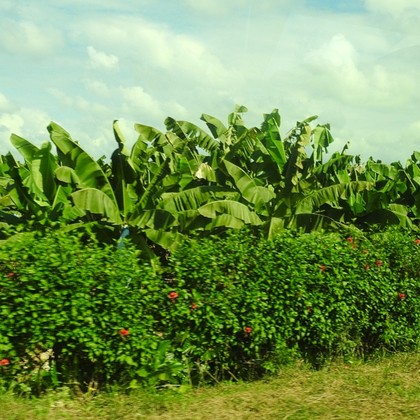
Forest edges, open woodland, secondary forest, scrub with tall trees, shade coffee, cacao and other plantations, orchards, parks and gardens with fruiting trees; also seasonal forest. From sea level to about 1500 m. It lives in pairs or small groups and feeds mainly on mistletoe berries and other small fruit. The nest is a domed structure with a side entrance, often in an epiphyte or a crevice in a tree trunk.
Where the bird is most at home, classified by the vegetation units of Mexico and Central America.






Range and movements
Endemic to the guide area. From eastern Mexico (southern Tamaulipas and San Luis Potosí) south through Veracruz, Oaxaca, Tabasco, Chiapas and the Yucatán Peninsula, and on through Belize, Guatemala, El Salvador, Honduras and Nicaragua to Costa Rica and extreme western Panama.
- Resident
- dark = core range, pale = thinly spread
How and when to look
In gardens and plantations, listen for the clear dee-deet from a fruiting tree or a tree with mistletoe; several euphonias often gather there at once.
Conservation status
Not threatened (LC). Common and adapted to human-modified landscapes such as plantations and gardens. Locally trapped as a cage bird.
Scientific name
Euphonia hirundinacea | Bonaparte, 1838
Bonaparte described the species in 1838 and placed it straight away in the genus where it still stands. The genus Euphonia was introduced in 1806 by Desmarest, A-G. Euphonia is Greek, from eu 'good' and phōnē 'sound': 'sweet-voiced', after the pleasing calls. hirundinacea is New Latin for 'swallow-like', from hirundo 'swallow', probably after the glossy blue-black upperparts. The specimen the first description was based on came from Guatemala.