All species › Passerines › Shrike-babblers, Erpornis and vireos › Yellow-browed Shrike-Vireo
Position in the tree Birds Aves › Birds with a flexible palate Neognathae › All other modern birds Neoaves › Landbirds Telluraves › Falcons, parrots and passerines Australaves › Falcons and passerines Eufalconimorphae › Parrots and passerines Psittacopasserae
Yellow-browed Shrike-Vireo | Vireolanius eximius
Geelbrauwklauwiervireo | Vireón cejiamarillo
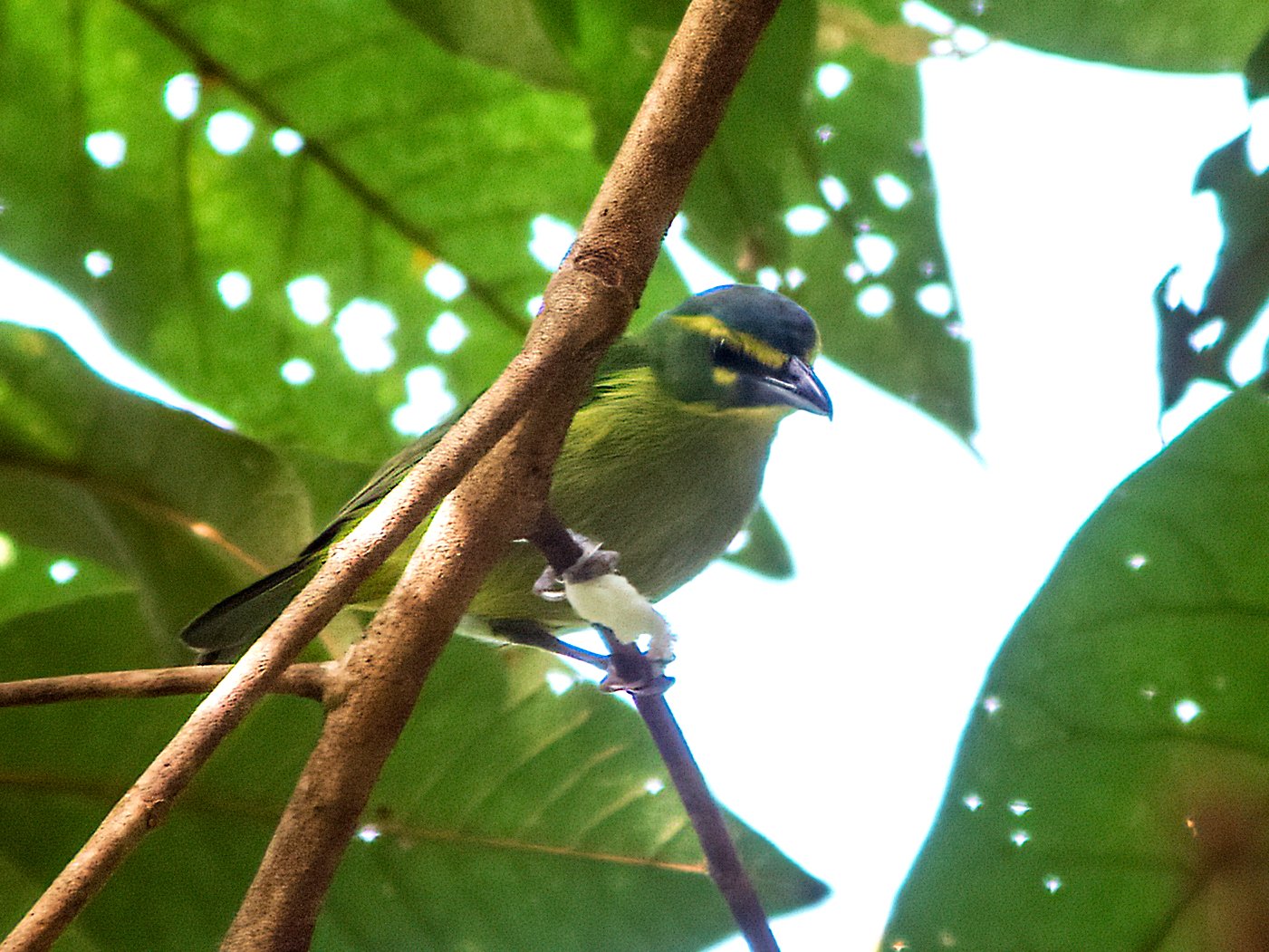
The Yellow-browed Shrike-Vireo is a bright green shrike-vireo with a blue crown and a yellow supercilium. Within the guide area it occurs only in eastern Panama.
Voice
The song is a monotonously repeated whistled phrase, similar to that of Green Shrike-Vireo.
Recording: Carlos Delgado JUMABITA — CC BY-NC-SA 4.0 · converted to mono · xeno-canto
Identification
13–14 cm. Upperparts bright green; crown and nape blue, with a distinct yellow supercilium. Throat and breast yellow, belly yellowish green. Bill heavy, with a hooked tip.
Confusion species
Green Shrike-Vireo Vireolanius pulchellus lacks the yellow supercilium. Both species keep to the canopy; check the head pattern carefully.
Habitat
Canopy of humid lowland and foothill forest and forest edges. Forages slowly among the leaves for insects.
Where the bird is most at home, classified by the vegetation units of Mexico and Central America.



Range and movements
In the guide area only in eastern Panama (Darién). Outside the guide area in northern Colombia and north-western Venezuela.
- Resident
- dark = core range, pale = thinly spread
How and when to look
Only to be expected in eastern Panama; there the song from the canopy is the best clue.
Conservation status
Not threatened. In the guide area scarce and restricted to eastern Panama; often overlooked because it lives in the canopy.
Scientific name
Vireolanius eximius | Baird, 1866
Baird described the species in 1866 and placed it straight away in the genus where it still stands. The genus Vireolanius was introduced in 1850 by Bonaparte. Vireolanius combines Vireo with Lanius, the shrike genus, after the stout, hook-tipped, shrike-like bill. eximius is Latin for 'excellent, distinguished', after the strikingly handsome plumage. The specimen the first description was based on came from 'Bogotá', Colombia (trade skin).