All species › Passerines › Crows, jays and magpies › White-throated Magpie-Jay
Position in the tree Birds Aves › Birds with a flexible palate Neognathae › All other modern birds Neoaves › Landbirds Telluraves › Falcons, parrots and passerines Australaves › Falcons and passerines Eufalconimorphae › Parrots and passerines Psittacopasserae
White-throated Magpie-Jay | Cyanocorax formosus
Ekstergaai | Urraca hermosa cara blanca
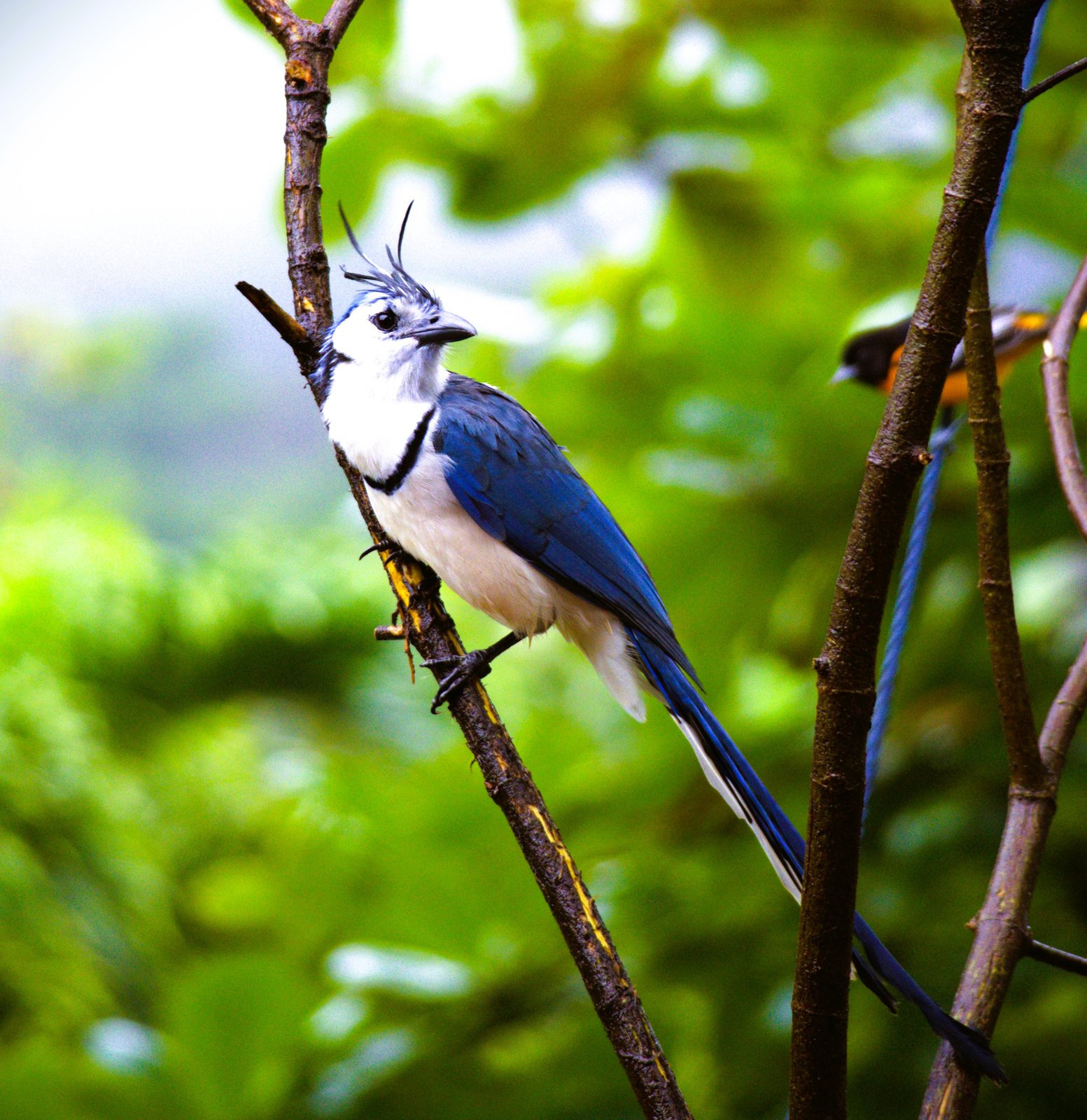
The White-throated Magpie-Jay is a large jay with a long, graduated tail, a crest of forward-curled feathers and a white throat and breast. Groups move noisily through dry forest, savanna with trees, pasture and villages along the Pacific side of Central America. In the guide area it lives from south-western Mexico to north-western Costa Rica.
Voice
Highly varied: loud, shrill and rasping calls, parrot-like screeches, clicking notes and whistles. It gives loud warnings when disturbed and often follows people or predators with alarm calls.
Recording: Étienne Leroy — CC BY-NC-SA 4.0 · converted to mono · xeno-canto
Identification
43–56 cm, about half of which is tail. Crest tall and curled forward, black with bluish feather tips. Face, throat and underparts white, with a narrow black band running from behind the eye down the side of the neck and across the upper breast. Upperparts greyish blue to blue. Tail long and graduated, blue with broad white tips to the outer feathers. Bill and legs black.
Confusion species
Black-throated Magpie-Jay Cyanocorax colliei of north-western Mexico has a black throat and breast and an even longer tail; hybrids occur in the contact zone in western Mexico. Brown Jay Cyanocorax morio is brown with a white or dark belly and has no crest.
Habitat
Tropical dry forest, thorn scrub, open woodland, savanna with scattered trees, wooded pasture, forest edges, and villages, gardens and parks. Groups forage in trees and on the ground for insects, small vertebrates, eggs, fruit and nectar. It is a cooperative breeder: young birds from earlier years help raise the young.
Where the bird is most at home, classified by the vegetation units of Mexico and Central America.





Range and movements
Pacific slope of south-western Mexico, from about Jalisco and Colima, through Guatemala, El Salvador, Honduras and Nicaragua to north-western Costa Rica, locally also in dry interior valleys. The entire range lies within the guide area.
- Resident
- dark = core range, pale = thinly spread
How and when to look
Common and often fairly tame in Guanacaste in Costa Rica, including at Palo Verde National Park, where groups also forage around villages and car parks.
Conservation status
Not threatened. Common and tolerant of open, human-modified land.
Scientific name
Cyanocorax formosus | (Swainson, 1827) (GBIF: Calocitta formosa)
Swainson described the species in 1827 as Pica formosa; because it was later moved to another genus, the author and year stand in brackets. The genus Cyanocorax was introduced in 1826 by Boie. Cyanocorax is Greek, from kuanos 'dark blue' and korax 'raven': a 'blue raven', after the blue colours of many species. formosus is Latin for 'beautiful, handsome', after the striking blue-and-white plumage and long tail. The specimen the first description was based on came from Temascaltepec, State of México, Mexico.