All species › Swifts › Swifts › Vaux's Swift
Position in the tree Birds Aves › Birds with a flexible palate Neognathae › All other modern birds Neoaves › Birds of the elements Elementaves › Nightjars and swifts Strisores
Vaux's Swift | Chaetura vauxi
Vaux' gierzwaluw | Vencejo de Vaux
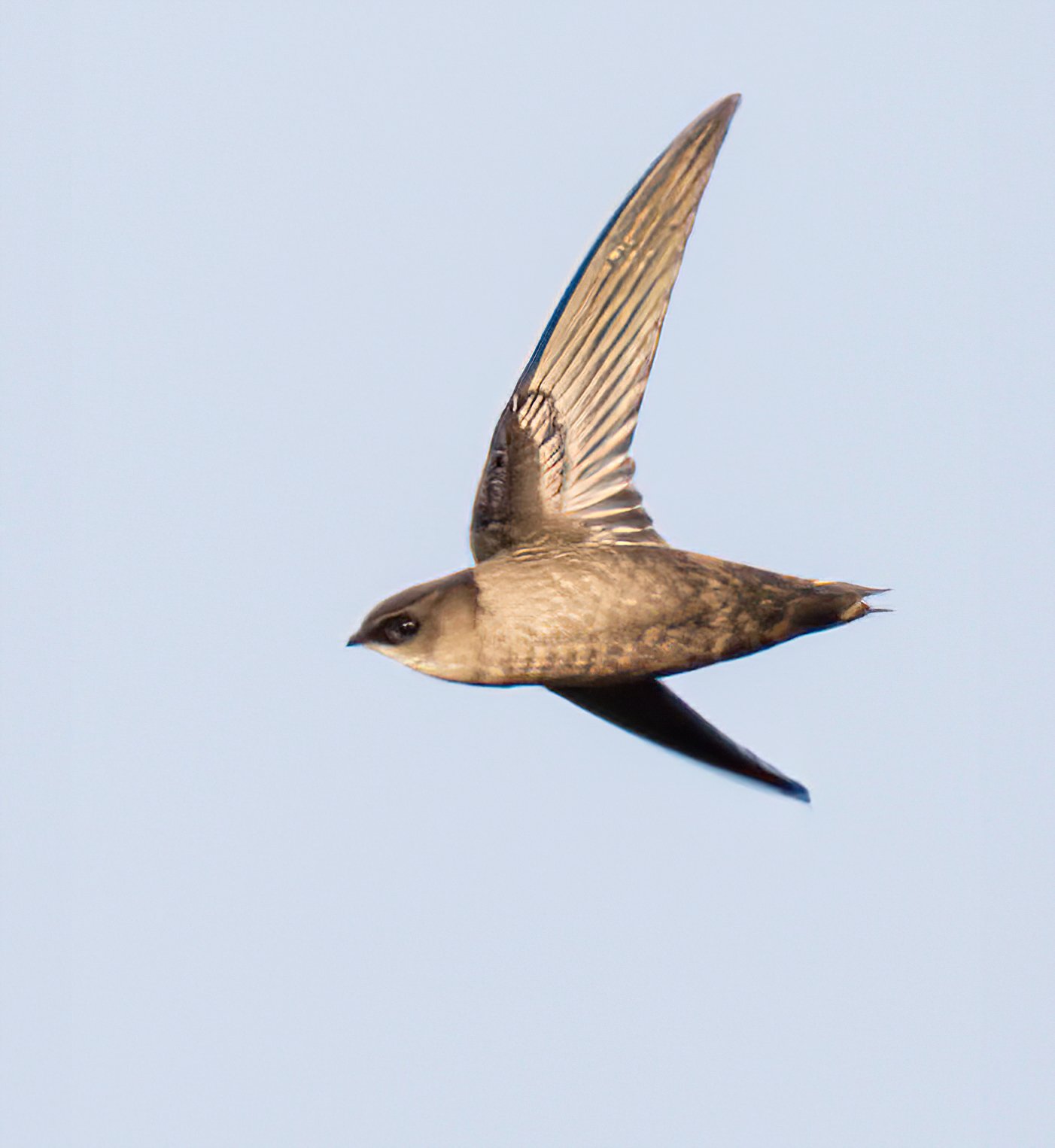
Vaux's Swift is the most widespread small swift of the guide area, from northern Mexico to Panama. It comprises a series of resident populations that differ slightly in colour, including a dark form in southern Mexico and Central America and a pale form on the Yucatán Peninsula. In winter they are joined by migrants from western North America. The species is named after the American naturalist William S. Vaux.
Voice
High, thin, insect-like chips and a rapid, buzzy twitter, chip-chip-chiiiir, often in flight and from groups circling a roost. Higher and softer than the call of the Chimney Swift.
Recording: Elias Aristides Elias — CC BY-NC-SA 4.0 · shortened to the first 60 s, mono · xeno-canto
Identification
11–12 cm. A small, compact swift with a short, spiny tail and wings that are broadest in the middle. The upperparts are dark sooty brown, the rump and uppertail coverts slightly paler greyish brown without a sharp border. The throat and breast are distinctly paler grey than the belly. Residents in southern Mexico and Central America are darker with little contrast; birds of the Yucatán Peninsula are paler, and birds of the Azuero Peninsula in Panama have a pale, buffy rump. Male and female are alike.
Confusion species
The Chimney Swift Chaetura pelagica, which passes through in spring and autumn, is larger, with longer wings, a darker breast and a louder call; in the field the two species often cannot be separated with certainty. The Costa Rican Swift Chaetura fumosa and the Band-rumped Swift Chaetura spinicaudus have a sharply defined pale rump band. The Grey-rumped Swift Chaetura cinereiventris has a glossy blue-black back, a broad, contrasting grey rump and grey underparts. The Short-tailed Swift Chaetura brachyura in Panama has an even shorter tail and a pale undertail.
Habitat
Hunts over almost every wooded landscape, from lowland rainforest and the seasonal forest of Yucatán to cloud forest and pine-oak forest in the mountains, and over forest edges, clearings, villages and towns, from sea level to about 2500 m. Hunts small flying insects in groups, often together with swallows and other swifts. Nests and roosts in hollow trees, and in the north of the guide area also in chimneys and other cavities in buildings.
Where the bird is most at home, classified by the vegetation units of Mexico and Central America.







Range and movements
In most of the guide area. In Mexico on the Gulf side from Tamaulipas south through Veracruz and Oaxaca, on the Pacific side in the south, on the Yucatán Peninsula and Cozumel; further through Guatemala, Belize, El Salvador, Honduras, Nicaragua and Costa Rica to western Panama, with a separate population on the Azuero Peninsula. Largely absent from eastern Panama. Migrants from western North America winter mainly in western and central Mexico, in smaller numbers south into Central America. Outside the guide area the species breeds from south-eastern Alaska to California, and also in northern Venezuela.
- Resident
- Summer visitor (c. Apr–Sep)
- Winter visitor (c. Oct–Mar)
- Passage (Mar–Apr, Oct–Nov)
- dark = core range, pale = thinly spread
How and when to look
In the Central American mountains, for example around Monteverde, in the Central Valley of Costa Rica and in the highlands of Guatemala, groups are often seen over villages and forest edges. In Mexico, wintering migrants sometimes gather in large groups at roosts. Especially during migration it closely resembles the Chimney Swift; the higher, weaker call helps.
Conservation status
Not threatened. The species has a large range and is common in much of the guide area. The loss of old trees with cavities may locally limit the number of nest and roost sites.
Scientific name
Chaetura vauxi | (Townsend, 1839)
Townsend described the species in 1839 as Cypcelus Vauxi; because it was later moved to another genus, the author and year stand in brackets. The genus Chaetura was introduced in 1826 by Stephens. Chaetura is Greek, from khaitē 'hair, bristle' and oura 'tail', after the spiny projecting shafts of the tail feathers. vauxi honours the American mineralogist William Sansom Vaux (1811–1882) of Philadelphia, a friend of the describer John Kirk Townsend. The specimen the first description was based on came from Fort Vancouver on the Columbia River, Washington, USA.