All species › Passerines › Thrushes and allies › Townsend's Solitaire
Position in the tree Birds Aves › Birds with a flexible palate Neognathae › All other modern birds Neoaves › Landbirds Telluraves › Falcons, parrots and passerines Australaves › Falcons and passerines Eufalconimorphae › Parrots and passerines Psittacopasserae
Townsend's Solitaire | Myadestes townsendi
Bergsolitaire | Clarín norteño
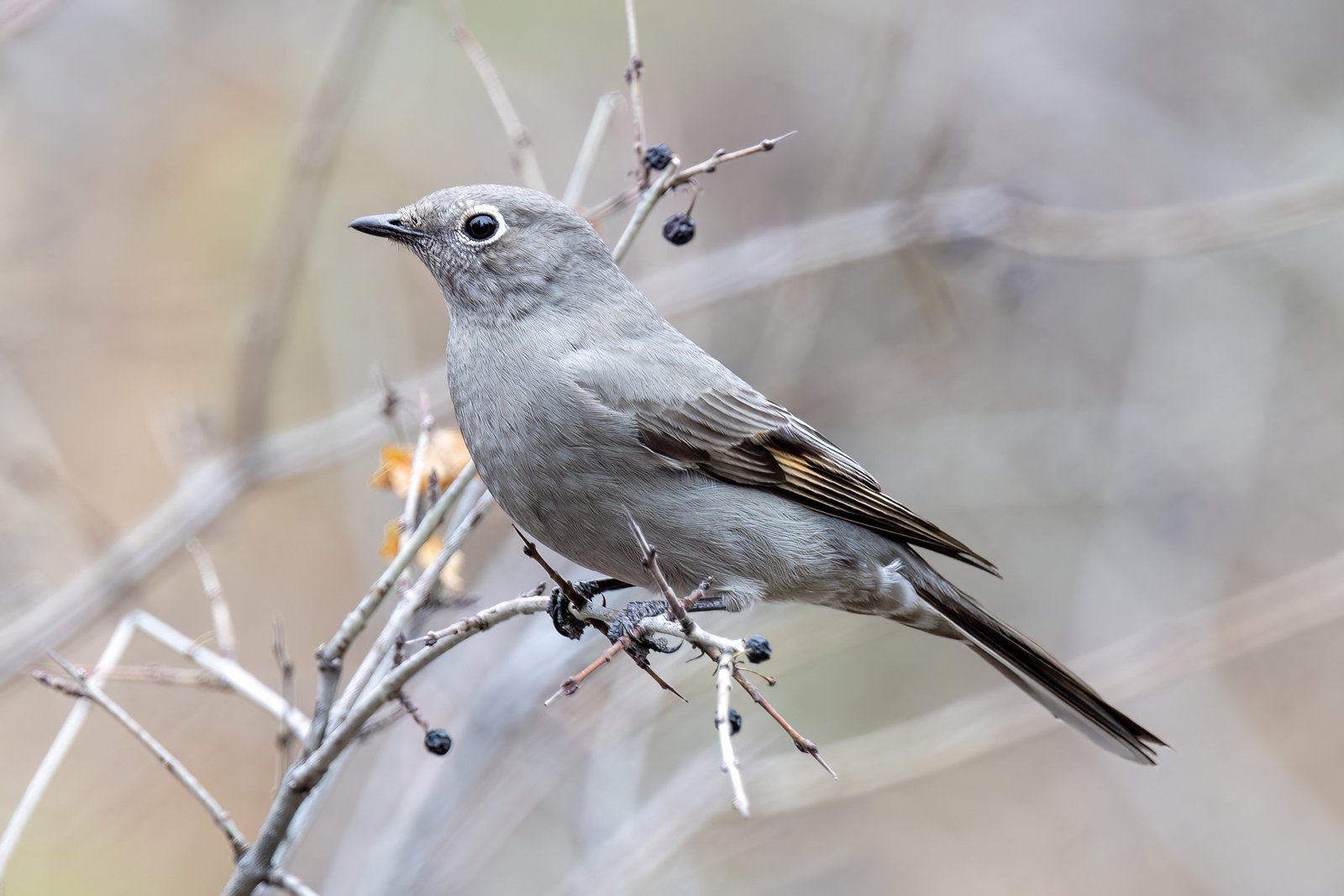
Townsend's Solitaire is a slender, grey thrush with a long tail and a conspicuous white eye-ring. It often sits upright and motionless at the top of a tree and catches insects in the air. In winter it defends its own territory around shrubs with berries. In the guide area a small population breeds in the Sierra Madre Occidental; in winter birds from North America join it in northern Mexico.
Voice
The call is a clear, high, single whistled heee, repeated at intervals for hours in winter. The song is a long, flowing series of clear, rapid and varied warbling notes, often given from a high perch or in flight.
Recording: Greg Irving — CC BY-NC-SA 4.0 · converted to mono · xeno-canto
Identification
20–23 cm. Slender, with a small head, a short black bill and a long tail. Almost entirely grey, with a conspicuous white eye-ring. On the wing a buff band at the base of the flight feathers, visible as a pale patch at rest and as a broad band in flight. Outer tail feathers white. The sexes are alike. Juveniles grey-brown with dense buff and black spotting.
Confusion species
Northern Mockingbird Mimus polyglottos has white patches on the wing, a longer, curved bill and no distinct eye-ring. Female Mountain Bluebird Sialia currucoides is smaller, has blue in the wings and tail and lacks the buff wing band. Brown-backed Solitaire Myadestes occidentalis has a brown back and wings and a dark malar stripe, and lives in more humid montane forest further south in Mexico.
Habitat
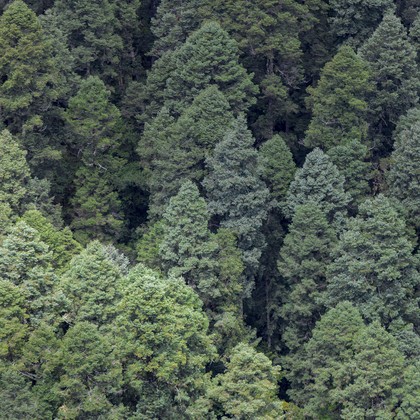
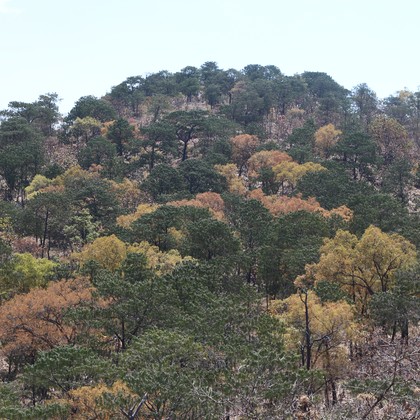
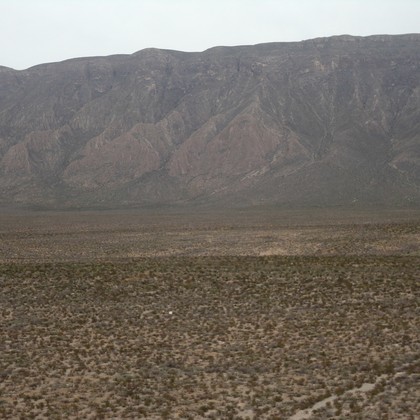
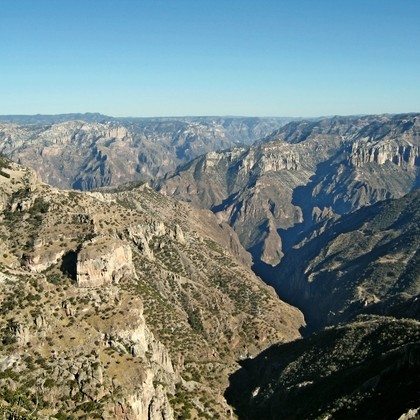
Breeds in open coniferous and pine-oak forest in the mountains, often near steep slopes, rock faces and road cuts where it nests on the ground; in the guide area mostly above 2000 m. In winter in open woodland, juniper scrub and ravines with berry-bearing shrubs, also at lower elevations. In summer it eats mainly insects and in winter almost only berries, especially of juniper.
Where the bird is most at home, classified by the vegetation units of Mexico and Central America.
Range and movements
Breeds in western North America, from Alaska and western Canada to the south-western United States, and in the Sierra Madre Occidental of Mexico, from Chihuahua and Durango to Zacatecas. In winter scattered across northern Mexico, from Baja California and Sonora to Coahuila and Nuevo León, scarcely to the central plateau.
- Resident
- Summer visitor (c. Apr–Sep)
- Winter visitor (c. Oct–Mar)
- Passage (Mar–Apr, Oct–Nov)
- dark = core range, pale = thinly spread
How and when to look
In winter often first noticed by the repeated whistle; the bird then usually sits high and in the open in a tree close to berry-bearing shrubs. Breeding birds can be found in the high forests of the Sierra Madre Occidental in Durango.
Conservation status
Not threatened. Widespread in North America; the Mexican breeding population is small and local, and sensitive to logging of high-elevation coniferous forest.
Scientific name
Myadestes townsendi | (Audubon, 1838)
Audubon described the species in 1838 as Ptiliogony's Townsendi; because it was later moved to another genus, the author and year stand in brackets. The genus Myadestes was introduced in 1838 by Swainson. Myadestes is Greek, from muia 'fly' and edestēs 'eater': 'fly-eater'. townsendi honours the American naturalist John Kirk Townsend (1809–1851), who explored the north-western United States. The specimen the first description was based on came from Columbia River, near Astoria, Oregon.