All species › Kingfishers, bee-eaters and rollers › Motmots › Tody Motmot
Position in the tree Birds Aves › Birds with a flexible palate Neognathae › All other modern birds Neoaves › Landbirds Telluraves › Raptors, owls, kingfishers and woodpeckers Afroaves › Mousebirds, rollers and woodpeckers Coraciimorphae › Trogons and cavity nesters Cavitaves › Hornbills, kingfishers and woodpeckers Picocoraciae › Kingfishers, bee-eaters and woodpeckers Picodynastornithes
Tody Motmot | Hylomanes momotula
Kleine motmot | Momoto enano
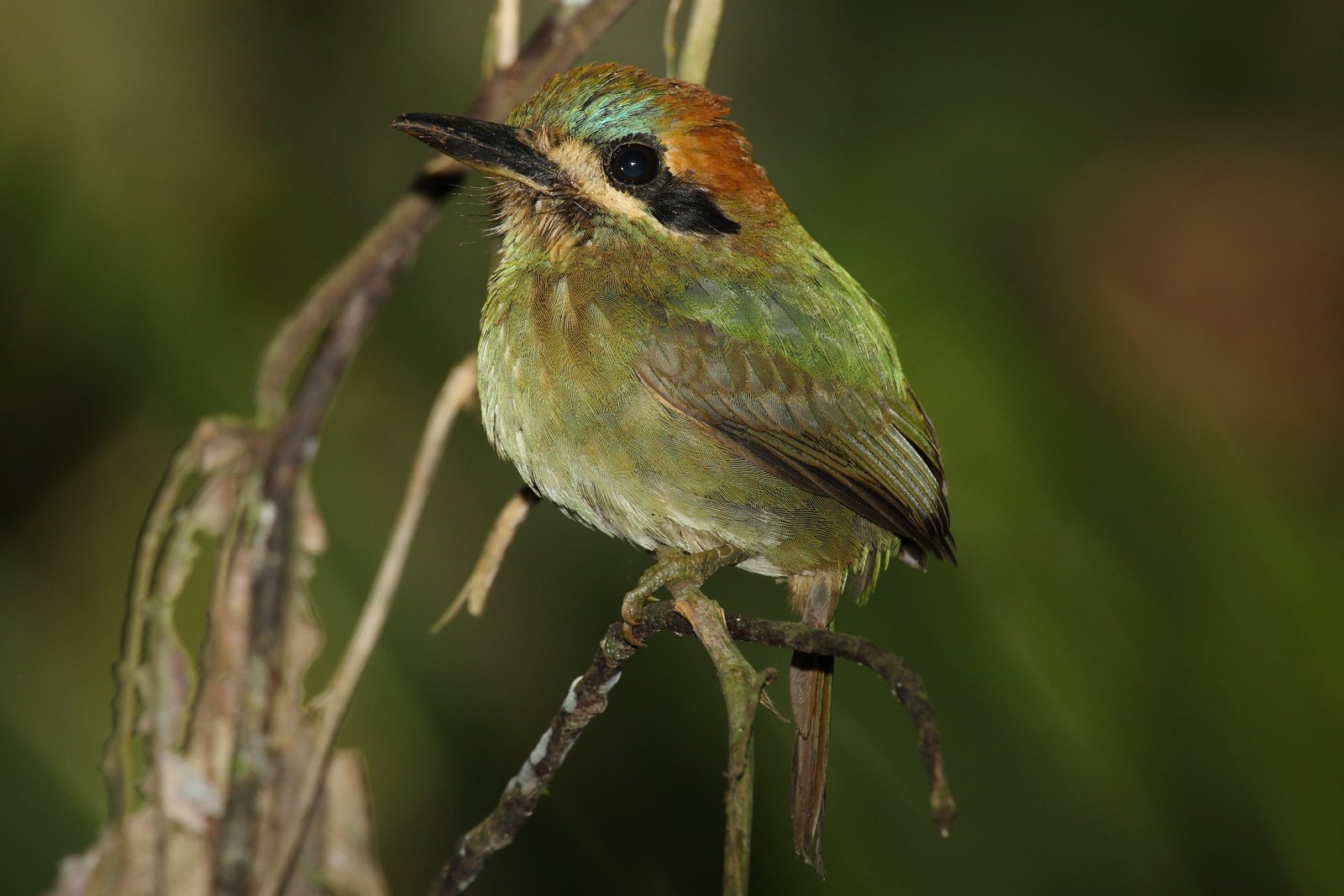
The Tody Motmot is the smallest motmot and, with its broad, flat bill and short tail, looks more like a large tody than a motmot. It lives in the lower layers of humid forest from south-eastern Mexico to Panama and is often overlooked because of its quiet behaviour.
Voice
A rapid series of hollow, somewhat nasal kwa-kwa-kwa-kwa notes, often ten or more in a row and mostly heard around dawn. Also a single, soft hoo.
Recording: Manuel Grosselet - Josue de Leon — CC BY-NC-SA 4.0 · converted to mono · xeno-canto
Identification
16–18 cm. The upperparts are green, the crown and nape rufous. A short, bright turquoise stripe runs above and behind the eye, over a black mask. Below the mask is a narrow white cheek stripe; the throat is whitish, the breast olive-brown and the belly dull white. The tail is short and green, without bare shafts or rackets. The bill is broad and flat. The sexes are alike.
Confusion species
Other motmots in the guide area are much larger and have a long tail, most of them with rackets. Keel-billed Motmot Electron carinatum and Broad-billed Motmot Electron platyrhynchum also have a broad bill but are nearly twice as long and have a black breast spot. Todies are absent from the guide area; the Tody Motmot may also recall a jacamar or a puffbird, but these have a differently shaped bill.
Habitat
Humid and semi-humid forest in lowlands and foothills up to about 1500 m, especially on slopes, in ravines and along streams; also in tall secondary forest and the seasonal forest of Yucatán. It sits still for long periods on a low, open branch in the understorey and catches large insects and spiders in a short sally. It nests in a self-dug tunnel in a bank or ditch wall.
Where the bird is most at home, classified by the vegetation units of Mexico and Central America.




Range and movements
In Mexico in southern Veracruz, northern Oaxaca, Tabasco, Chiapas and the southern Yucatán Peninsula (Campeche, Quintana Roo), further in Belize, Guatemala, Honduras, El Salvador (rare), Nicaragua, Costa Rica and Panama, where it occurs locally east to Darién. Outside the guide area in north-western Colombia.
- Resident
- dark = core range, pale = thinly spread
How and when to look
Often found only by the series of kwa notes at dawn. A perched bird stays motionless for a long time and at most flicks its tail briefly sideways. Regularly seen in Belize, at Tikal in Guatemala and in the foothills of northern Costa Rica.
Conservation status
Least Concern. It occurs over a large area but disappears where forest is cleared completely; rare in El Salvador and parts of Nicaragua.
Scientific name
Hylomanes momotula | Lichtenstein, 1839
Lichtenstein described the species in 1839 and placed it straight away in the genus where it still stands. He introduced the genus Hylomanes in that same work. Hylomanes is Greek, from hulē 'woodland' and -manēs 'passionately fond of': 'lover of the woods'. momotula is a diminutive of the genus Momotus: 'little motmot', after its small size. The specimen the first description was based on came from Valle Real, Mexico.