All species › Passerines › Ovenbirds and woodcreepers › Tawny-throated Leaftosser
Position in the tree Birds Aves › Birds with a flexible palate Neognathae › All other modern birds Neoaves › Landbirds Telluraves › Falcons, parrots and passerines Australaves › Falcons and passerines Eufalconimorphae › Parrots and passerines Psittacopasserae
Tawny-throated Leaftosser | Sclerurus mexicanus
Bruinkeelbladkrabber | Tirahojas golianteado
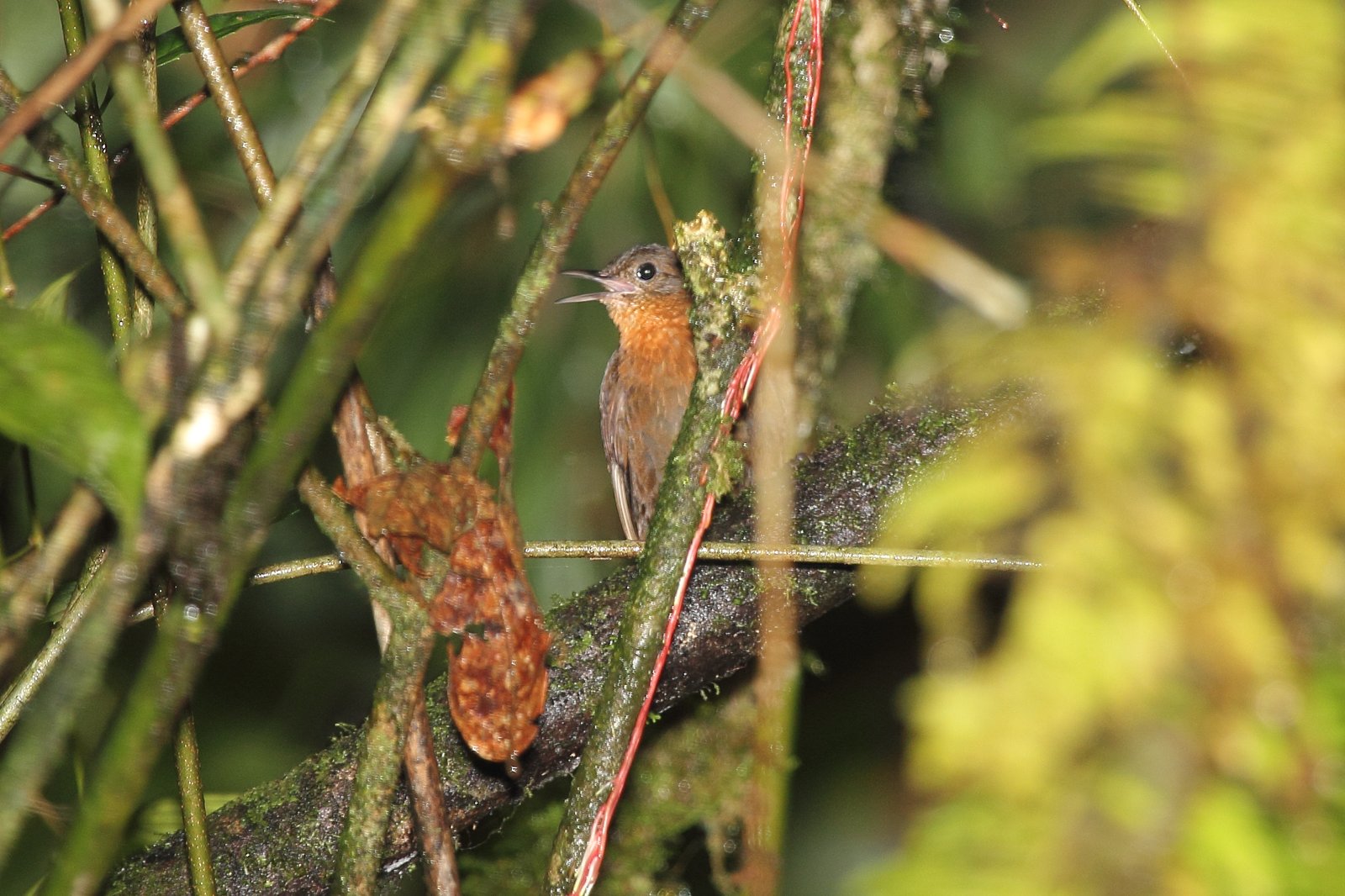
The Tawny-throated Leaftosser is a small, dark brown ground bird of humid forest in the hills and mountains, with a rufous throat and breast. It walks over the forest floor and flicks dead leaves aside with its bill to search for food underneath. It is shy and usually noticed only when it flies off low with a sharp call.
Voice
The song is a series of a few high, plaintive whistles that fall in pitch. The call, often given when flushed, is a sharp, shrill tseek.
Recording: Johan Chaves — CC BY-NC-SA 4.0 · converted to mono · xeno-canto
Identification
15–16 cm. Upperparts dark chocolate brown, rump rufous; tail short and blackish. Throat and breast warm rufous to tawny, merging into the dark brown belly. Bill long, thin and slightly decurved, blackish. Legs dark. Male and female are alike.
Confusion species
Scaly-throated Leaftosser Sclerurus guatemalensis lives mainly lower, in lowland forest, and has a whitish throat with dark scaling, a shorter, straighter bill and no rufous rump. Grey-throated Leaftosser Sclerurus albigularis (Costa Rica and western Panama) has a grey throat sharply contrasting with a rufous breast band.
Habitat
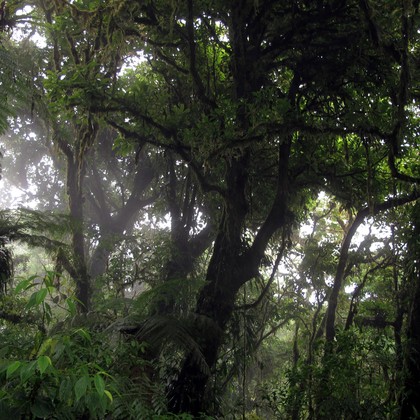
Floor of humid evergreen forest and cloud forest in the foothills and lower mountains, locally lower; mainly in dark, undisturbed forest with a thick layer of leaf litter. It searches for insects and other invertebrates among and under dead leaves. It digs a nest tunnel in an earth bank.
Where the bird is most at home, classified by the vegetation units of Mexico and Central America.


Range and movements
Locally from southern Mexico (including Veracruz, Oaxaca and Chiapas) through Guatemala, Honduras, Nicaragua and Costa Rica to Panama. Related populations in South America are now often treated as one or more separate species.
- Resident
- dark = core range, pale = thinly spread
How and when to look
Best found by listening carefully in humid montane forest for the falling song and the rustle of tossed leaves. Flushed birds often land on a low branch or vine shortly afterwards.
Conservation status
Not threatened. Scarce and inconspicuous; sensitive to loss and fragmentation of forest.
Scientific name
Sclerurus mexicanus | Sclater, 1857
Sclater described the species in 1857 and placed it straight away in the genus where it still stands. The genus Sclerurus was introduced in 1827 by Swainson. Sclerurus is Greek, from sklēros 'stiff, hard' and oura 'tail', after the stiff tail feathers. mexicanus means 'from Mexico', after the type locality near Córdoba, Veracruz. The specimen the first description was based on came from Córdoba, Veracruz, Mexico.