All species › Nightjars › Nightjars and nighthawks › Tawny-collared Nightjar
Position in the tree Birds Aves › Birds with a flexible palate Neognathae › All other modern birds Neoaves › Birds of the elements Elementaves › Nightjars and swifts Strisores
Tawny-collared Nightjar | Antrostomus salvini
Salvins nachtzwaluw | Tapacaminos ticurú
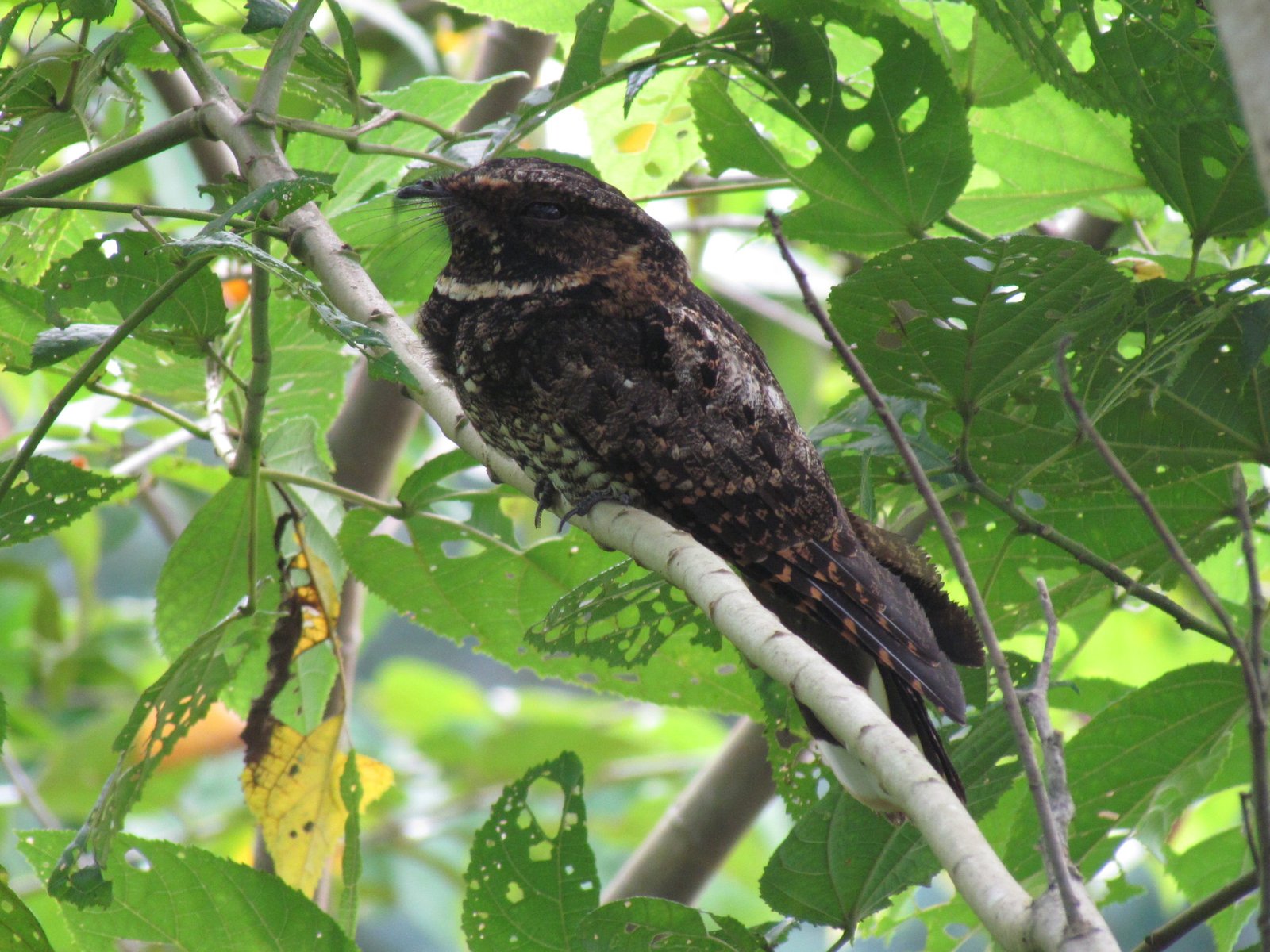
The Tawny-collared Nightjar is a medium-sized, dark nightjar with a rufous hindneck collar, known only from eastern Mexico. It lives in forest, forest edges and scrub on the Gulf slope, from Nuevo León and Tamaulipas southwards. Like most nightjars it is found mainly by its song; little is known about its habits.
Voice
The song is described as a rich, falling chuck-weeeoo with a short, soft introductory note, repeated at intervals, mainly at dusk. It resembles the song of the Yucatan Nightjar but is simpler. The calls are poorly known.
Recording: Leonardo Guzman Hernandez — CC BY-NC-SA 4.0 · converted to mono · xeno-canto
Identification
22–25 cm. A medium-sized nightjar with a large head, rounded wings and a fairly long, rounded tail. The plumage is dark grey-brown to blackish brown, finely marbled and spotted, with black streaks on the crown. A rufous to buff collar crosses the hindneck. The throat is dark with a white or pale band below. The male has broad white tips to the three outer tail feathers; in the female these tips are narrower and buff. The wings lack a white bar.
Confusion species
The Yucatan Nightjar Antrostomus badius, long treated as the same species, is very similar but slightly warmer brown and has a different song; the two ranges meet without clear overlap. Chuck-will's-widow Antrostomus carolinensis occurs in the same area in winter but is larger and warmer rufous-brown, without a distinct collar. The Mexican Whip-poor-will Antrostomus arizonae is greyer, without a rufous collar, and lives mainly higher in the mountains. The Pauraque Nyctidromus albicollis is larger and longer-tailed, with a white wing band in the male.
Habitat
Evergreen and semi-evergreen forest in the lowlands and foothills, forest edges, secondary forest, thorn scrub and pasture with copses, up to about 1500 m. By day it rests on the ground. At night it hunts flying insects from a branch or the ground. Little is known about breeding; as in related species, the eggs are laid on the ground.
Where the bird is most at home, classified by the vegetation units of Mexico and Central America.




Range and movements
Endemic to eastern Mexico. On the Gulf slope from Nuevo León and Tamaulipas through San Luis Potosí, Querétaro and Veracruz to northern Oaxaca, and locally in northern Chiapas, including the Lacandon forest around Nahá. Isolated records elsewhere in Mexico and in Guatemala are unconfirmed. The species does not occur outside the guide area.
- Resident
- Summer visitor (c. Apr–Sep)
- dark = core range, pale = thinly spread
How and when to look
In the breeding season, from March to June, the song can be heard at dusk in the foothills of the Sierra Madre Oriental in Tamaulipas, for example around Gómez Farías and El Cielo, and in the Nahá protected area in Chiapas. Along dirt roads the eye shines red in torchlight.
Conservation status
Not threatened. The range is fairly small and the species is poorly known, but it also occurs in secondary forest and forest edges. Clearance of lowland forest on the Gulf slope for farming and cattle is the main pressure.
Scientific name
Antrostomus salvini | (Hartert, 1892)
Hartert described the species in 1892 as Caprimulgus salvini; because it was later moved to another genus, the author and year stand in brackets. The genus Antrostomus was introduced in 1838 by Bonaparte. Antrostomus is Greek, from antron 'cave' and stoma 'mouth': 'cave-mouth', after the enormous gape. salvini honours the British naturalist Osbert Salvin (1835–1898), co-author of the Biologia Centrali-Americana. The specimen the first description was based on came from Mirador, Veracruz, Mexico (accepted).