All species › Passerines › Tyrant flycatchers and allies › Tawny-chested Flycatcher
Position in the tree Birds Aves › Birds with a flexible palate Neognathae › All other modern birds Neoaves › Landbirds Telluraves › Falcons, parrots and passerines Australaves › Falcons and passerines Eufalconimorphae › Parrots and passerines Psittacopasserae
Tawny-chested Flycatcher | Aphanotriccus capitalis
Salvins tiran | Mosquero pechileonado
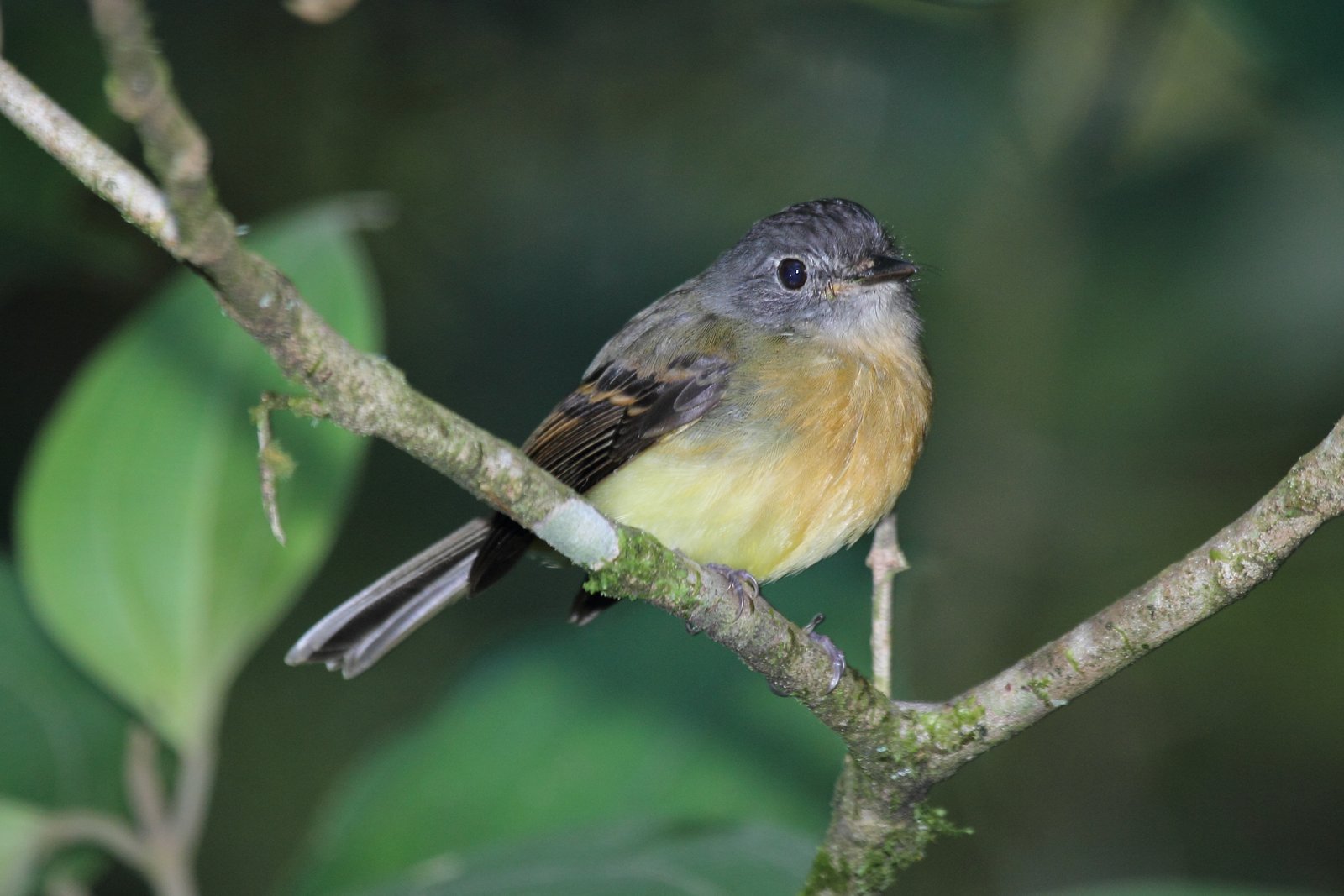
The Tawny-chested Flycatcher is a small, inconspicuous tyrant flycatcher of the understorey of humid lowland forest on the Caribbean slope of Nicaragua and Costa Rica. It has a grey head, an olive-green back and a warm ochre breast. The species occurs only in the guide area and is scarce.
Voice
Short, sharp calls and a rapid, dry series of notes; the song is poorly known.
Recording: Beth Cottam — CC0 · converted to mono · xeno-canto
Identification
12–13 cm. Head grey with white lores and a narrow white eye-ring. Back olive-green. Wings dark with two ochre wing-bars. Throat whitish, breast warm ochre to tawny, belly pale yellow. Upper mandible black, lower mandible pale. Male and female are alike.
Confusion species
Ruddy-tailed Flycatcher Terenotriccus erythrurus is smaller, with a rufous tail and rump and no wing-bars. Acadian Flycatcher Empidonax virescens and other Empidonax flycatchers lack the ochre breast and grey head. Sulphur-rumped Myiobius Myiobius sulphureipygius has a conspicuous yellow rump.
Habitat
Understorey and edges of humid lowland forest and the lower foothills, often in dense vine tangles and thickets at forest edges, along streams and in mature secondary forest. It hunts insects from a low branch, picking them from leaves or catching them in the air.
Where the bird is most at home, classified by the vegetation units of Mexico and Central America.




Range and movements
Only in the guide area: the Caribbean slope of south-eastern Nicaragua and northern and central Costa Rica.
- Resident
- dark = core range, pale = thinly spread
How and when to look
Seldom seen; the best chance is in dense thickets at forest edges and along streams in the Caribbean lowlands of northern Costa Rica. It often sits still for long periods and is better located by sound.
Conservation status
Vulnerable. Its small range lies in a region where much lowland forest has been converted to pasture and plantations.
Scientific name
Aphanotriccus capitalis | (Salvin, 1865)
Salvin described the species in 1865 as Myiobius capitalis; because it was later moved to another genus, the author and year stand in brackets. The genus Aphanotriccus was introduced in 1905 by Ridgway. Aphanotriccus is Greek, from aphanēs 'unseen, obscure' and trikkos, an unidentified small bird, used for tyrant flycatchers. capitalis is Latin for 'of the head', from caput 'head', probably after the grey head contrasting with the body. The specimen the first description was based on came from Tucurrique, Costa Rica.