All species › Passerines › Ovenbirds and woodcreepers › Strong-billed Woodcreeper
Position in the tree Birds Aves › Birds with a flexible palate Neognathae › All other modern birds Neoaves › Landbirds Telluraves › Falcons, parrots and passerines Australaves › Falcons and passerines Eufalconimorphae › Parrots and passerines Psittacopasserae
Strong-billed Woodcreeper | Xiphocolaptes promeropirhynchus
Reuzenmuisspecht | Trepatroncos gigante
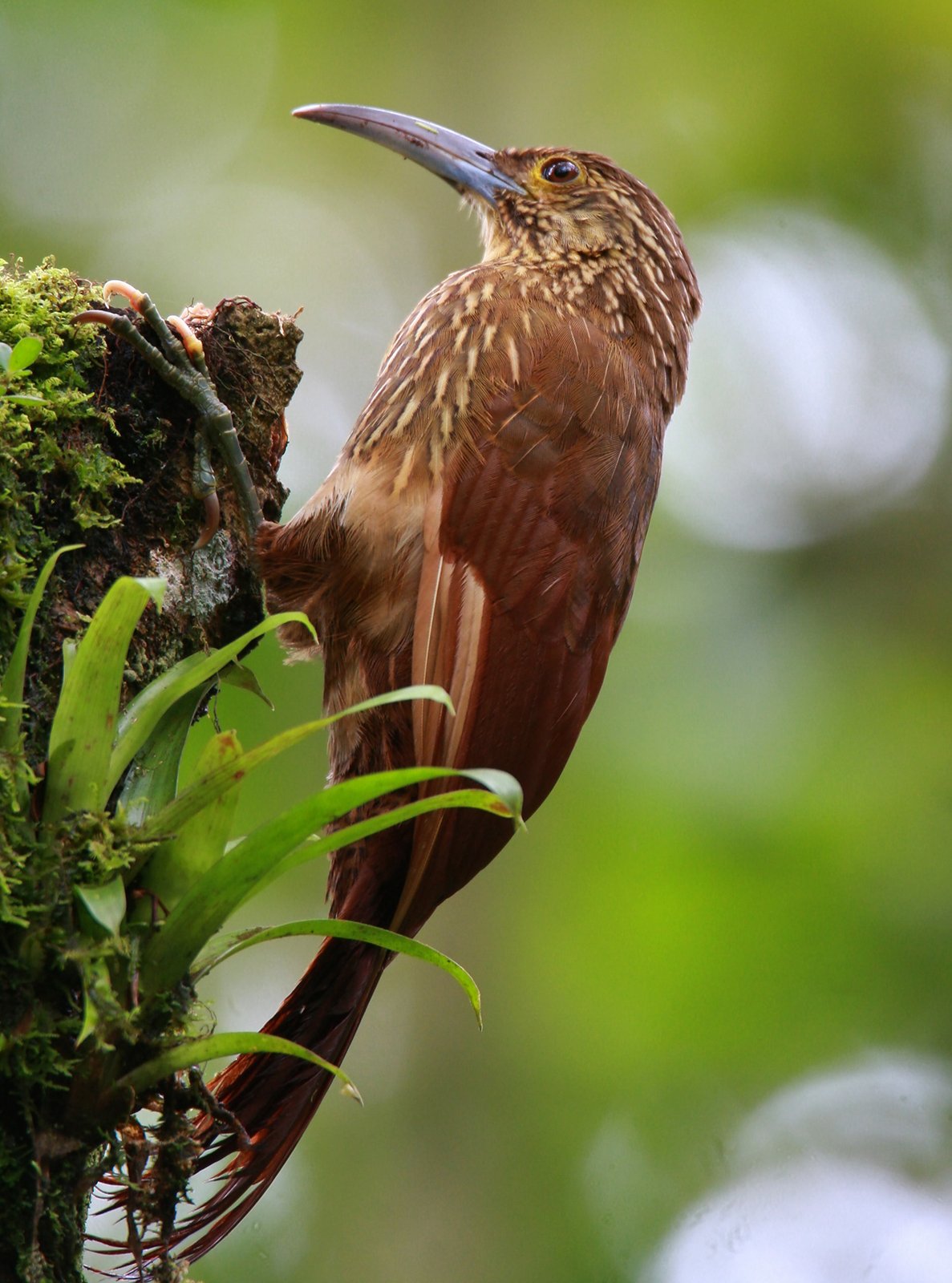
The Strong-billed Woodcreeper is the largest woodcreeper in the guide area, with a long, heavy, slightly curved bill. It lives mainly in montane forest, but in northern Central America it also occurs in the lowlands. Despite its size it often goes unnoticed, as it forages quietly high on trunks and thick branches.
Voice
A series of loud, descending, often two-part whistles, mainly at dawn and dusk. Also nasal calls.
Recording: Juan Freile — CC BY-NC-SA 4.0 · shortened to the first 60 s, mono · xeno-canto
Identification
28–31 cm. Large and heavy, with a long, powerful, slightly curved bill that ranges from dark horn to paler greyish. Throat pale buff with a dark malar stripe. Head and breast brown with narrow pale streaks; belly brown, sometimes with faint dark bars. Back olive-brown, wings and tail rufous. Male and female are alike.
Confusion species
Northern Barred Woodcreeper Dendrocolaptes sanctithomae and Black-banded Woodcreeper Dendrocolaptes picumnus are slightly smaller and have a straight bill and clear black barring (especially on the belly). Ivory-billed Woodcreeper Xiphorhynchus flavigaster and Spotted Woodcreeper Xiphorhynchus erythropygius are clearly smaller, with a slimmer bill.
Habitat
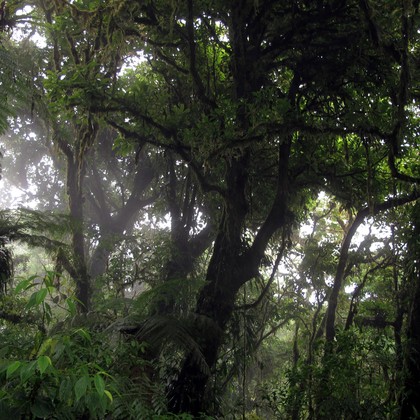
Humid montane forest, cloud forest and pine-oak forest, and in northern Central America also lowland and foothill forest. It searches trunks and thick branches, including epiphytes and loose bark, for large insects, spiders and small vertebrates; it sometimes follows army-ant swarms. It nests in a tree cavity.
Where the bird is most at home, classified by the vegetation units of Mexico and Central America.




Range and movements
From southern Mexico through Belize, Guatemala, El Salvador, Honduras and Nicaragua to Costa Rica and Panama; in Costa Rica and Panama scarce and mainly in the mountains. Outside the guide area in the Andes and the Amazon basin to Bolivia.
- Resident
- dark = core range, pale = thinly spread
How and when to look
Usually detected by its loud whistled song in the early morning. Then scan thick trunks in the middle levels.
Conservation status
Not threatened. Generally scarce and local; as a large forest bird sensitive to deforestation.
Scientific name
Xiphocolaptes promeropirhynchus | (Lesson, 1840)
Lesson described the species in 1840 as Dendrocolaptes promeropirhynchus; because it was later moved to another genus, the author and year stand in brackets. The genus Xiphocolaptes was introduced in 1840 by Lesson. Xiphocolaptes is Greek, from xiphos 'sword' and kolaptēs 'chiseller, pecker', after the long, powerful bill. promeropirhynchus combines Promerops (sugarbirds, then also used for other long-billed birds) with Greek rhunkhos 'bill': 'with a Promerops-like bill'. The specimen the first description was based on came from Bogotá, Colombia (designated).