All species › Passerines › Wrens › Spot-breasted Wren
Position in the tree Birds Aves › Birds with a flexible palate Neognathae › All other modern birds Neoaves › Landbirds Telluraves › Falcons, parrots and passerines Australaves › Falcons and passerines Eufalconimorphae › Parrots and passerines Psittacopasserae
Spot-breasted Wren | Pheugopedius maculipectus
Vlekborstwinterkoning | Chivirín moteado
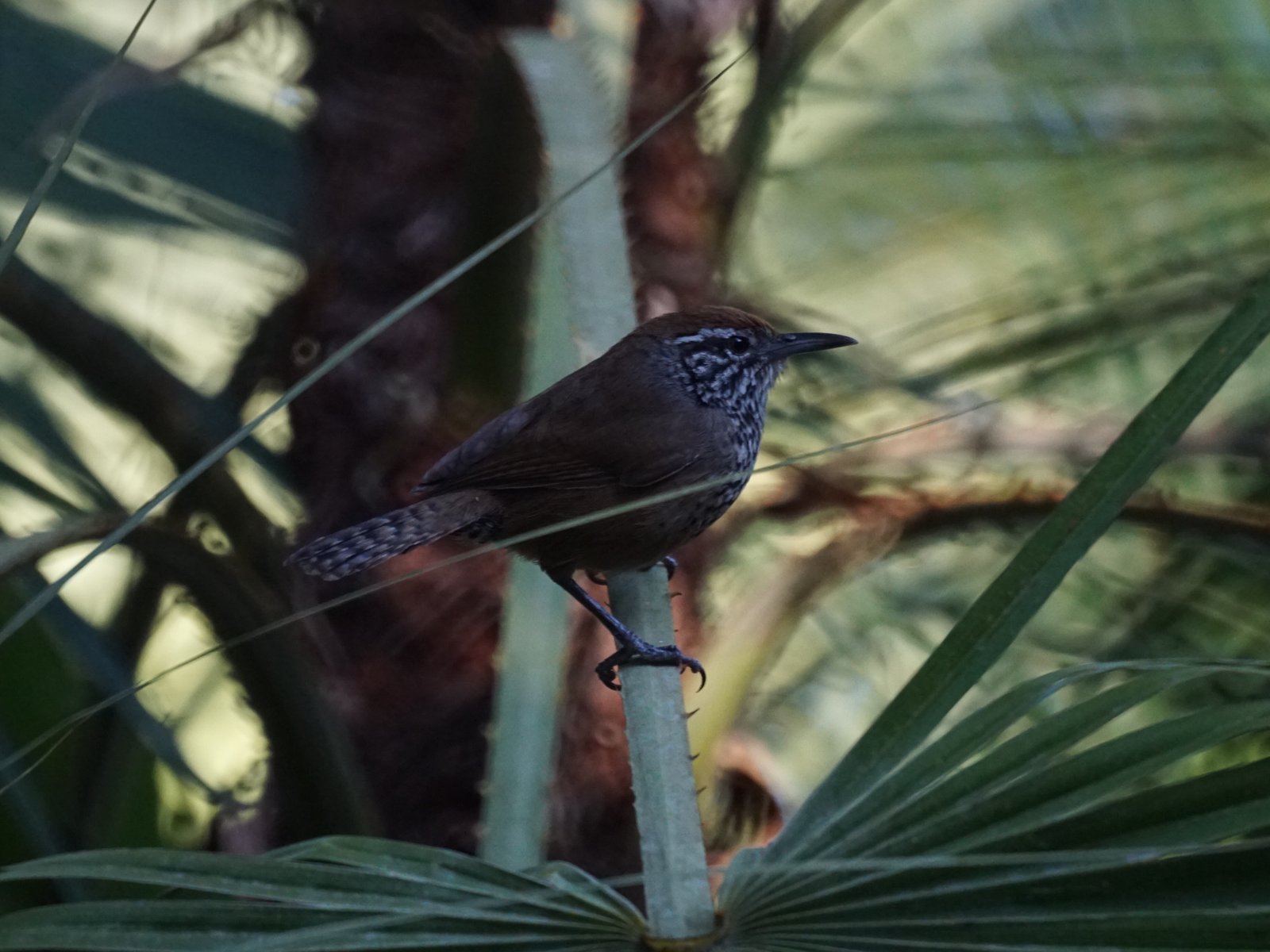
The Spot-breasted Wren is a medium-sized wren with a white breast covered in round black spots and a black-and-white striped face. It lives in dense undergrowth and scrub and is mostly detected by its loud whistled song. In the guide area it occurs from eastern Mexico to northern Costa Rica.
Voice
A loud song of short, clear whistled phrases, often given as a duet by male and female. The call is a dry, grating rattle.
Recording: Manuel Grosselet — CC BY-NC-SA 4.0 · converted to mono · xeno-canto
Identification
13–14 cm. Crown and back brown, tail brown with black bars. White supercilium; cheeks and sides of the neck streaked black and white. Throat and breast white with dense, round black spots; flanks and lower belly warm orange-brown. Bill fairly long and dark. Sexes alike; young birds are less sharply spotted.
Confusion species
Rufous-breasted Wren Pheugopedius rutilus (Costa Rica and Panama) has an unspotted orange-rufous breast. Banded Wren Thryophilus pleurostictus has an unspotted white breast with black bars on the flanks and lives in drier country. Carolina Wren Thryothorus ludovicianus (north-eastern Mexico) has plain buff underparts without spots.
Habitat
Dense undergrowth and scrub at the edges of humid and semi-humid forest, secondary forest, thickets, riverside vegetation and plantations; mainly in the lowlands and foothills. It forages low to mid-level for insects and spiders.
Where the bird is most at home, classified by the vegetation units of Mexico and Central America.





Range and movements
Eastern and south-eastern Mexico, including the Yucatán Peninsula, through Belize, Guatemala, Honduras and Nicaragua to northern Costa Rica, mainly on the Caribbean slope. Endemic to the guide area.
- Resident
- dark = core range, pale = thinly spread
How and when to look
Common in the lowlands of Yucatán, Belize and northern Guatemala, for example at Tikal. The loud song from dense scrub along forest edges and trails usually gives the bird away first.
Conservation status
Not threatened. Common and tolerant of human-modified landscapes, as long as dense scrub remains.
Scientific name
Pheugopedius maculipectus | (de Lafresnaye, 1845)
De Lafresnaye described the species in 1845 as Thriothorus maculipectus; because it was later moved to another genus, the author and year stand in brackets. The genus Pheugopedius was introduced in 1851 by Cabanis. Pheugopedius is Greek, from pheugō 'to shun, flee' and pedion 'plain, open country': a bird that shuns the open ground. maculipectus is Latin, from macula 'spot' and pectus 'breast', after the black-spotted breast. The specimen the first description was based on came from Veracruz, Mexico.