All species › Passerines › Tanagers and allies › Spangle-cheeked Tanager
Position in the tree Birds Aves › Birds with a flexible palate Neognathae › All other modern birds Neoaves › Landbirds Telluraves › Falcons, parrots and passerines Australaves › Falcons and passerines Eufalconimorphae › Parrots and passerines Psittacopasserae
Spangle-cheeked Tanager | Tangara dowii
Glansvlektangare | Tangara caripinta
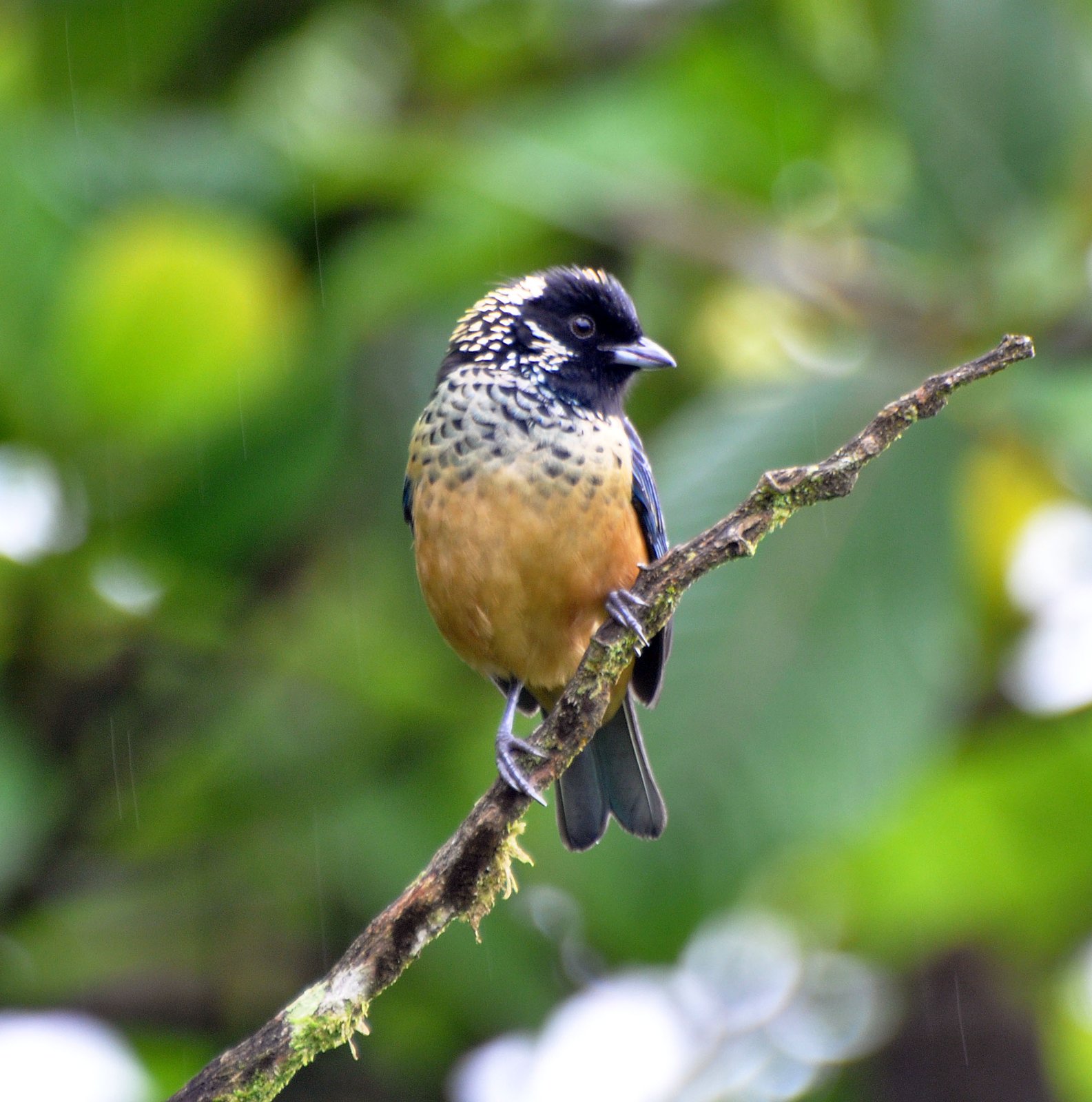
The Spangle-cheeked Tanager is a small, largely black tanager of the montane forest of Costa Rica and western Panama, with a pattern of glossy blue-green spangles on the cheeks and breast. It moves through the canopy and along forest edges in small groups with mixed flocks. The species does not occur outside the guide area.
Voice
The calls are thin, high tsit and tsip notes, especially in groups. A true song is rarely heard.
Recording: Odirlei Vieira da Fonseca — CC BY-NC-SA 4.0 · shortened to the first 60 s, mono · xeno-canto
Identification
12–13 cm. Head, back and breast largely black. Cheeks, throat and breast covered with small, glossy blue-green to silvery scale-like spots; the crown is also lightly spotted. Belly and undertail coverts cinnamon to ochre-brown. Wings and tail black with blue to blue-green edges; shoulder and rump with blue. Bill short and black. Male and female are alike; young birds are duller and greyer.
Confusion species
Green-naped Tanager Tangara fucosa is very similar but lives only in the mountains of eastern Panama, far from the range of Spangle-cheeked Tanager; it has a green band across the nape and a paler, more buff belly. Speckled Tanager Ixothraupis guttata is green with black spots rather than black with pale spots. Other tanagers of montane forest lack the combination of a black, spangled breast and a cinnamon belly.
Habitat
Canopy and edges of humid montane forest and cloud forest, also mature secondary forest and open country with tall trees, roughly between 1200 and 3000 m, mainly between 1500 and 2500 m. It forages in pairs or small groups, often with mixed flocks. It eats fruit and insects, which it picks from mossy branches and leaves.
Where the bird is most at home, classified by the vegetation units of Mexico and Central America.


Range and movements
Endemic to the guide area: the mountains of Costa Rica, from the Cordillera de Tilarán and Cordillera Central to the Cordillera de Talamanca, and western Panama (Chiriquí, Bocas del Toro and northern Veraguas).
- Resident
- dark = core range, pale = thinly spread
How and when to look
Regularly seen in the Savegre valley at San Gerardo de Dota, at Monteverde and in Tapantí in Costa Rica, and around Boquete and Volcán Barú in Panama, usually in mixed flocks in fruiting trees.
Conservation status
Not threatened (LC). Fairly common in the montane forest of its limited range; large parts lie within protected areas.
Scientific name
Tangara dowii | (Salvin, 1863)
Salvin described the species in 1863 as Calliste dowii; because it was later moved to another genus, the author and year stand in brackets. The genus Tangara was introduced in 1760 by Brisson. Tangara is a Tupi name from Brazil, often explained as 'dancer', for a brightly coloured bird. dowii honours the American sea captain, explorer and collector John Melmoth Dow (1827–1892). The specimen the first description was based on came from Rancho Redondo, San José, Costa Rica.