All species › Swifts › Hummingbirds › Scintillant Hummingbird
Position in the tree Birds Aves › Birds with a flexible palate Neognathae › All other modern birds Neoaves › Birds of the elements Elementaves › Nightjars and swifts Strisores
Scintillant Hummingbird | Selasphorus scintilla
Fonkelende kolibrie | Colibrí centelleante
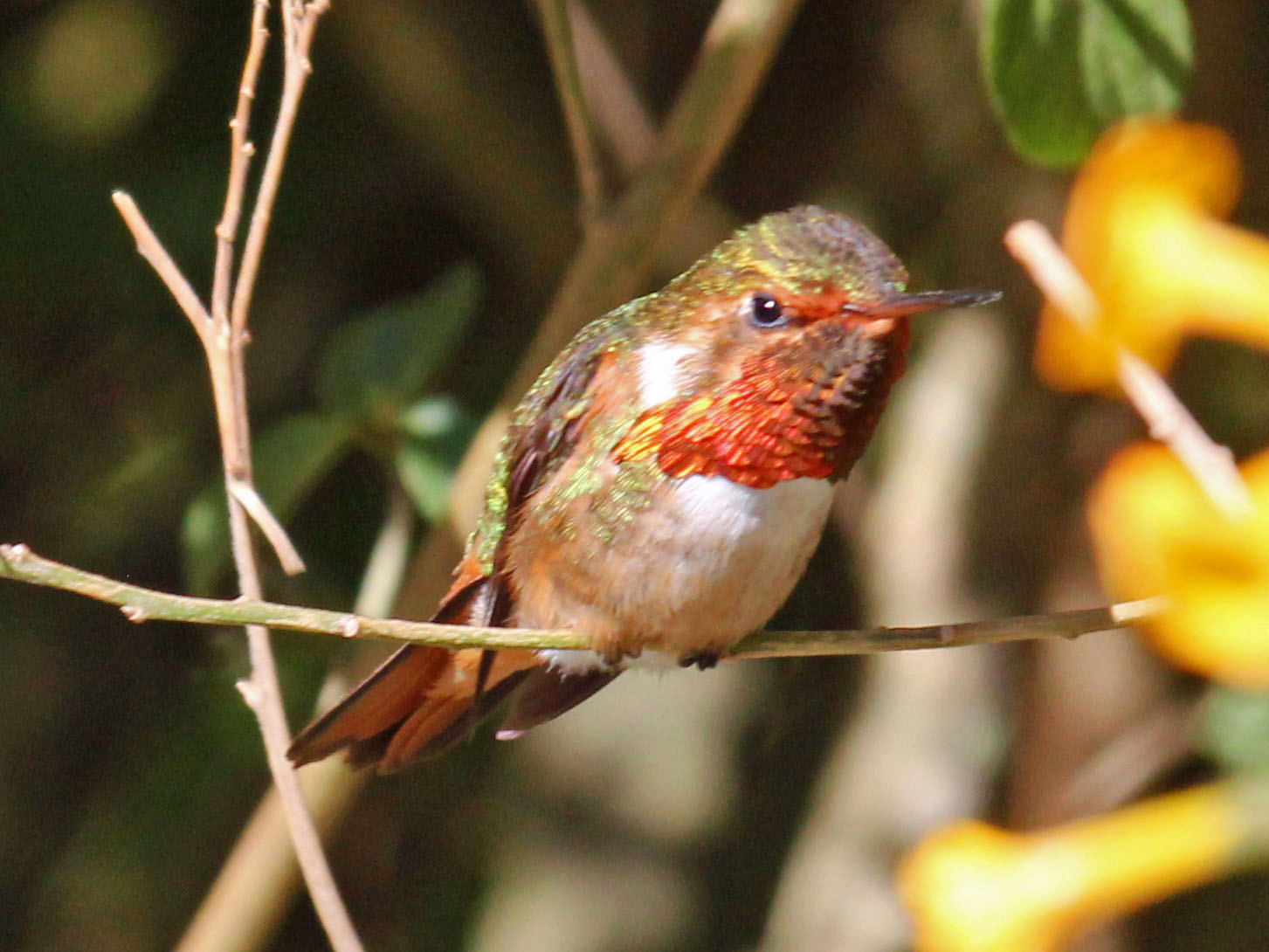
The Scintillant Hummingbird, at just over 2 grams, is one of the smallest birds of Central America. It lives in the mountains of Costa Rica and western Panama, on average lower than the Volcano Hummingbird. The male has an orange-red throat and a rufous tail striped with black.
Voice
A high, soft tsip, and in chases a thin, rattling twitter. The wings of the male produce a high buzzing sound.
Recording: Mike Nelson — CC BY-NC-SA 3.0 · converted to mono · xeno-canto
Identification
6–7 cm, with a short, straight black bill. The upperparts are bronze-green. The male has a glittering orange-red to coppery-red throat, a white band across the upper breast and otherwise rufous underparts; the tail is rufous with black stripes along the feathers. The female has a pale, finely spotted throat, rufous underparts and a rufous tail with a black band and pale tips.
Confusion species
Volcano Hummingbird Selasphorus flammula is larger and usually lives higher; the male has a rose-red to greyish-purple throat and a dark tail, the female whiter underparts with rufous only on the flanks. Glow-throated Hummingbird Selasphorus ardens in the mountains of Veraguas and eastern Chiriquí is almost identical, but the male has a rose-red to magenta throat; females are hardly separable in the field.
Habitat
Forest edges, clearings, scrub, pastures with flowering shrubs, coffee plantations and gardens in the mountains, at about 900 to 2100 m, locally higher. It feeds low down at small flowers of herbs and shrubs, and catches small insects.
Where the bird is most at home, classified by the vegetation units of Mexico and Central America.





Range and movements
Endemic to the guide area. In the mountains of central and southern Costa Rica, mainly on the Pacific side of the Cordillera Central and the Cordillera de Talamanca, and in western Panama in the highlands of Chiriquí.
- Resident
- dark = core range, pale = thinly spread
How and when to look
Around San Vito and in the valleys of the Cordillera de Talamanca in Costa Rica, and around Boquete and Volcán in Chiriquí. Often at low flowering plants in gardens and along roadsides, where its size and buzzing flight often cause it to be mistaken for a large insect.
Conservation status
Not threatened. Locally common in semi-open mountain country, and it also occurs in gardens and scrub in farmland.
Scientific name
Selasphorus scintilla | (Gould, 1851)
Gould described the species in 1851 as Trochilus (Selosphorus) scintilla; because it was later moved to another genus, the author and year stand in brackets. The genus Selasphorus was introduced in 1832 by Swainson. Selasphorus is Greek, from selas 'light, flame' and -phoros 'bearing': 'light-bearer', after the fiery, glittering throat. scintilla is Latin for 'spark', after the male's glittering gorget. The specimen the first description was based on came from Barú Volcano (Chiriquí), Panama, c. 2700 m.