All species › Passerines › Tanagers and allies › Scarlet-browed Tanager
Position in the tree Birds Aves › Birds with a flexible palate Neognathae › All other modern birds Neoaves › Landbirds Telluraves › Falcons, parrots and passerines Australaves › Falcons and passerines Eufalconimorphae › Parrots and passerines Psittacopasserae
Scarlet-browed Tanager | Heterospingus xanthopygius
Wenkbrauwkuiftangare | Tangara cejirroja
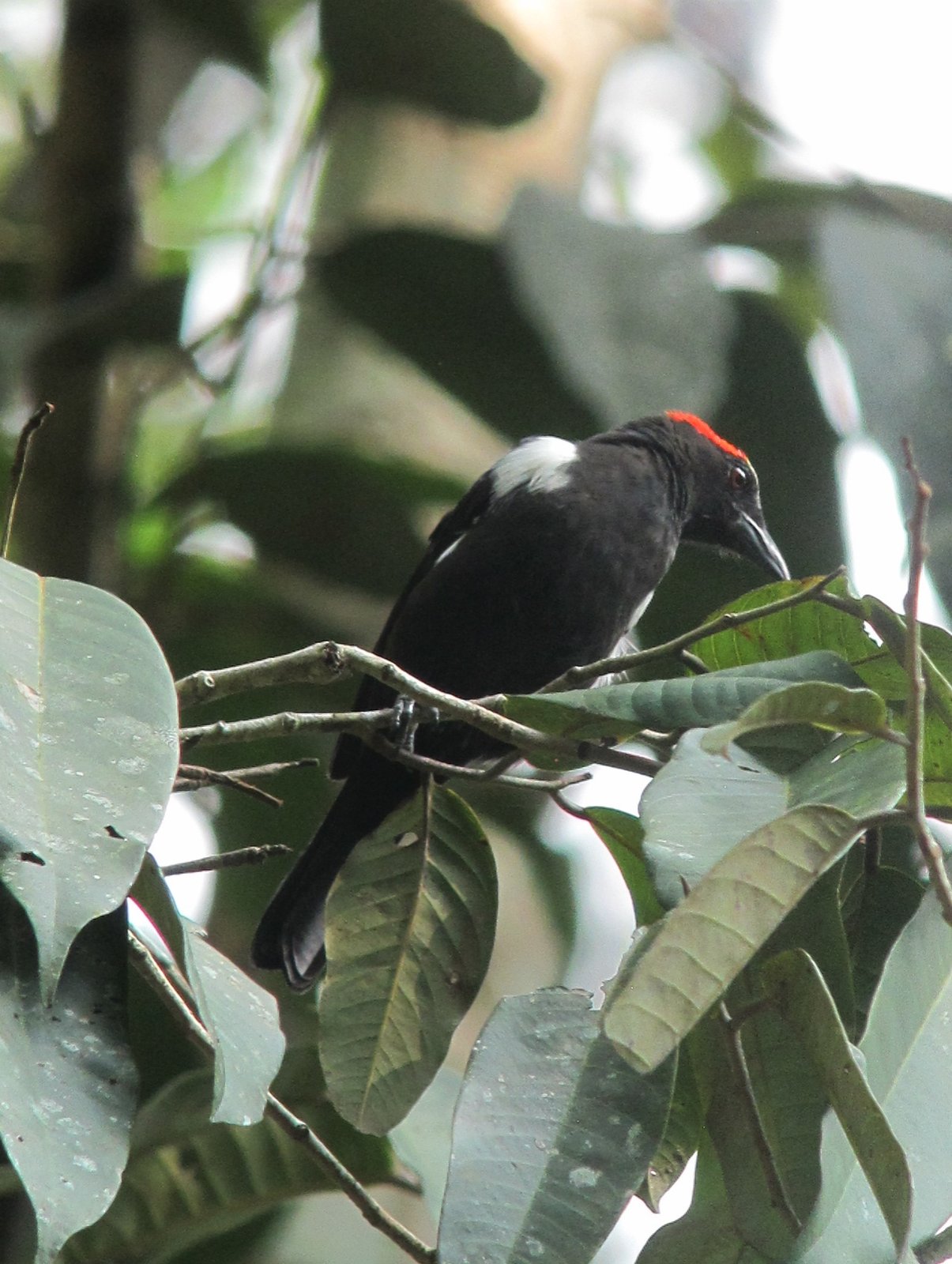
The Scarlet-browed Tanager is a sturdy tanager of the canopy of humid lowland forest. The black male bears a scarlet tuft above the eye. In the guide area it occurs only in eastern Panama; most of its range lies in western Colombia and Ecuador.
Voice
Calls with sharp, high chip notes. The song is a short series of high, thin notes, mainly at dawn.
Recording: Juan Freile — CC BY-NC-SA 4.0 · shortened to the first 60 s, mono · xeno-canto
Identification
15–17 cm. A sturdy tanager with a fairly thick, dark bill. Male glossy black with a narrow scarlet eyebrow tuft behind the eye, a yellow rump and white tufts on the sides of the breast. Female plain grey, slightly paler below, also with a yellow rump and white breast tufts, but without red.
Confusion species
The female closely resembles Sulphur-rumped Tanager Heterospingus rubrifrons, which occurs mainly further west in Panama; in eastern Panama the two can scarcely be separated in the field. The male White-shouldered Tanager Loriotus luctuosus is smaller, black with a large white shoulder patch, and lacks the red eyebrow and yellow rump.
Habitat
Canopy and edges of humid evergreen lowland and foothill forest, including Chocó rainforest, mostly below 1000 m; also tall secondary forest. It travels with mixed flocks and eats insects and fruit.
Where the bird is most at home, classified by the vegetation units of Mexico and Central America.



Range and movements
In the guide area in eastern Panama, mainly in Darién and the east of Panamá and Guna Yala provinces. Beyond that on the Pacific slope of Colombia to north-western Ecuador and in northern Colombia.
- Resident
- dark = core range, pale = thinly spread
How and when to look
Look for it in the lowland forests of Darién; a group is often first noticed by its sharp calls, after which a male on a bare branch shows its red eyebrow.
Conservation status
Not threatened (LC). Locally fairly common in undisturbed forest in the guide area; dependent on large, continuous lowland forest.
Scientific name
Heterospingus xanthopygius | (Sclater, 1855)
Sclater described the species in 1855 as Tachyphonus xanthopygius; because it was later moved to another genus, the author and year stand in brackets. The genus Heterospingus was introduced in 1898 by Ridgway. Heterospingus is Greek, from heteros 'different' and spingos 'finch': a different finch, split by Ridgway from Tachyphonus. xanthopygius is Greek, from xanthos 'yellow' and pugē 'rump', after the bright yellow rump. The specimen the first description was based on came from 'New Granada' (Bogotá skins), Colombia.