All species › Passerines › Tanagers and allies › Rufous-winged Tanager
Position in the tree Birds Aves › Birds with a flexible palate Neognathae › All other modern birds Neoaves › Landbirds Telluraves › Falcons, parrots and passerines Australaves › Falcons and passerines Eufalconimorphae › Parrots and passerines Psittacopasserae
Rufous-winged Tanager | Tangara lavinia
Roodvleugeltangare | Tangara alirrufa
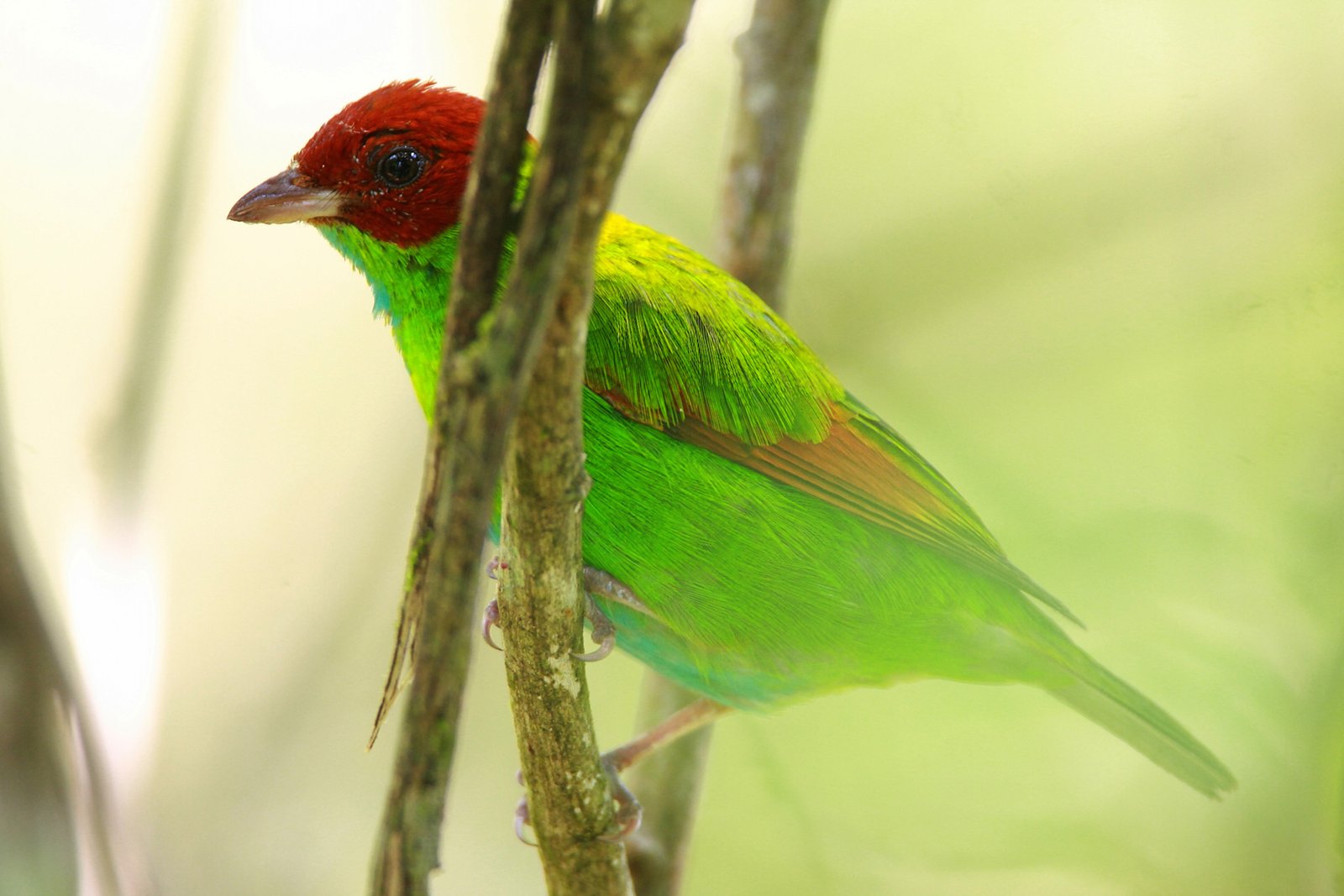
The Rufous-winged Tanager is a small, grass-green tanager with a rufous head and rufous wings that lives in the canopy of humid lowland forest. It usually moves through the treetops with mixed flocks of tanagers and is therefore often poorly visible from below. In the guide area it occurs on the Caribbean slope from Guatemala to Panama.
Voice
The calls are thin, high and sharp tseet notes. A true song is rarely heard.
Recording: Patricio Mena Valenzuela — CC BY-NC-SA 4.0 · converted to mono · xeno-canto
Identification
12–13 cm. Male: head rufous; a golden-yellow band across the nape and upper back; rest of the body grass-green, with some blue in the centre of the belly. Flight feathers and greater wing coverts largely rufous. Female duller: mostly green, with only some rufous on the forehead and cheeks and rufous edges to the wing feathers; the yellow nape band is absent or faint.
Confusion species
Bay-headed Tanager Tangara gyrola also has a rufous head and green body, but green rather than rufous wings and no yellow band across the upper back; it also usually lives higher, in foothill and montane forest. The female resembles female dacnises and honeycreepers, but these lack rufous on the head and wings.
Habitat
Canopy and edges of humid evergreen lowland and foothill forest, also tall secondary forest and clearings with tall fruiting trees, mostly below 1000 m. It forages in pairs or small groups, almost always with mixed flocks. It eats fruit and insects.
Where the bird is most at home, classified by the vegetation units of Mexico and Central America.



Range and movements
Caribbean slope of eastern Guatemala, northern Honduras, Nicaragua and Costa Rica; in Panama on both slopes to Darién. Outside the guide area in western Colombia and north-western Ecuador.
- Resident
- dark = core range, pale = thinly spread
How and when to look
Seen in the Caribbean lowlands of Costa Rica, for example in the Sarapiquí region and around Boca Tapada, and in Panama in the Canal area. Search the tops of fruiting trees where mixed flocks of tanagers gather.
Conservation status
Not threatened (LC). Rather scarce to locally common; declines where lowland forest is cleared.
Scientific name
Tangara lavinia | (Cassin, 1858)
Cassin described the species in 1858 as Calliste Lavinia; because it was later moved to another genus, the author and year stand in brackets. The genus Tangara was introduced in 1760 by Brisson. Tangara is a Tupi name from Brazil, often explained as 'dancer', for a brightly coloured bird. lavinia honours Lavinia Lydia Bowen (1820–1888), lithographer, natural-history artist and co-owner of the lithographic firm Bowen & Co. in Philadelphia. The specimen the first description was based on came from Isthmus of Darién, Panama.