All species › Swifts › Hummingbirds › Rufous-tailed Hummingbird
Position in the tree Birds Aves › Birds with a flexible palate Neognathae › All other modern birds Neoaves › Birds of the elements Elementaves › Nightjars and swifts Strisores
Rufous-tailed Hummingbird | Amazilia tzacatl
Roodstaartamazilia | Amazilia colirrufa
From southern Mexico to Panama the Rufous-tailed Hummingbird is one of the commonest hummingbirds of the humid lowlands and foothills. In gardens, plantations and along forest edges it is often the first hummingbird to be noticed. It noisily defends flower-rich spots against other hummingbirds.
Voice
A hard, dry chik or chit, often in series, and in chases a sharp, rattling twitter. The song is a high, squeaky series.
Recording: Christian Kerihuel — CC BY-NC-SA 4.0 · converted to mono · xeno-canto
Identification
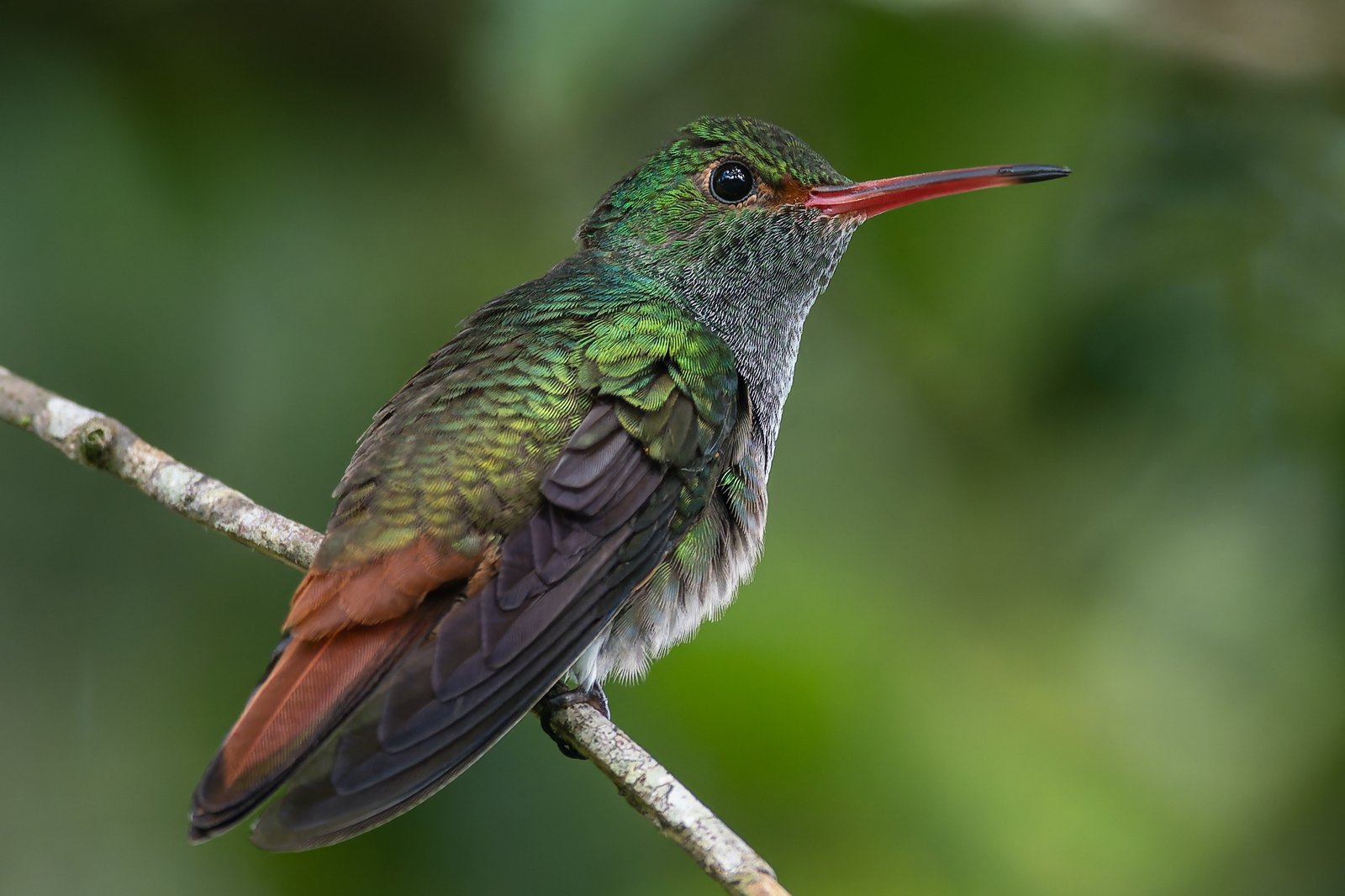
10–11 cm, with a straight red bill with a dark tip; in the female the upper mandible is darker. The upperparts are bronze-green, with rufous uppertail coverts and a rufous tail with narrow dark edges. Throat and breast are glittering green, the belly grey to greyish-brown. The female has slightly less gloss and pale fringes to the throat feathers.
Confusion species
Buff-bellied Hummingbird Amazilia yucatanensis has a buff rather than grey belly. Cinnamon Hummingbird Amazilia rutila has a cinnamon throat and breast. Snowy-bellied Hummingbird Saucerottia edward has a pure white belly and a bronze rather than rufous tail. Blue-chested Hummingbird Polyerata amabilis has a blue patch on the breast and a dark tail.
Habitat
Forest edges, secondary forest, clearings in rainforest, riparian woodland, coffee and cacao plantations, banana and citrus plantations, farmyards and gardens, from sea level to about 1800 m, locally higher. It feeds at flowers at all heights and also catches small insects.
Where the bird is most at home, classified by the vegetation units of Mexico and Central America.






Range and movements
In the guide area on the Caribbean slope from Veracruz in Mexico, through Tabasco, northern Chiapas and the southern Yucatán Peninsula, through Belize, Guatemala, Honduras and Nicaragua; in Costa Rica and Panama on both slopes. Outside the guide area in Colombia, western Venezuela and western Ecuador, to extreme north-west Peru.
- Resident
- dark = core range, pale = thinly spread
How and when to look
Everywhere in gardens and lodges with feeders and flowering shrubs in Costa Rica and Panama, such as around La Selva and in the Canal area; in Mexico around Palenque and Los Tuxtlas. Often on a regular perch near a flowering shrub.
Conservation status
Least Concern. Very common, and increasing where forest gives way to semi-open country.
Scientific name
Amazilia tzacatl | (de la Llave, 1833)
De la Llave described the species in 1833 as Trochilus Tzacatl; because it was later moved to another genus, the author and year stand in brackets. The genus Amazilia was introduced in 1843 by Lesson. Amazilia comes from Amazili, an Inca heroine in Jean-François Marmontel's novel Les Incas (1777). tzacatl is a Nahuatl word; one explanation is that it is the name of a warrior chief in Aztec tradition. De la Llave's exact intention is uncertain. The specimen the first description was based on came from Mexico (not specified).