All species › Birds of prey › Kites, Old World vultures, eagles and hawks › Roadside Hawk
Position in the tree Birds Aves › Birds with a flexible palate Neognathae › All other modern birds Neoaves › Landbirds Telluraves › Raptors, owls, kingfishers and woodpeckers Afroaves › Hawks and owls Hieraves
Roadside Hawk | Rupornis magnirostris
Wegbuizerd | Aguililla caminera
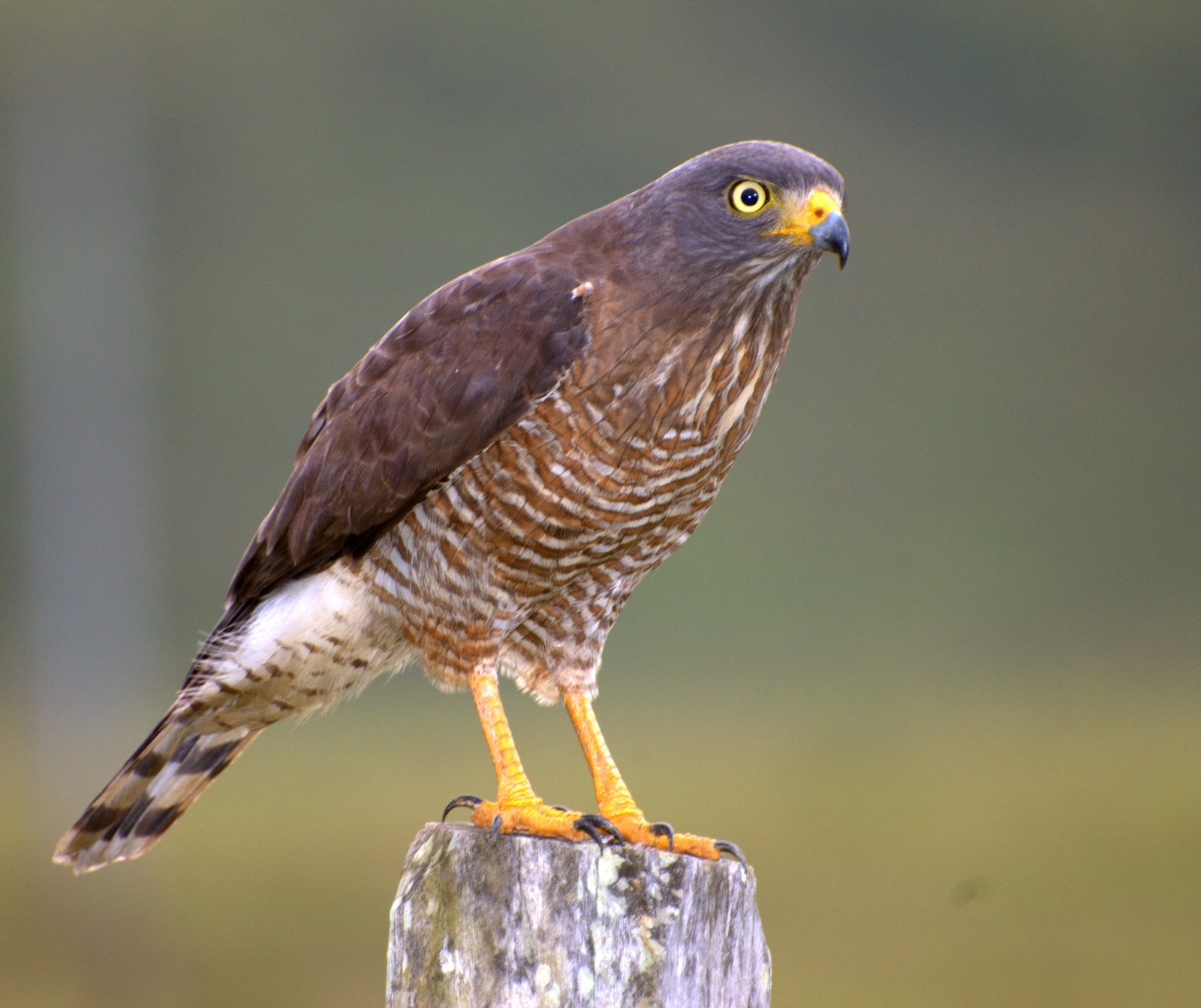
The Roadside Hawk is a small, grey-brown buzzard with barred underparts and a pale yellow eye that often sits on a post, wire or low branch along the road. From such a perch it hunts lizards, large insects, frogs and small rodents. In the guide area it is a common resident from eastern and southern Mexico to Panama, especially in semi-open country with scattered trees.
Voice
A drawn-out, nasal, rather plaintive scream, keeeeer, often from a perch and also in the middle of the day; also a fast, laughing series ka-ka-ka-ka, mainly from pairs in flight.
Recording: Richard E. Webster — CC BY-NC-SA 4.0 · converted to mono · xeno-canto
Identification
31–41 cm, with short, rounded wings and a fairly long tail. Head, breast and upperparts are grey-brown to grey; belly and thighs are densely barred rufous-brown and white. The eye is pale yellow to whitish, the cere and legs are yellow. The tail is grey with four or five dark bands. In flight many birds show a rufous patch in the primaries, and the underwings are finely barred. Young birds have a pale supercilium, brown streaks on the breast and a barred belly. Male and female are alike; the female is larger.
Confusion species
The Grey Hawk Buteo plagiatus is plainer grey, has a dark eye and a black tail with two or three broad white bands. The Broad-winged Hawk Buteo platypterus has a dark eye, white underwings with a dark trailing edge and a tail with broad black and white bands. The Red-shouldered Hawk Buteo lineatus has rufous shoulders, black-and-white chequered wings and pale crescent-shaped windows in the primaries. The pale eye and grey breast also separate the Roadside Hawk from young birds of these species.
Habitat
Semi-open country with scattered trees, forest edges, secondary forest, pastures with hedges and trees, plantations and shade coffee, roadsides and village edges, from the lowlands into the foothills and lower mountains; also along rivers and in dry forest. It avoids the interior of closed forest. It hunts from a low perch and during the morning often soars low over forest edges.
Where the bird is most at home, classified by the vegetation units of Mexico and Central America.







Range and movements
Resident on the Gulf side of Mexico from Tamaulipas and on the Pacific side from Nayarit, south through southern Mexico and the Yucatán Peninsula, including Cozumel, and on throughout Belize, Guatemala, El Salvador, Honduras, Nicaragua, Costa Rica and Panama. Mainly in the lowlands and foothills, locally high into the mountains. Absent from the dry central plateau of Mexico. Outside the guide area in South America to northern Argentina; a vagrant to southern Texas.
- Resident
- dark = core range, pale = thinly spread
How and when to look
Regularly seen from the road: along almost every road through the lowlands of the Yucatán Peninsula, Belize or the Caribbean side of Costa Rica it sits on posts and wires. The pale eye and grey breast are clearly visible from the road, and its scream often gives it away first.
Conservation status
Not threatened. One of the commonest raptors in the guide area, benefiting from forest clearance.
Scientific name
Rupornis magnirostris | (Gmelin, 1788)
Gmelin described the species in 1788 as Falco magnirostris; because it was later moved to another genus, the author and year stand in brackets. The genus Rupornis was introduced in 1844 by Kaup. Rupornis is Greek, from rhupos 'dirt, filth' and ornis 'bird': 'dirty bird', probably after the dull, drab plumage. magnirostris is Latin, from magnus 'great' and rostrum 'bill': 'large-billed', after Daubenton's 'Épervier à gros bec de Cayenne'. The specimen the first description was based on came from Cayenne, French Guiana.