All species › Swifts › Hummingbirds › Rivoli's Hummingbird
Position in the tree Birds Aves › Birds with a flexible palate Neognathae › All other modern birds Neoaves › Birds of the elements Elementaves › Nightjars and swifts Strisores
Rivoli's Hummingbird | Eugenes fulgens
Rivoli's kolibrie | Colibrí magnífico
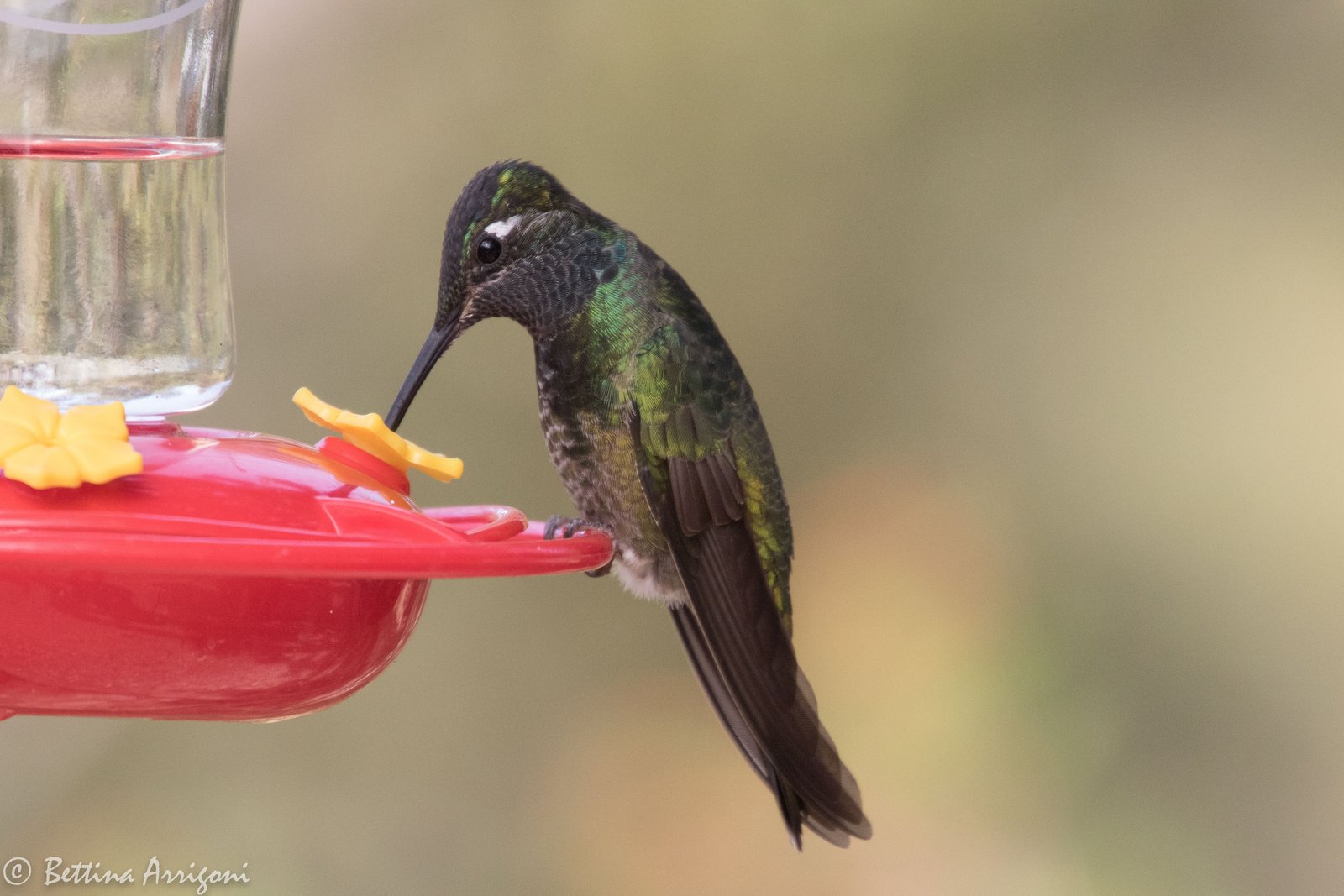
Rivoli's Hummingbird is a large hummingbird of the pine-oak forests of Mexico and northern Central America, breeding north into the south-western United States. Until 2017 it was treated as one species with Talamanca Hummingbird. In poor light the male looks all black, until the purple crown and green throat light up.
Voice
A sharp, dry chip or chik, and in chases a dry, rattling twitter.
Recording: Richard E. Webster — CC BY-NC-SA 4.0 · shortened to the first 60 s, mono · xeno-canto
Identification
12–13 cm, with a long, straight black bill. The male is dark green, with a glittering violet-purple crown, a glittering emerald-green throat, a blackish breast and belly, a white spot behind the eye and a bronze-green tail. The female is green above, with a white stripe behind the eye, grey, lightly spotted underparts and a green tail with greyish-white tips to the outer feathers.
Confusion species
Blue-throated Mountaingem Lampornis clemenciae is as large, but has a shorter bill, a white malar stripe and large white tail corners; the male has a blue throat. Talamanca Hummingbird Eugenes spectabilis lives only in Costa Rica and Panama, is slightly larger and the male has a bluer-green throat. Female Garnet-throated Hummingbird Lamprolaima rhami has rufous wings.
Habitat
Pine-oak, oak, pine and fir forest and cloud forest in the mountains, especially in open parts, along forest edges and in canyons, at about 1500 to 3300 m. It feeds at flowering shrubs, agaves and salvias, catches many insects in flight and visits feeders in gardens. In winter some birds move down to lower elevations.
Where the bird is most at home, classified by the vegetation units of Mexico and Central America.





Range and movements
In the mountains of Mexico: the Sierra Madre Occidental from Sonora and Chihuahua, the Sierra Madre Oriental from Coahuila and Nuevo León, the Trans-Mexican Volcanic Belt, the Sierra Madre del Sur and the highlands of Chiapas; further in the highlands of Guatemala, El Salvador, Honduras and northern Nicaragua. Outside the guide area the species breeds in south-eastern Arizona, south-western New Mexico and western Texas; those birds winter largely in Mexico.
- Resident
- dark = core range, pale = thinly spread
How and when to look
In the pine-oak forest around San Cristóbal de las Casas in Chiapas, on the slopes of the Nevado de Colima and in the mountains of Durango; in Guatemala in the highlands around Quetzaltenango. Often at feeders and flowering salvias along forest edges.
Conservation status
Not threatened. Fairly common in suitable montane forest. The range is large.
Scientific name
Eugenes fulgens | (Swainson, 1827)
Swainson described the species in 1827 as Trochilus fulgens; because it was later moved to another genus, the author and year stand in brackets. The genus Eugenes was introduced in 1856 by Gould. Eugenes is Greek, from eugenēs 'well-born, noble', after the stately appearance of this large hummingbird. fulgens is Latin for 'shining, glittering', after the male's sparkling crown and throat. The specimen the first description was based on came from Temascaltepec, Mexico.