All species › Gamebirds › Partridges, pheasants, grouse and allies › Ring-necked Pheasant
Position in the tree Birds Aves › Birds with a flexible palate Neognathae › Fowl Galloanserae
Ring-necked Pheasant | Phasianus colchicus
Fazant | Faisán vulgar
The Ring-necked Pheasant is an alien in the guide area: it is native to Asia. In Mexico a small feral population lives in the farmland of the Colorado River delta, in north-eastern Baja California and adjacent Sonora, connected to the population in the Imperial Valley in California.
Voice
The male gives an explosive, hoarse, two-note crow, kork-kok, immediately followed by a short drumming of the wings. When flushed a loud, rattling kutuk-kutuk-kutuk.
Recording: Jens Schöller — CC BY-NC-SA 4.0 · converted to mono · xeno-canto
Identification
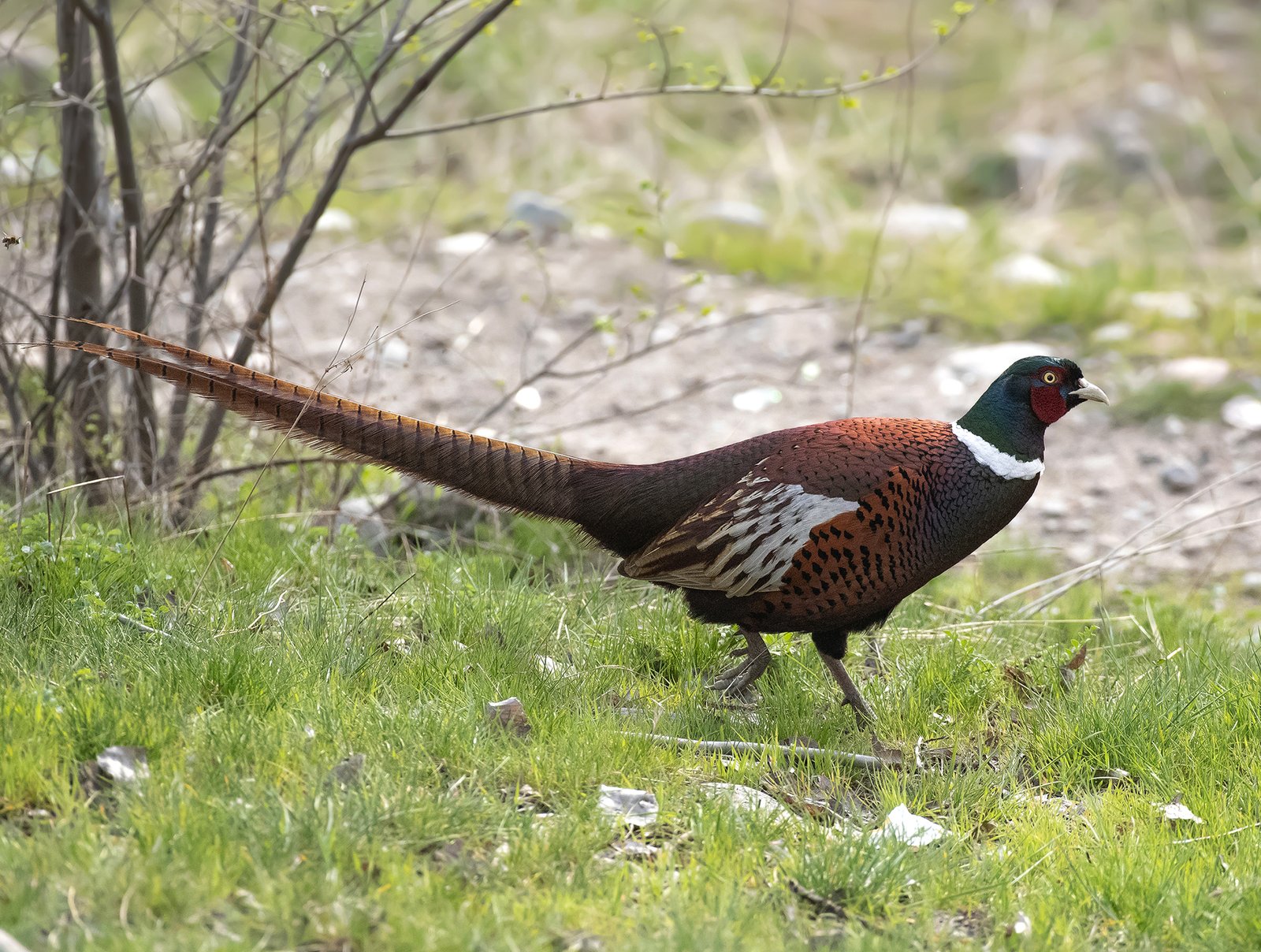
53–89 cm, including the long tail; the male is much larger than the female. The male is coppery brown with black scaling, with a glossy green head, red facial wattles, small ear tufts, usually a white neck ring and a very long, barred, pointed tail. The female is sandy brown with dark spots and has a shorter, also pointed tail. It flies with a short burst of rapid wingbeats followed by long glides low over the ground.
Confusion species
Not to be confused with any other wild bird in the guide area. At a distance the female may recall a quail, but it is much larger and has a long, pointed tail.
Habitat
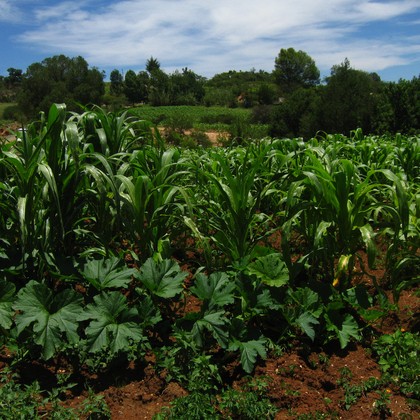
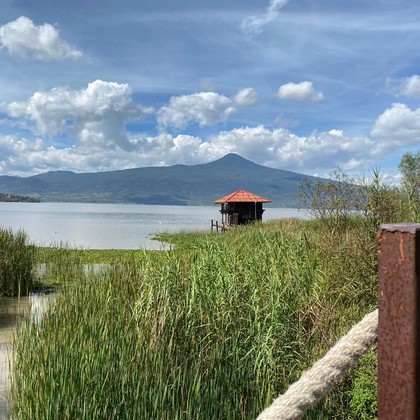
Irrigated fields of wheat, alfalfa and other crops, with ditch banks, reed fringes and scrub along canals and the river. It forages on the ground for seeds, grain, green plant material and insects and hides in dense cover.
Where the bird is most at home, classified by the vegetation units of Mexico and Central America.


Range and movements
In the guide area established only in the Mexicali Valley and the Colorado River delta in north-eastern Baja California, extending into the far north-west of Sonora near San Luis Río Colorado. Odd birds elsewhere in northern Mexico are usually escapes or releases. Native from the Caucasus and Central Asia to China, Korea and Japan; introduced to Europe, North America, New Zealand and Hawaii, among other places.
- Resident
- Summer visitor (c. Apr–Sep)
- dark = core range, pale = thinly spread
How and when to look
In the farmland south and east of Mexicali, early in the morning along the edges of fields and canals; the male's crow usually gives it away before it is seen.
Conservation status
Not threatened globally. In the guide area an alien with a small, local population that is hunted.
Scientific name
Phasianus colchicus | Linnaeus, 1758
Linnaeus described the species in 1758 and placed it straight away in the genus where it still stands. He introduced the genus Phasianus in that same work. Phasianus is Latin for 'pheasant', borrowed from Greek phasianos '(bird) of the Phasis', the river now called the Rioni, which flows to the Black Sea in western Georgia. colchicus means 'of Colchis', the region on the Black Sea in what is now western Georgia where Europeans came to know the pheasant. The specimen the first description was based on came from Rioni, Georgia.