All species › Woodpeckers and allies › Woodpeckers › Red-naped Sapsucker
Position in the tree Birds Aves › Birds with a flexible palate Neognathae › All other modern birds Neoaves › Landbirds Telluraves › Raptors, owls, kingfishers and woodpeckers Afroaves › Mousebirds, rollers and woodpeckers Coraciimorphae › Trogons and cavity nesters Cavitaves › Hornbills, kingfishers and woodpeckers Picocoraciae › Kingfishers, bee-eaters and woodpeckers Picodynastornithes
Red-naped Sapsucker | Sphyrapicus nuchalis
Roodneksapspecht | Chupasavia nuca roja
The Red-naped Sapsucker is the sapsucker of the interior of western North America and in the guide area winters mainly in north-western and western Mexico. It was long treated as a subspecies of Yellow-bellied Sapsucker; both species and Red-breasted Sapsucker hybridise where their breeding ranges meet. Like other sapsuckers it drills rows of holes in bark and drinks the sap that flows from them.
Voice
A nasal, mewing neeah, as in Yellow-bellied Sapsucker. The drum has the typical sapsucker rhythm: a fast opening followed by a few separate, slower taps. Seldom heard in winter.
Recording: Richard E. Webster — CC BY-NC-SA 4.0 · converted to mono · xeno-canto
Identification
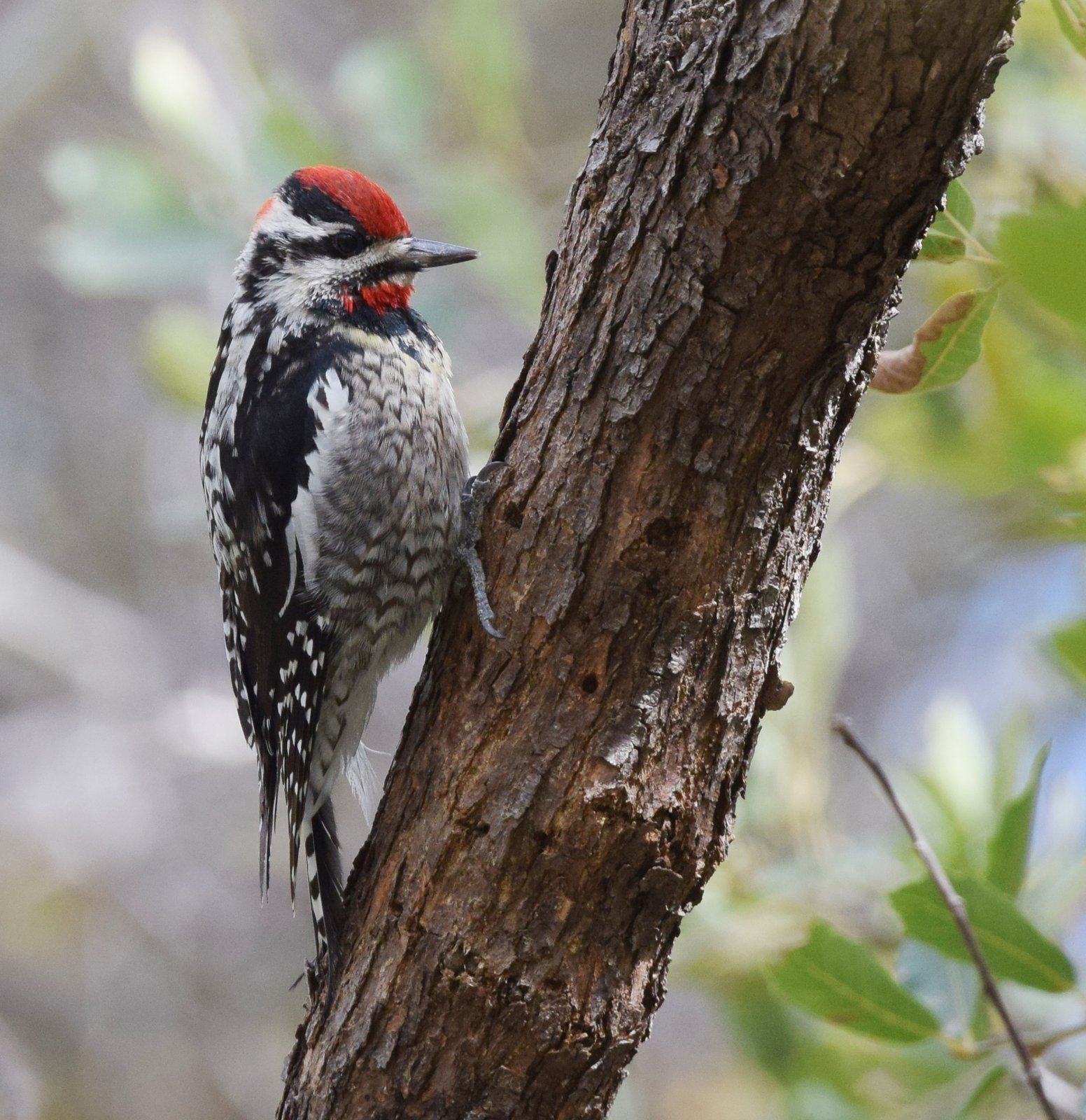
19–21 cm. Adults have a red crown, a small red patch on the nape, a black-and-white head pattern and a black breast band; the underparts are pale yellowish with dark marks on the flanks. A long white wing stripe is visible even on perched birds. The back is black with two narrow, irregular white lengthwise stripes; the rump is white. The male has an all-red throat, the red breaking through the black border; the female has a white chin and a partly red throat. Young birds are already largely in adult plumage by autumn.
Confusion species
Yellow-bellied Sapsucker Sphyrapicus varius has no red on the nape, a throat fully bordered with black in the male and a more spotted back marked with buff and white; first-winter birds stay brownish until late winter. Red-breasted Sapsucker Sphyrapicus ruber has an all-red head and breast. Hybrids with both species occur and cannot always be identified with certainty.
Habitat
In winter pine-oak and oak woodland, riparian woodland with cottonwoods and willows, orchards and parks with trees, from the lowlands to over 2500 m. It takes sap and insects from its wells and also eats fruit and berries. In winter it is solitary and holds a particular tree or group of trees with sap wells.
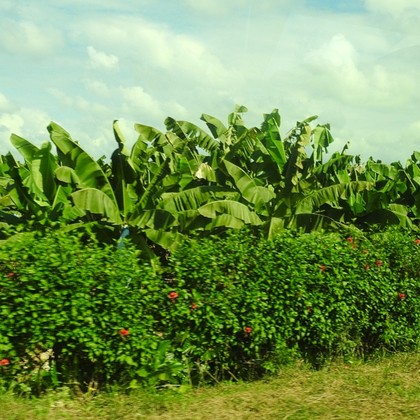
Where the bird is most at home, classified by the vegetation units of Mexico and Central America.




Range and movements
In winter in northern Baja California and from Sonora and Chihuahua south through Sinaloa, Durango, Coahuila and Zacatecas to Jalisco and Guanajuato; rare further south and east. Outside the guide area it breeds in the Rocky Mountains and Great Basin of the western United States and south-western Canada, and also winters in the south-western United States.
- Winter visitor (c. Oct–Mar)
- dark = core range, pale = thinly spread
How and when to look
In winter in riparian and oak woodland in the valleys of Sonora and Chihuahua and in the pine-oak forests of the Sierra Madre Occidental. A tree with wet sap wells is visited again and again by the same bird; waiting patiently near such a tree often produces a sighting.
Conservation status
Not threatened. The species is fairly common in its breeding range.
Scientific name
Sphyrapicus nuchalis | Baird, 1858
Baird described the species in 1858 and placed it straight away in the genus where it still stands. He introduced the genus Sphyrapicus in that same work. Sphyrapicus combines Greek sphura 'hammer' with Picus 'woodpecker': 'hammer woodpecker'. nuchalis is modern Latin for 'of the nape', from nucha 'nape', after the red nape patch. The specimen the first description was based on came from Mimbres River, New Mexico.