All species › Passerines › Shrike-babblers, Erpornis and vireos › Red-eyed Vireo
Position in the tree Birds Aves › Birds with a flexible palate Neognathae › All other modern birds Neoaves › Landbirds Telluraves › Falcons, parrots and passerines Australaves › Falcons and passerines Eufalconimorphae › Parrots and passerines Psittacopasserae
Red-eyed Vireo | Vireo olivaceus
Roodoogvireo | Vireo ojirrojo
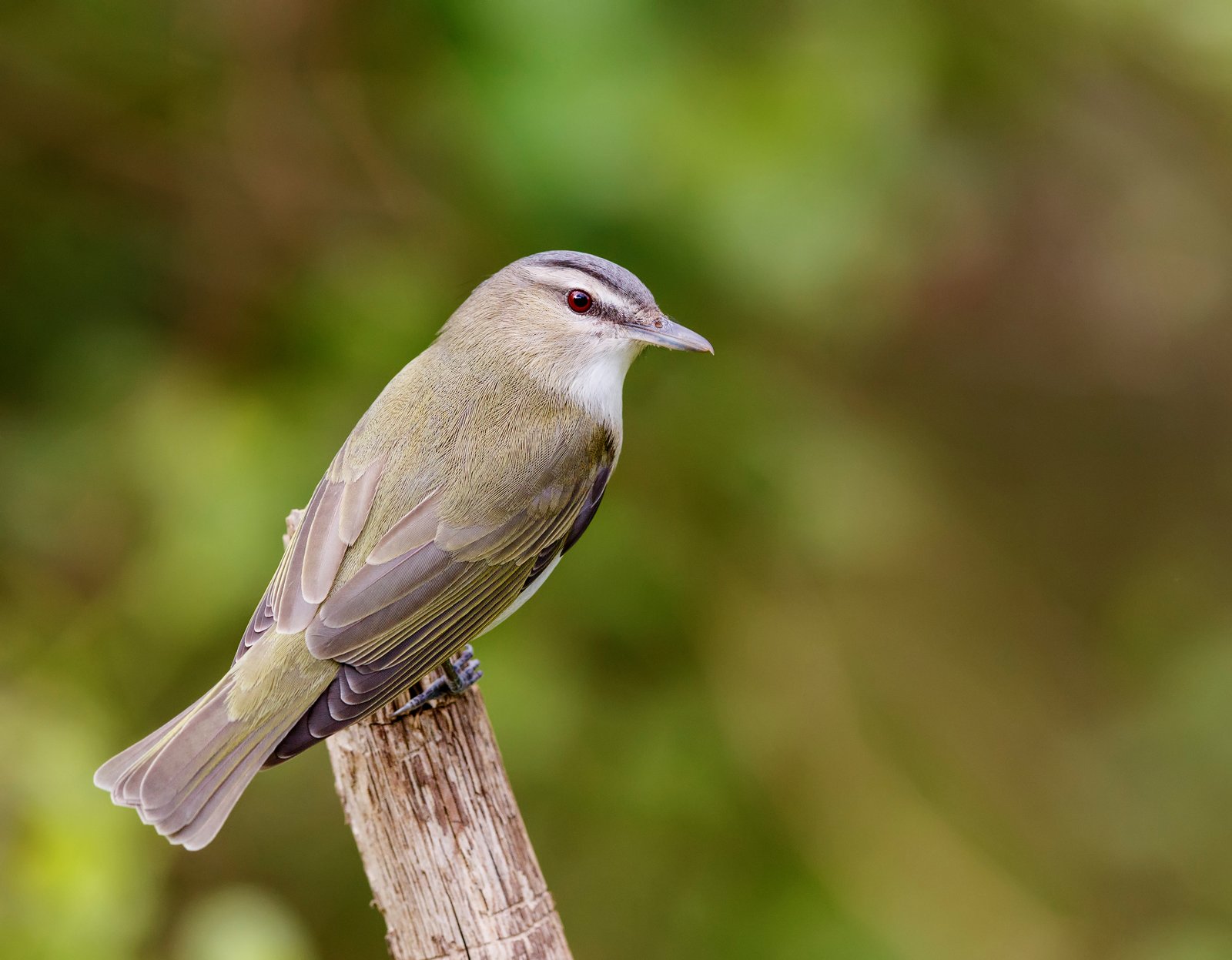
The Red-eyed Vireo is a vireo with a grey crown, a black-bordered white supercilium and, in adults, a red eye. It breeds in North America and passes through the guide area in large numbers on its way to South America.
Voice
The song, heard in the guide area mainly in spring, is a series of short, question-and-answer phrases separated by pauses. The call is a nasal, complaining sound.
Recording: Jacob Saucier — CC BY-NC-SA 4.0 · converted to mono · xeno-canto
Identification
13–15 cm. Crown grey, bordered at the side by a black line above the white supercilium; dark eye-stripe. Back olive-green. Underparts white, undertail coverts and, in young birds in autumn, sometimes the flanks faintly yellowish. Eye red in adults, brown in young birds. Bill fairly long.
Confusion species
Yellow-green Vireo Vireo flavoviridis has bright yellow flanks and a less contrasting head without a distinct black border. Black-whiskered Vireo Vireo altiloquus has a narrow black malar stripe. Philadelphia Vireo Vireo philadelphicus is smaller, with a yellow throat and breast.
Habitat
On migration in all kinds of forest, forest edges, secondary forest, plantations and gardens with trees, mainly in the lowlands. It searches the canopy for insects and eats much fruit on migration.
Where the bird is most at home, classified by the vegetation units of Mexico and Central America.





Range and movements
Breeds across much of Canada and the United States. Passes through the entire guide area, especially on the Caribbean slope and across the Yucatán Peninsula, and winters in the Amazon basin.
- Passage (Mar–Apr, Oct–Nov)
- dark = core range, pale = thinly spread
How and when to look
During autumn migration in September and October sometimes in large numbers in fruiting trees, especially on the Caribbean slope of Central America.
Conservation status
Not threatened. One of the most numerous songbirds migrating through the guide area.
Scientific name
Vireo olivaceus | (Linnaeus, 1766)
Linnaeus described the species in 1766 as Muscicapa olivacea; because it was later moved to another genus, the author and year stand in brackets. The genus Vireo was introduced in 1808 by Vieillot. Vireo was used by Latin authors for a small, green, migratory bird, probably the Eurasian golden oriole, though the European greenfinch has also been suggested. olivaceus is Latin for 'olive-green', from oliva 'olive', after the greenish upperparts. The specimen the first description was based on came from the Yungas, Bolivia.