All species › Pigeons and doves › Doves and pigeons › Red-billed Pigeon
Position in the tree Birds Aves › Birds with a flexible palate Neognathae › All other modern birds Neoaves › Doves, turacos and allies Columbaves › Doves and sandgrouse Columbimorphae
Red-billed Pigeon | Patagioenas flavirostris
Roodsnavelduif | Paloma morada
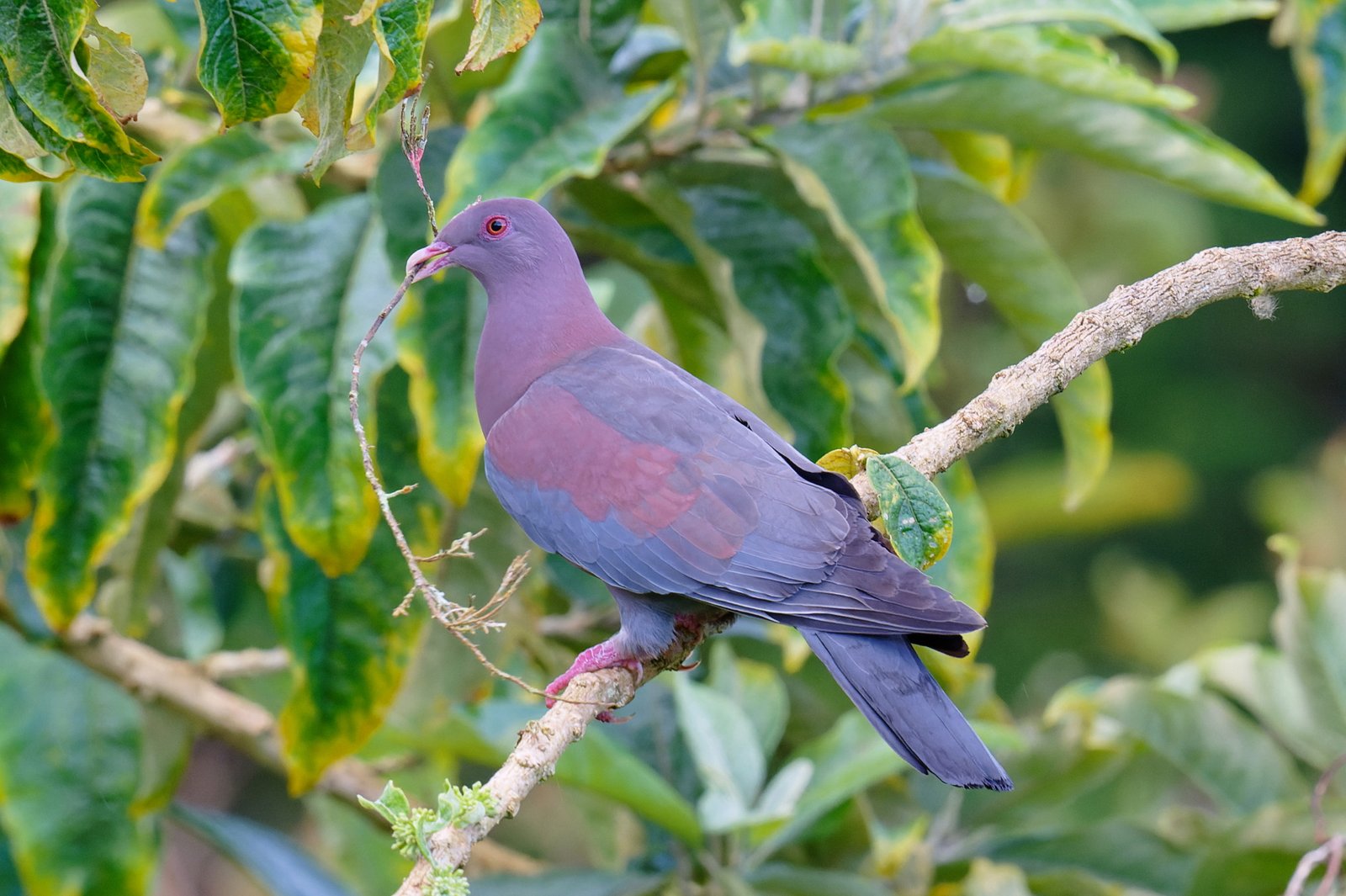
The Red-billed Pigeon is a large, dark pigeon of dry forest, riparian woodland and semi-open country with tall trees, from northern Mexico to Costa Rica. It is the commonest large tree pigeon of the drier regions of the guide area, often seen on a bare branch above the forest or in fast flight over open country. The name refers to the red base of the bill; the rest of the bill is pale.
Voice
A long, swelling first note followed by a repeated, rhythmic cooing: whoooooo, up-a-coo-coo, up-a-coo-coo, up-a-coo-coo. Mainly in the morning and late afternoon from a high perch, in the breeding season also in the middle of the day.
Recording: Alain Malengreau — CC BY-NC-SA 4.0 · converted to mono · xeno-canto
Identification
33–37 cm. The head, neck, breast and lesser wing coverts are dark vinaceous to purplish red. The mantle and scapulars are olive-brown, the greater wing coverts blue-grey, which shows as a pale wing panel in flight. The lower back, rump, belly and undertail coverts are slate grey, the tail dark grey. The bill is pale yellow to whitish with a red base. The eye is orange with a red eye-ring, the legs are red. The female is slightly duller than the male; young birds are browner and largely lack the vinaceous tone. A slightly paler island form lives on the Islas Marías (P. f. madrensis).
Confusion species
Pale-vented Pigeon Patagioenas cayennensis has a black bill, a blue-grey rump and pale undertail coverts and lives in the humid Caribbean lowlands. Band-tailed Pigeon P. fasciata is larger and paler grey, with a white crescent on the hindneck, a yellow bill and a pale terminal tail band, and lives higher in the mountains. Scaled Pigeon P. speciosa has a scaled neck and breast and a red bill with a white tip.
Habitat
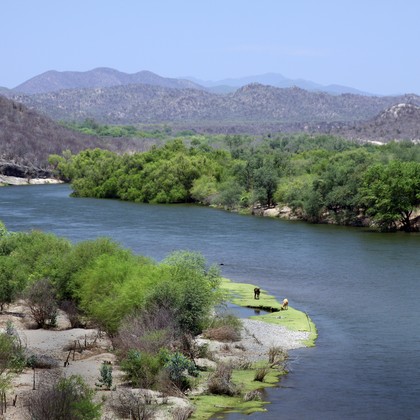
Tropical dry forest, seasonal forest, riparian and gallery forest, forest edges and semi-open country with scattered tall trees, also in pasture and around villages, from sea level to about 1800 m, mostly lower. In humid regions mainly in open or disturbed landscapes, not in closed rainforest. Eats fruit, berries, acorns and seeds, in the canopy and also on the ground. The nest is a platform of twigs in a tree or shrub, with one white egg.
Where the bird is most at home, classified by the vegetation units of Mexico and Central America.





Range and movements
In Mexico on the Pacific slope from Sonora south through Sinaloa, Nayarit, Jalisco, Colima and Guerrero to Oaxaca and Chiapas, including the Islas Marías; on the Gulf side from Nuevo León and Tamaulipas through San Luis Potosí, Veracruz and Tabasco to the whole Yucatán Peninsula. Further throughout Belize, Guatemala, El Salvador, Honduras and Nicaragua and in Costa Rica, mainly in the north-west and the Central Valley. Scarce and local in the far west of Panama, in Bocas del Toro. Outside the guide area only in the far south of Texas.
- Resident
- dark = core range, pale = thinly spread
How and when to look
Regular in Guanacaste in Costa Rica, in the dry forest around San Blas in Nayarit and on the Yucatán Peninsula. Birds often sit on the highest bare branch of a tree; the pale bill with a red base is clearly visible at close range.
Conservation status
Not threatened. Common over much of the guide area and locally benefits from the opening up of forest. It is hunted; in Texas, at the northern edge of the range, it has declined through the loss of riparian woodland.
Scientific name
Patagioenas flavirostris | (Wagler, 1831)
Wagler described the species in 1831 as Columba flavirostris; because it was later moved to another genus, the author and year stand in brackets. The genus Patagioenas was introduced in 1853 by Reichenbach. Patagioenas is Greek, from patageō 'to clatter' and oinas 'pigeon', after the clattering wings on take-off. flavirostris is Latin, from flavus 'yellow' and rostrum 'bill', after the pale yellowish bill tip. The specimen the first description was based on came from Veracruz, Mexico.