All species › Passerines › Crows, jays and magpies › Purplish-backed Jay
Position in the tree Birds Aves › Birds with a flexible palate Neognathae › All other modern birds Neoaves › Landbirds Telluraves › Falcons, parrots and passerines Australaves › Falcons and passerines Eufalconimorphae › Parrots and passerines Psittacopasserae
Purplish-backed Jay | Cyanocorax beecheii
Purperruggaai | Chara de Beechey
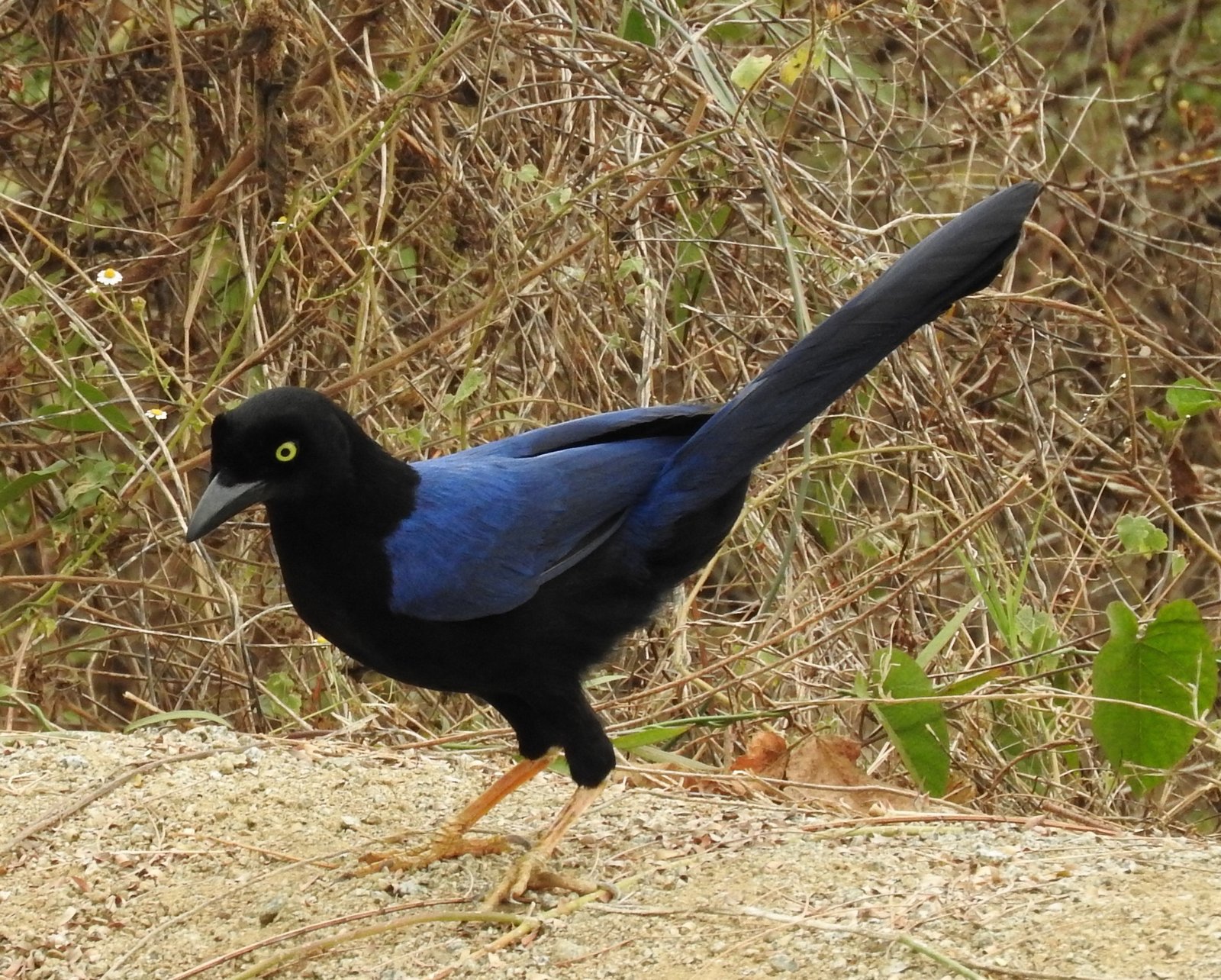
The Purplish-backed Jay is a large, long-tailed jay with black head and underparts, a purplish-blue back and a bright yellow eye. It occurs only in the dry lowlands of north-western Mexico. In the guide area it lives from Sonora to Nayarit.
Voice
Noisy. Loud, harsh calls, often in series, and dry rattles; groups call a lot.
Recording: Manuel Grosselet — CC BY-NC-SA 4.0 · converted to mono · xeno-canto
Identification
38–42 cm, with a long tail. Head, neck and underparts black; back, wings and tail dull purplish blue. Iris bright yellow; legs yellow. Adults have a black bill; young birds have a yellow bill that gradually turns black. Male and female are alike.
Confusion species
San Blas Jay Cyanocorax sanblasianus (further south, from Nayarit) is smaller and brighter blue, with a short tuft on the forehead. Tufted Jay Cyanocorax dickeyi has a tall crest, white belly and white tail tip and lives higher in the mountains. Green Jay Cyanocorax yncas is green and yellow.
Habitat
Dry deciduous forest, thorn forest and thorn scrub, riparian woodland and forest edges in the lowlands and foothills, also in plantations and neglected orchards. It eats insects, small vertebrates and fruit. It lives in groups.
Where the bird is most at home, classified by the vegetation units of Mexico and Central America.




Range and movements
Pacific lowlands and foothills of north-western Mexico, from southern Sonora through Sinaloa to northern Nayarit. It does not occur outside the guide area.
- Resident
- dark = core range, pale = thinly spread
How and when to look
Groups can be found in the dry forest of inland Sinaloa and southern Sonora, for example around Álamos.
Conservation status
Not threatened. Fairly common within its restricted range, but dependent on dry forest, which is locally giving way to agriculture.
Scientific name
Cyanocorax beecheii | (Vigors, 1829)
Vigors described the species in 1829 as Pica Beecheii; because it was later moved to another genus, the author and year stand in brackets. The genus Cyanocorax was introduced in 1826 by Boie. Cyanocorax is Greek, from kuanos 'dark blue' and korax 'raven': a 'blue raven', after the blue colours of many species. beecheii honours the British naval officer and explorer Frederick William Beechey (1796–1856), commander of the Blossom, which called at Mexico's west coast. The specimen the first description was based on came from Mazatlán (Sinaloa) or San Blas (Nayarit), Mexico.