All species › Passerines › Crows, jays and magpies › Pinyon Jay
Position in the tree Birds Aves › Birds with a flexible palate Neognathae › All other modern birds Neoaves › Landbirds Telluraves › Falcons, parrots and passerines Australaves › Falcons and passerines Eufalconimorphae › Parrots and passerines Psittacopasserae
Pinyon Jay | Gymnorhinus cyanocephalus
Pinyongaai | Chara piñonera
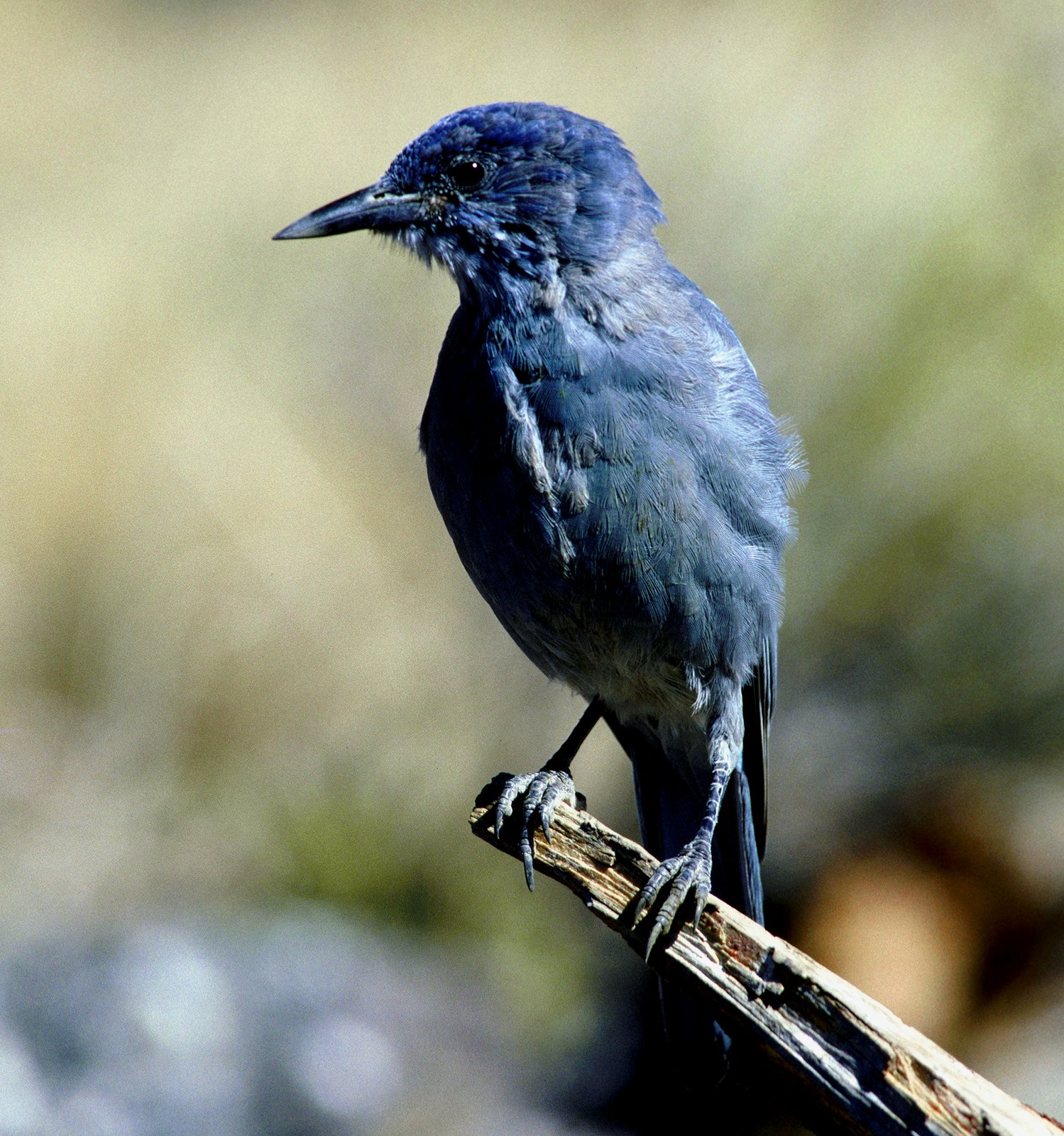
The Pinyon Jay is a uniformly dull blue, crow-like jay without a crest, with a short tail and a long, pointed bill. It lives in large, wandering flocks in pinyon and juniper woodland of the interior of western North America and reaches the guide area only in northern Baja California.
Voice
High, nasal, somewhat plaintive calls heard constantly within a flock; flying flocks are often audible from far away.
Recording: Matt Wistrand — CC BY-NC-SA 4.0 · converted to mono · xeno-canto
Identification
26–28 cm. Plumage uniformly dull blue, slightly darker and brighter blue on the head and throat, with fine pale streaks on the throat. No crest. Tail fairly short. Bill long, straight and pointed, black; legs black. In flight the short tail and pointed wings give a somewhat starling- or crow-like look. Juveniles are greyer.
Confusion species
California Scrub Jay Aphelocoma californica has a longer tail, a white throat with a blue breast band and a grey-brown back. Steller's Jay Cyanocitta stelleri has a prominent dark crest and a longer tail with black bars.
Habitat
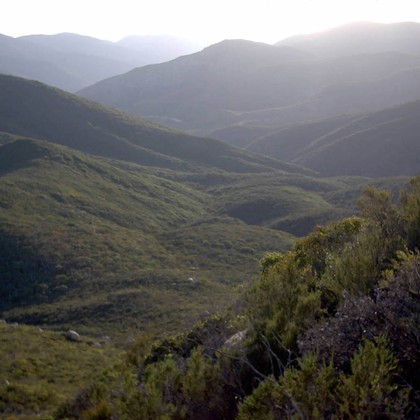
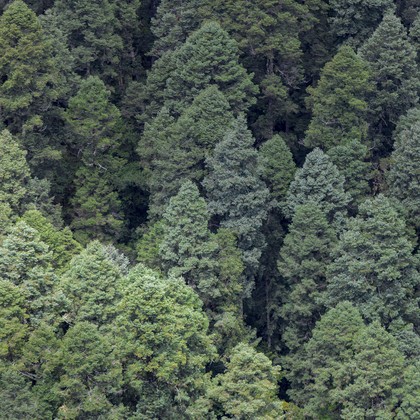
Open pinyon and juniper woodland on mountain slopes and plateaus, also adjacent pine forest and scrub. It feeds mainly on pinyon pine seeds, which are cached in large numbers in the ground as a winter store, as well as on insects. It breeds in colonies and lives in flocks all year, sometimes numbering hundreds of birds.
Where the bird is most at home, classified by the vegetation units of Mexico and Central America.
Range and movements
In the guide area only in northern Baja California, mainly in the Sierra de Juárez, where it is scarce and irregular. Outside the guide area in the interior of the western United States, from Montana and Oregon to Arizona and New Mexico.
- Resident
- dark = core range, pale = thinly spread
How and when to look
Flocks wander over large distances and are therefore unpredictable. The calls of flocks flying over pinyon woodland are often the first sign.
Conservation status
Vulnerable. The world population has declined steeply in recent decades, partly through clearing and conversion of pinyon-juniper woodland. Rare in Mexico.
Scientific name
Gymnorhinus cyanocephalus | Wied-Neuwied, 1841
Wied-Neuwied described the species in 1841 and placed it straight away in the genus where it still stands. He introduced the genus Gymnorhinus in that same work. Gymnorhinus is Greek, from gumnos 'naked' and rhis, rhinos 'nose', after the bare nostrils, which in other jays are covered by bristly feathers. cyanocephalus is Greek, from kuanos 'dark blue' and kephalē 'head', after the deep blue head. The specimen the first description was based on came from between the Marias and Yellowstone rivers, Montana (USA).