All species › Owls › Owls › Pacific Screech Owl
Position in the tree Birds Aves › Birds with a flexible palate Neognathae › All other modern birds Neoaves › Landbirds Telluraves › Raptors, owls, kingfishers and woodpeckers Afroaves › Hawks and owls Hieraves
Pacific Screech Owl | Megascops cooperi
Mangroveschreeuwuil | Autillo de manglar
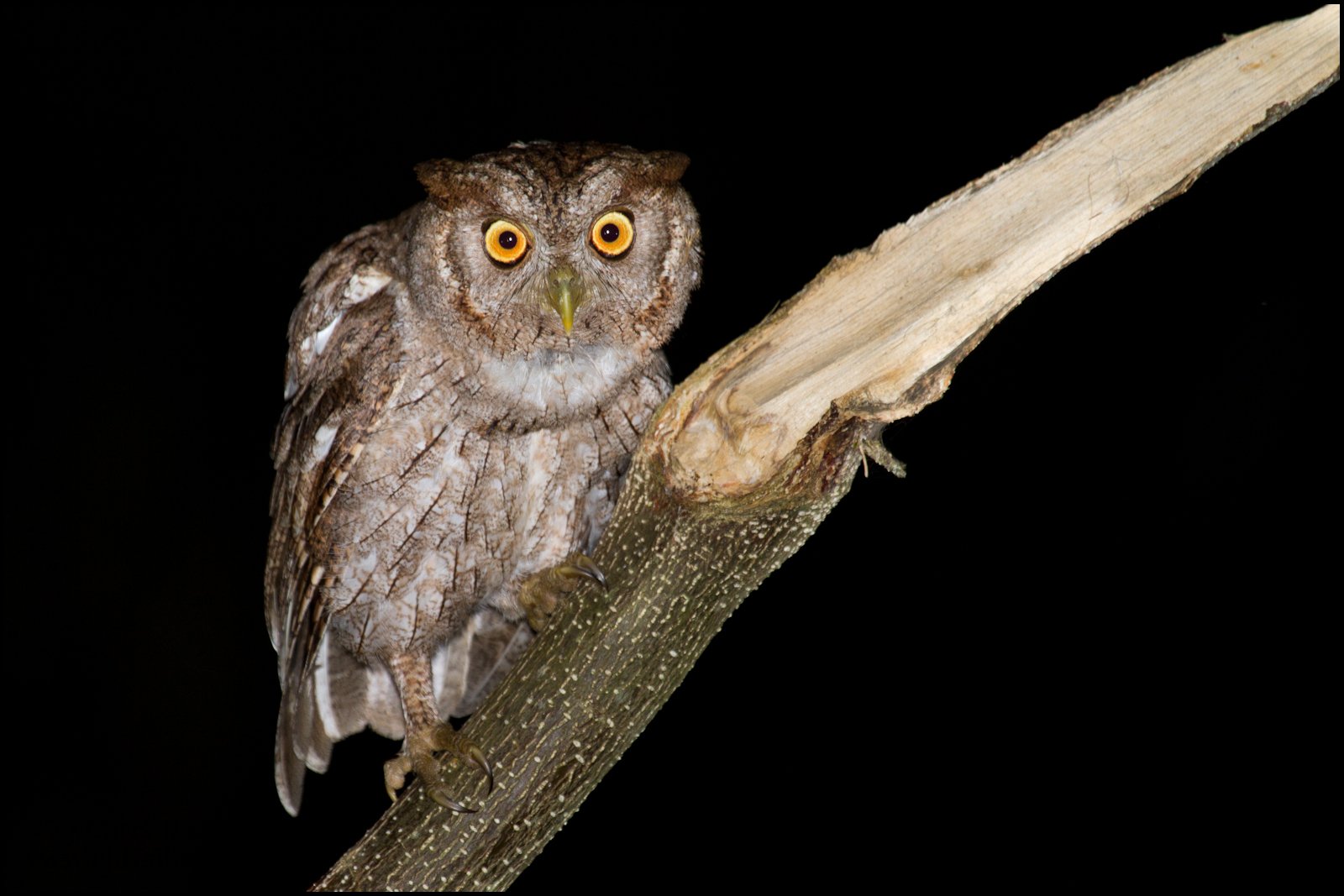
The Pacific Screech Owl is a large, grey screech owl of the Pacific side of Central America, from Oaxaca to northwestern Costa Rica. It lives not only in mangrove but also in dry deciduous forest, swamp forest and semi-open country with scattered trees. It is active only at night, and its entire range lies within the guide area.
Voice
The song is a series of gruff, somewhat barking notes that, after a short rattling start, swell and fade again: prrr pu-pu-PU-PU-PU-pu-pu. Birds in Oaxaca have a distinct staccato song, a croaking croarrr followed by a rapid series go-go-go-go. Pairs often sing in duet, mainly in the first part of the night.
Recording: Gary Elton — CC BY-NC-SA 4.0 · shortened to the first 60 s, mono · xeno-canto
Identification
20–26 cm, with prominent ear tufts, bright yellow eyes and a short tail. The facial disc is pale grey with a white and blackish rim. Crown and upperparts are pale grey-brown with dark vermiculation and black streaks; two pale lines cross the closed wing. The underparts are off-white with a herringbone pattern of black streaks and fine cross-bars. Birds of the Pacific slope of Oaxaca (subspecies lambi) are smaller and have a darkly streaked and barred crown. Male and female are alike.
Confusion species
The Middle American Screech Owl Megascops guatemalae lives in the same regions but is smaller, browner and finely vermiculated below without clear streaks, and sings a long, even trill. The Tropical Screech Owl Megascops choliba, in Costa Rica mainly farther south and in the Central Valley, is smaller, has a sharply black-rimmed facial disc and sings a short trill with one or two separate final notes. The Balsas Screech Owl Megascops seductus, farther northwest, has dark eyes.
Habitat
Mangrove, swamp forest, dry deciduous forest, thorn scrub and semi-open country with scattered trees and cacti, also secondary forest, farmyards and village edges with large trees; from sea level to about 1000 m in Oaxaca and 1300 m in Costa Rica, but usually lower. It nests in tree cavities. It hunts at night from a perch for large insects, spiders, crabs and small vertebrates.
Where the bird is most at home, classified by the vegetation units of Mexico and Central America.






Range and movements
Resident on the Pacific side of Central America: in Oaxaca (subspecies lambi) and Chiapas, and on through Guatemala, El Salvador, southern Honduras around the Gulf of Fonseca and Nicaragua to northwestern Costa Rica, in Guanacaste and around the Gulf of Nicoya. It does not occur outside the guide area.
- Resident
- dark = core range, pale = thinly spread
How and when to look
In the lowlands of Guanacaste in Costa Rica, for example around Palo Verde and in Santa Rosa, the song is regularly heard in the evening, also near farmyards and lodges with large trees. By day it hides in a cavity or in dense foliage, sometimes in a palm.
Conservation status
Not threatened. Most of the dry forest and mangrove on the Pacific side has been cleared or fragmented, but the species also occurs in semi-open farmland with trees.
Scientific name
Megascops cooperi | (Ridgway, 1878)
Ridgway described the species in 1878 as Scops cooperi; because it was later moved to another genus, the author and year stand in brackets. The genus Megascops was introduced in 1848 by Kaup. Megascops combines the Greek megas 'great' with Scops, the old genus name of the scops owls. cooperi honours Juan J. Cooper, who collected birds in Costa Rica in the 1870s. The specimen the first description was based on came from Santa Ana, Costa Rica.