All species › Woodpeckers and allies › Woodpeckers › Olivaceous Piculet
Position in the tree Birds Aves › Birds with a flexible palate Neognathae › All other modern birds Neoaves › Landbirds Telluraves › Raptors, owls, kingfishers and woodpeckers Afroaves › Mousebirds, rollers and woodpeckers Coraciimorphae › Trogons and cavity nesters Cavitaves › Hornbills, kingfishers and woodpeckers Picocoraciae › Kingfishers, bee-eaters and woodpeckers Picodynastornithes
Olivaceous Piculet | Picumnus olivaceus
Groenrugdwergspecht | Carpinterito oliváceo
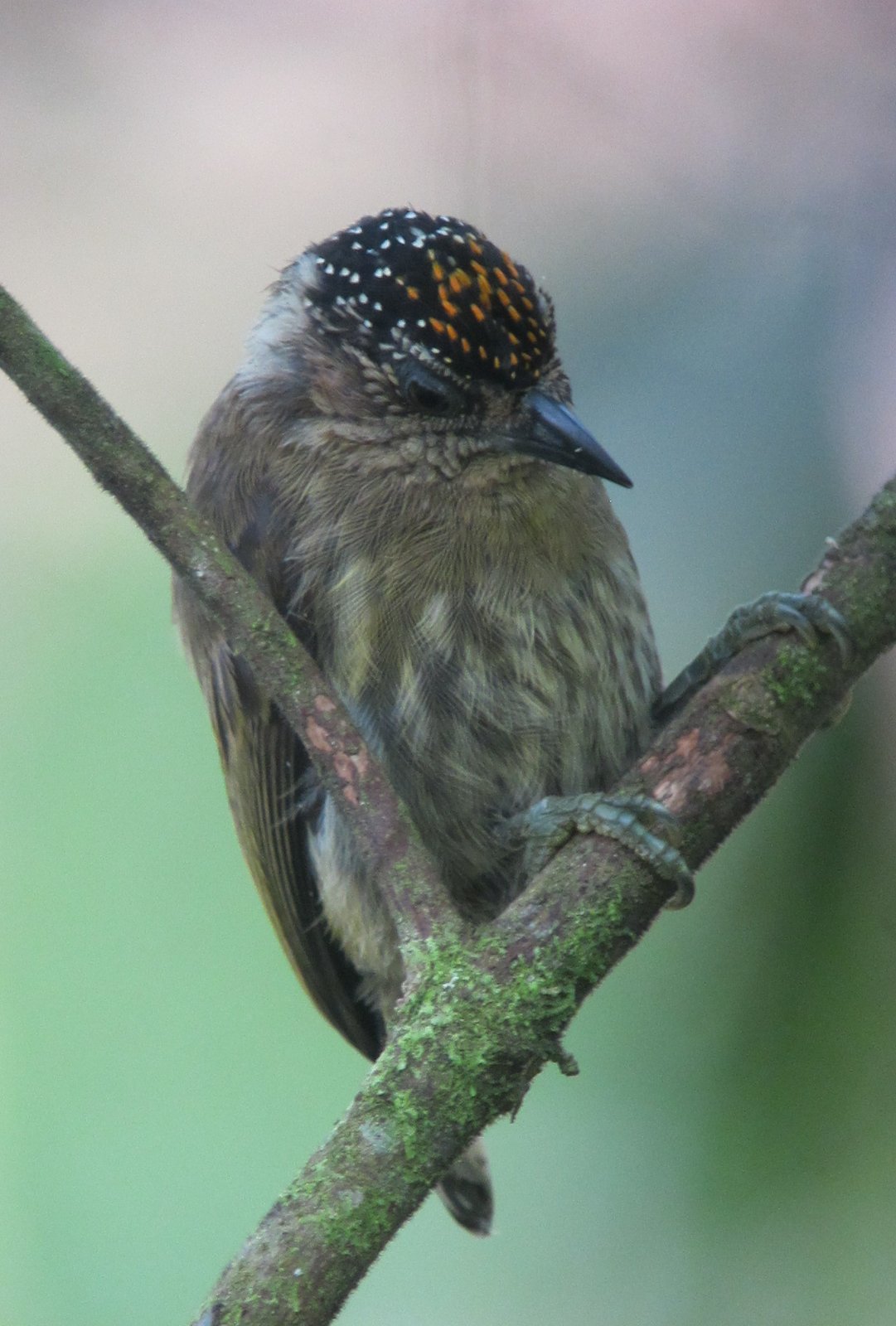
The Olivaceous Piculet is the only piculet in the guide area: a tiny, olive-brown woodpecker with a black, finely dotted crown. It does not use its tail as a prop but hangs and clambers like a tit on thin twigs and vines. In the guide area it lives from eastern Guatemala to Panama.
Voice
A high, thin, fast trill or a series of sharp tsee-tsee-tsee notes. It taps audibly on thin twigs and drums softly and briefly.
Recording: Juan Freile — CC BY-NC-SA 4.0 · converted to mono · xeno-canto
Identification
9–10 cm. The upperparts are plain olive-brown. The crown is black with fine dots: orange-red in the male, white in the female. The face and throat are pale brown with fine dark streaks. The breast is olive-brown, the belly yellowish with faint dark streaking. The short tail is black with pale, yellowish edges and central feathers. The bill is short, pointed and dark.
Confusion species
Its small size rules out confusion with other woodpeckers. Red-rumped Woodpecker Veniliornis kirkii and Smoky-brown Woodpecker Leuconotopicus fumigatus are much larger and climb trunks using the tail as a prop. Small songbirds foraging in the same understorey lack the dotted black crown.
Habitat
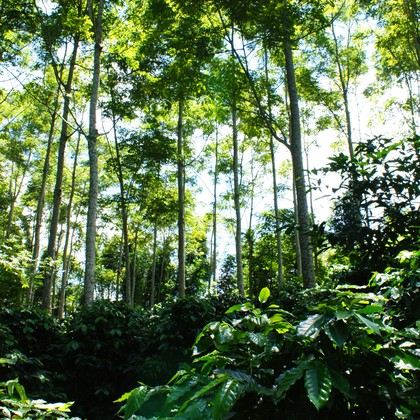
Edges of humid forest, secondary forest, open woodland with vines, forest edges and clearings, and shady plantations and gardens with trees, mainly in the lowlands and foothills up to about 1500 m. It searches thin branches, stems and vines in the lower and middle layers for ants, termites and their larvae, often in pairs or with mixed flocks. It excavates a small nest hole in soft, dead wood.
Where the bird is most at home, classified by the vegetation units of Mexico and Central America.



Range and movements
From eastern Guatemala and Honduras through Nicaragua and Costa Rica to Panama, mainly on the Caribbean slope; in south-western Costa Rica and in Panama also on the Pacific side. Outside the guide area in north-western South America, from Colombia and western Venezuela to Ecuador and north-western Peru.
- Resident
- dark = core range, pale = thinly spread
How and when to look
Regularly seen along Pipeline Road (Camino del Oleoducto) in Panama and at La Selva and Carara in Costa Rica. Soft tapping in a tangle of thin twigs and vines often gives the bird away before it is seen.
Conservation status
Not threatened. Fairly common and tolerates secondary forest, forest edges and gardens with trees.
Scientific name
Picumnus olivaceus | de Lafresnaye, 1845
De Lafresnaye described the species in 1845 and placed it straight away in the genus where it still stands. The genus Picumnus was introduced in 1825 by Temminck. Picumnus comes from French picumne 'piculet', after Picumnus, in Roman mythology the personification of the woodpecker. olivaceus is Latin for 'olive-coloured', after the olive-green upperparts. The specimen the first description was based on came from Bogotá, Colombia.