All species › Passerines › Tyrant flycatchers and allies › Ochraceous Pewee
Position in the tree Birds Aves › Birds with a flexible palate Neognathae › All other modern birds Neoaves › Landbirds Telluraves › Falcons, parrots and passerines Australaves › Falcons and passerines Eufalconimorphae › Parrots and passerines Psittacopasserae
Ochraceous Pewee | Contopus ochraceus
Okerkleurige piewie | Pibí ocráceo
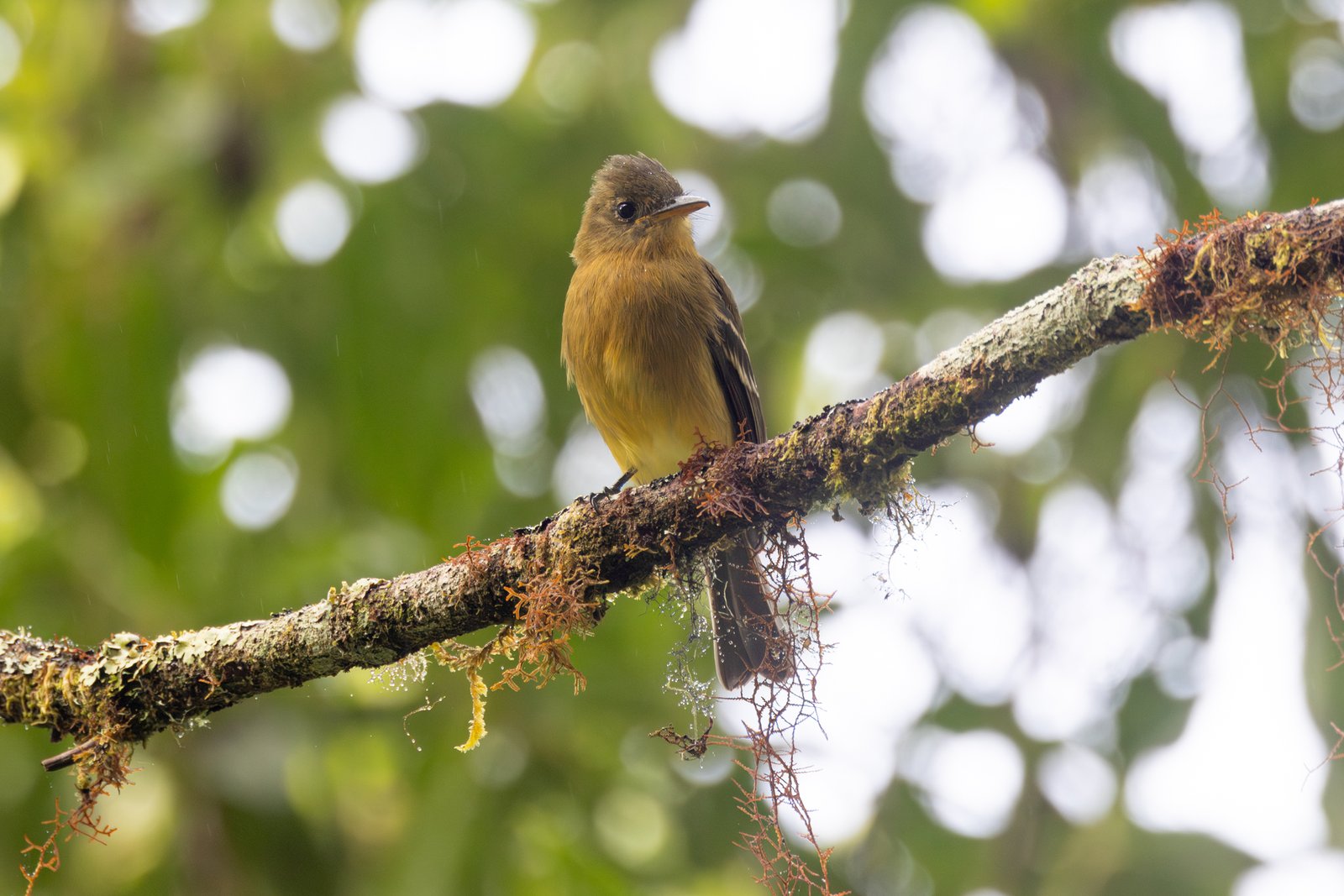
The Ochraceous Pewee is a rare and little-known pewee of the high mountains of Costa Rica and western Panama. It has a crest, an olive back and warm ochre underparts. The species lives in a small area and is seldom seen.
Voice
Poorly documented. Gives short, repeated whistled notes; the song has hardly been described.
Recording: Jorge Gabriel Campos — CC BY-NC-SA 4.0 · shortened to the first 60 s, mono · xeno-canto
Identification
16–17 cm, with a pointed crest and long wings. Upperparts olive-brown, crown slightly darker. Throat and underparts ochre to tawny-buff, washed olive on the breast and paler towards the lower belly. Wings dark with two faint, pale ochre wing bars. Lower mandible orange-yellow, upper mandible dark. Male and female are alike.
Confusion species
Northern Tufted Flycatcher Mitrephanes phaeocercus is very similar in colour and also crested, but is clearly smaller, with a short, narrower bill, and often quivers its tail. Dark Pewee Contopus lugubris is much darker, sooty grey, with no ochre below. Olive-sided Flycatcher Contopus cooperi (passage migrant and winter visitor) has a dark vest with a white central stripe.
Habitat
High montane rainforest and oak forest, roughly between 2000 and 3000 m, especially at forest edges, in clearings with tall trees and along stream valleys. It often sits high on a protruding branch and sallies from there after flying insects.
Where the bird is most at home, classified by the vegetation units of Mexico and Central America.


Range and movements
Endemic to the guide area: the highlands of Costa Rica (Cordillera Central and Cordillera de Talamanca) and western Panama (Chiriquí).
- Resident
- dark = core range, pale = thinly spread
How and when to look
Rare and erratic; most records come from the oak forest of the Talamanca range, including the area around the Savegre valley. Look for a crested pewee perched high and motionless at a forest edge.
Conservation status
Assessed globally as not threatened, but the range is small and the bird is rare everywhere. Little is known about numbers and trends; most of its habitat lies within protected areas.
Scientific name
Contopus ochraceus | Sclater & Salvin, 1869
Sclater & Salvin described the species in 1869 and placed it straight away in the genus where it still stands. The genus Contopus was introduced in 1855 by Cabanis. Contopus is Greek, from kontos 'pole, shaft' and pous 'foot', after the short legs. ochraceus is New Latin for 'ochre-coloured', after the ochraceous underparts. The specimen the first description was based on came from Costa Rica.