All species › Nightjars › Nightjars and nighthawks › Ocellated Poorwill
Position in the tree Birds Aves › Birds with a flexible palate Neognathae › All other modern birds Neoaves › Birds of the elements Elementaves › Nightjars and swifts Strisores
Ocellated Poorwill | Nyctiphrynus ocellatus
Gevlekte poorwill | Chotacabras ocelado
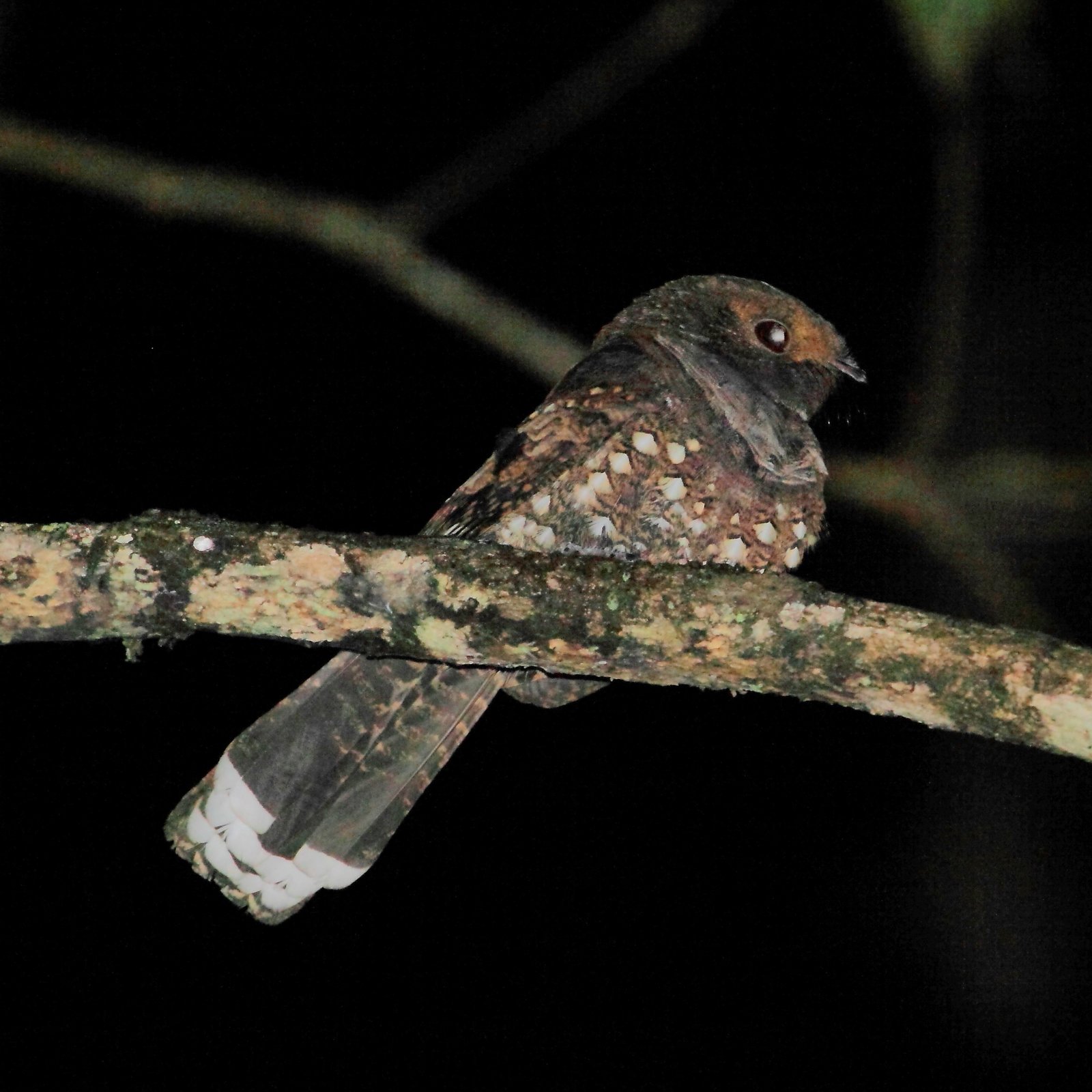
The Ocellated Poorwill is a small, dark nightjar of humid lowland forest, named after the rows of black-edged white spots on the scapulars and wing coverts. In the guide area it occurs only on the Caribbean side of eastern Honduras, Nicaragua and northern Costa Rica, far separated from the birds in South America. It is found mainly by its song, which is heard most in the dry season.
Voice
The song is a soft, whistled, somewhat trilled call, roughly poo-reeeoo, repeated at intervals, mainly at dusk and by moonlight. Its exact form varies between regions and has been little recorded in the guide area.
Recording: Fabio Schunck — CC BY-NC-SA 4.0 · converted to mono · xeno-canto
Identification
20–23 cm. A small, compact nightjar with a fairly short, rounded tail and a large head. The plumage is dark rufous-brown to blackish brown, finely vermiculated, without the coarse marbling of most nightjars. Rows of small white spots with black edges lie on the scapulars and wing coverts; there are also small white spots on the belly. A narrow white band crosses the throat. The tail feathers, except the central pair, have narrow white tips. The wings lack a white bar. The female closely resembles the male but has narrower, less clean white tail tips.
Confusion species
The Pauraque Nyctidromus albicollis is larger and paler grey-brown, with a long tail and, in the male, a broad white band in the wing. The Rufous Nightjar Antrostomus rufus and Chuck-will's-widow Antrostomus carolinensis are larger, more warmly rufous and marbled, and lack the rows of white spots. The Short-tailed Nighthawk Lurocalis semitorquatus has long, pointed wings and hunts in flight above the canopy. The Yucatan Poorwill Nyctiphrynus yucatanicus and Eared Poorwill Nyctiphrynus mcleodii are similar in build to the Ocellated Poorwill but live far outside its range.
Habitat
Humid lowland and foothill forest, also tall secondary forest, clearings and forest edges along rivers; in the guide area mainly below about 900 m. By day it sits on the ground or low on a branch inside the forest. At night it hunts flying insects from a low perch or the ground in clearings and along trails. The eggs are laid without a nest on the leaf litter.
Where the bird is most at home, classified by the vegetation units of Mexico and Central America.



Range and movements
In the guide area in the lowlands and foothills on the Caribbean side of eastern Honduras (Gracias a Dios, Olancho), in Nicaragua and in northern Costa Rica, especially on the Caribbean slopes of the Cordillera de Guanacaste. The subspecies there is N. o. lautus. Outside the guide area in South America, from Colombia and Amazonia to eastern Paraguay, north-eastern Argentina and south-eastern Brazil.
- Passage (Mar–Apr, Oct–Nov)
- dark = core range, pale = thinly spread
How and when to look
The best chance is at the Pitilla biological station in the Área de Conservación Guanacaste in Costa Rica and in the Mosquitia of Honduras. Birds are found mainly by their song in the dry season, from February to April; in torchlight the eye shines orange-red.
Conservation status
Not threatened. Widespread globally, but in the guide area scarce, local and poorly known. The species depends on continuous humid forest, which is declining in eastern Honduras and Nicaragua through clearance for cattle ranching.
Scientific name
Nyctiphrynus ocellatus | (Tschudi, 1844)
Tschudi described the species in 1844 as Caprimulgus ocellatus; because it was later moved to another genus, the author and year stand in brackets. The genus Nyctiphrynus was introduced in 1857 by Bonaparte. Nyctiphrynus is Greek, from nux, nuktos 'night' and phrunē 'toad': 'night toad', after the wide gape and nocturnal habits. ocellatus is Latin for 'with eye-spots', after the white spots on the wing coverts. The specimen the first description was based on came from Peru.