All species › Passerines › Tyrant flycatchers and allies › Mistletoe Tyrannulet
Position in the tree Birds Aves › Birds with a flexible palate Neognathae › All other modern birds Neoaves › Landbirds Telluraves › Falcons, parrots and passerines Australaves › Falcons and passerines Eufalconimorphae › Parrots and passerines Psittacopasserae
Mistletoe Tyrannulet | Zimmerius parvus
Maretakvliegenpikker | Mosquerito centroamericano
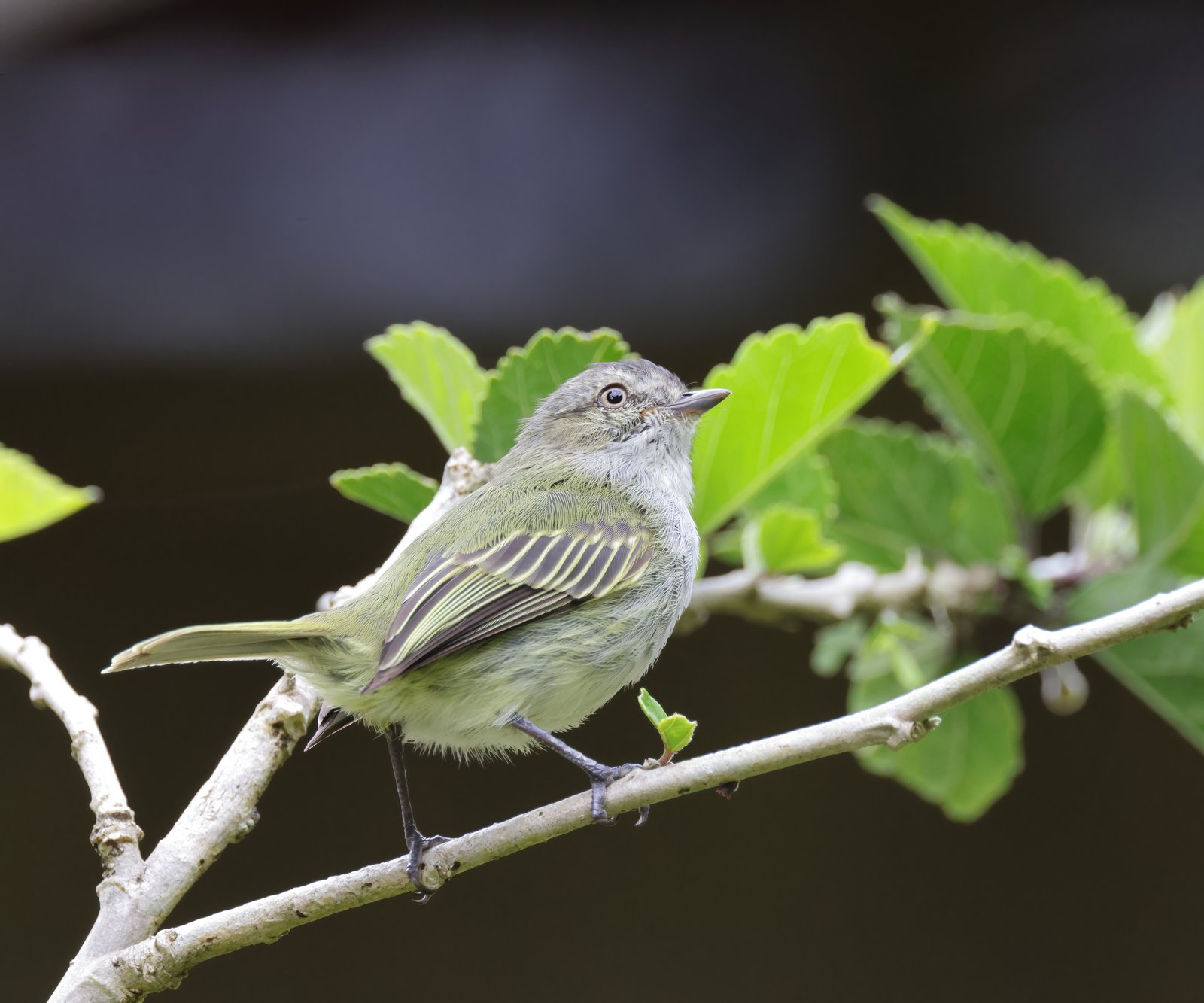
The Mistletoe Tyrannulet is a small, olive-green tyrant flycatcher with a grey crown, a white eyebrow and sharply defined yellow edges to the wing feathers, which often holds its tail cocked. It lives in the canopy, at forest edges and in gardens and eats many mistletoe berries. In the guide area it occurs from eastern Guatemala and Belize to Panama.
Voice
A clear, plaintive whistle, often repeated, and a quick series of high, rather shrill notes.
Recording: Michael Castaño — CC BY-NC-SA 4.0 · converted to mono · xeno-canto
Identification
10–11 cm, with a small, short black bill and a fairly long tail that is often slightly raised. Crown grey, with a white eyebrow and a dark eye-stripe. Back olive-green. Wings dark with narrow, sharply defined yellow edges to the coverts and flight feathers, without true wing-bars. Underparts greyish white with a yellowish wash on the flanks and lower belly. Male and female are alike.
Confusion species
Guatemalan Tyrannulet Zimmerius vilissimus of the highlands of Chiapas, Guatemala and El Salvador is very similar and was formerly treated as the same species; habitat and range are the best clues. Sooty-headed Tyrannulet Phyllomyias griseiceps lacks the yellow wing edges and the clear eyebrow. Yellow-bellied Tyrannulet Ornithion semiflavum and Brown-capped Tyrannulet Ornithion brunneicapillus are smaller, with a short tail and bright yellow underparts.
Habitat
Canopy and edges of humid forest, secondary forest, shade coffee, gardens and wooded parks, from the lowlands high into the mountains. It gleans insects from foliage and eats many berries, especially of mistletoes, and so disperses their seeds.
Where the bird is most at home, classified by the vegetation units of Mexico and Central America.






Range and movements
From eastern Guatemala and Belize through Honduras, Nicaragua and Costa Rica to Panama. Outside the guide area in north-western Colombia.
- Resident
- dark = core range, pale = thinly spread
How and when to look
In Costa Rica and Panama one of the commonest small tyrannulets in gardens and at forest edges. A small olive-green bird with a cocked tail in a tree with mistletoe is often this species.
Conservation status
Not threatened. Common and tolerant of man-made, semi-open landscapes.
Scientific name
Zimmerius parvus | (Lawrence, 1862) (GBIF: Zimmerius vilissimus)
Lawrence described the species in 1862 as Tyranniscus parvus; because it was later moved to another genus, the author and year stand in brackets. The genus Zimmerius was introduced in 1977 by Traylor. Zimmerius honours the American ornithologist John Todd Zimmer (1889–1957), an authority on South American birds. parvus is Latin for 'small'. The specimen the first description was based on came from Panama (presumably Lion Hill, former Canal Zone).