All species › Passerines › Crows, jays and magpies › Mexican Jay
Position in the tree Birds Aves › Birds with a flexible palate Neognathae › All other modern birds Neoaves › Landbirds Telluraves › Falcons, parrots and passerines Australaves › Falcons and passerines Eufalconimorphae › Parrots and passerines Psittacopasserae
Mexican Jay | Aphelocoma wollweberi
Noord-Mexicaanse gaai | Chara pecho gris
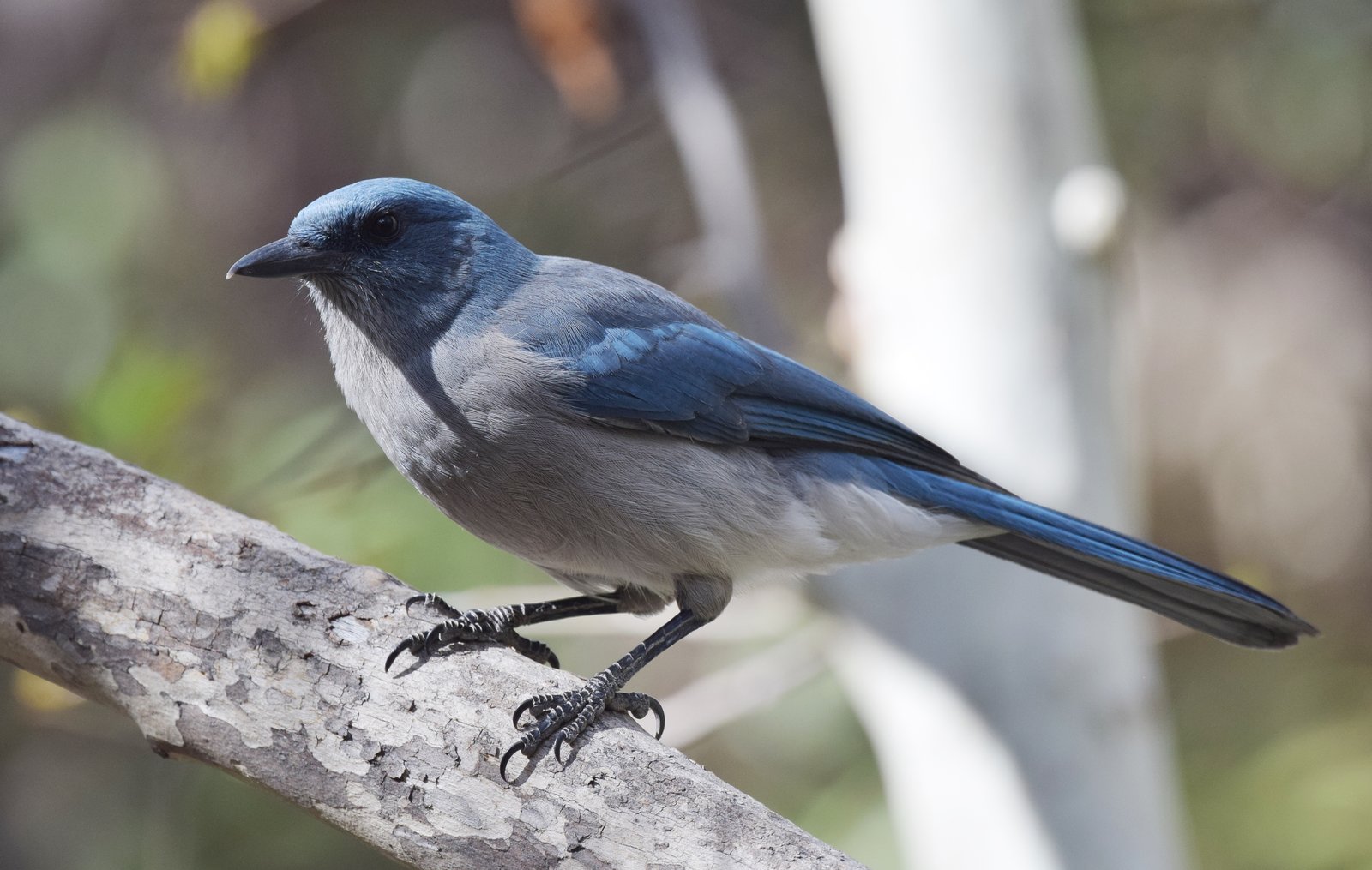
The Mexican Jay is a fairly large, plain blue-and-grey jay without a crest or a white supercilium that moves through oak and pine-oak woodland in noisy family groups. Group members help to raise the young. In the guide area it lives in the mountains of northern and western Mexico.
Voice
A loud, clear, often repeated weenk or wink, taken up from bird to bird within a group. Also rattles and softer chattering notes.
Recording: Richard E. Webster — CC BY-NC-SA 4.0 · shortened to the first 60 s, mono · xeno-canto
Identification
28–31 cm, of which much is tail. Head, wings and tail dull blue, back greyish blue to grey. Lores and ear coverts darker. Throat and underparts uniform pale grey, without streaks or breast band. Bill black and stout. In some populations juveniles keep a partly pale bill for a long time.
Confusion species
Woodhouse's Scrub Jay Aphelocoma woodhouseii has a white supercilium, a finely streaked white throat and a blue breast band and usually lives in drier, lower scrub. Steller's Jay Cyanocitta stelleri has a long dark crest. Transvolcanic Jay Aphelocoma ultramarina of the volcanic belt of central Mexico is very similar and is best separated in the field by range.
Habitat
Oak woodland, pine-oak forest and open oak woodland with grassland in the mountains, also wooded canyons and riparian woodland along mountain streams. It eats insects, acorns, seeds and fruit and caches acorns. It lives year-round in groups that defend a shared territory.
Where the bird is most at home, classified by the vegetation units of Mexico and Central America.



Range and movements
South-eastern Arizona, south-western New Mexico and western Texas, and south in the mountains of northern and western Mexico, including the Sierra Madre Occidental and Sierra Madre Oriental. Since the split of Transvolcanic Jay, the exact southern limit of the range is less well defined.
- Resident
- dark = core range, pale = thinly spread
How and when to look
Groups usually give themselves away by their loud calls; in mid-elevation oak woodland in the Sierra Madre Occidental and Sierra Madre Oriental it is often one of the first species to be noticed.
Conservation status
Not threatened. Common in suitable mountain woodland.
Scientific name
Aphelocoma wollweberi | Kaup, 1855
Kaup described the species in 1855 and placed it straight away in the genus where it still stands. The genus Aphelocoma was introduced in 1851 by Cabanis. Aphelocoma is Greek, from aphelēs 'simple, smooth' and komē 'hair of the head', after the uncrested head. wollweberi honours Wollweber (fl. 1850), a German traveller who collected in Mexico for the Darmstadt museum; little is known about him. The specimen the first description was based on came from Valparaíso Mountains, Zacatecas, Mexico.