All species › Passerines › Antthrushes › Mayan Antthrush
Position in the tree Birds Aves › Birds with a flexible palate Neognathae › All other modern birds Neoaves › Landbirds Telluraves › Falcons, parrots and passerines Australaves › Falcons and passerines Eufalconimorphae › Parrots and passerines Psittacopasserae
Mayan Antthrush | Formicarius moniliger
Mexicaanse mierlijster | Hormiguero cholino maya
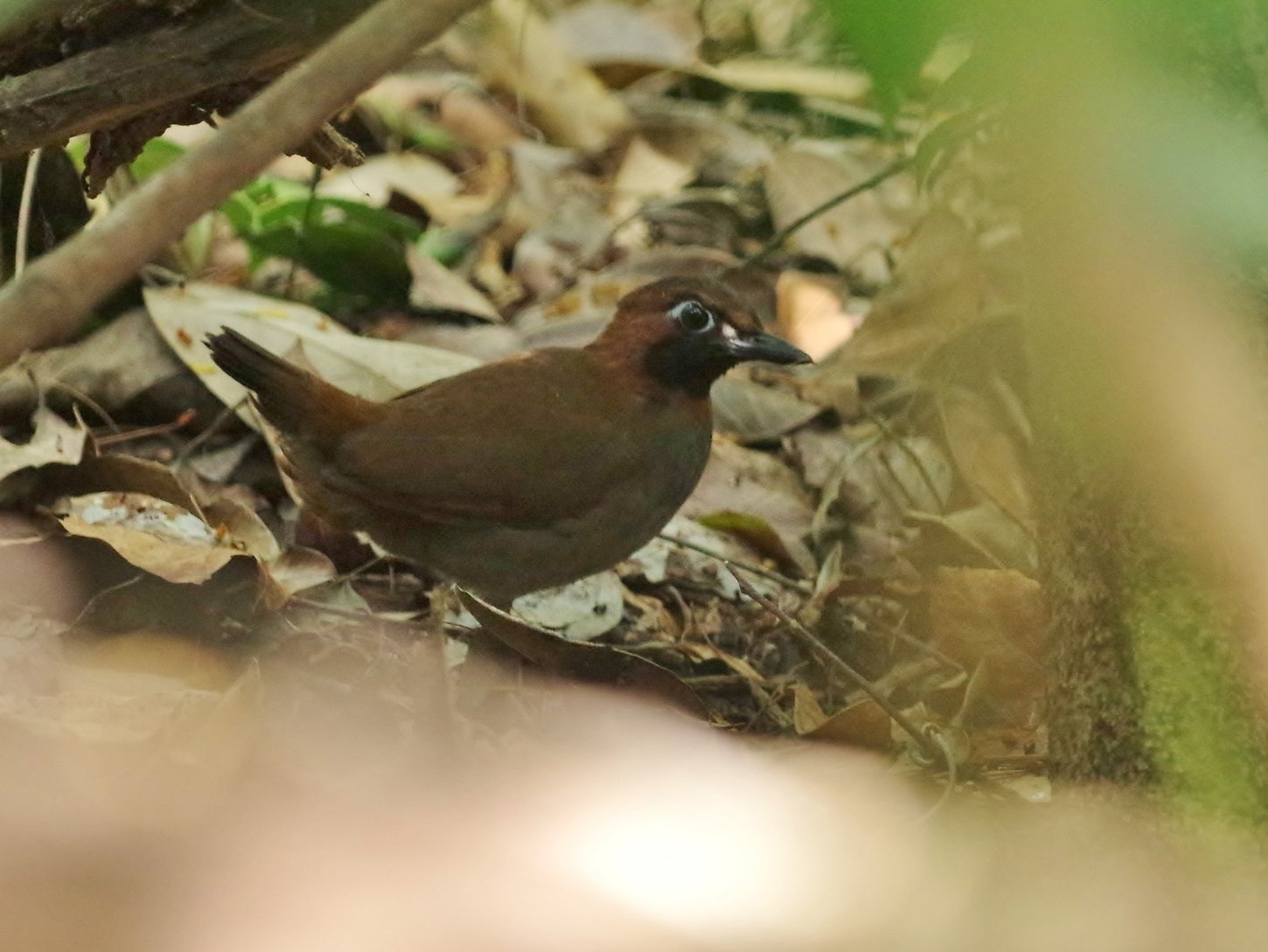
The Mayan Antthrush is a brown ground bird of the forests of south-eastern Mexico and northern Central America that walks over the forest floor like a small rail, tail cocked. It is heard far more often than seen. Long treated as a subspecies of Black-faced Antthrush, it is now regarded as a separate species on the basis of differences in song.
Voice
The song is a clear, long whistle followed by a series of shorter, slightly descending whistles. When alarmed a sharp, dry chuk.
Recording: Whitney Neufeld-Kaiser — CC BY-NC-SA 4.0 · shortened to the first 60 s, mono · xeno-canto
Identification
17–18 cm, with a compact, rounded build, fairly long legs and a short tail that is often held up. Upperparts warm brown, head slightly darker brown; side of the neck rufous. Lores, cheek and throat black; a conspicuous bare bluish-white ring around the eye. Underparts greyish to buffy grey, flanks browner, undertail coverts rufous. Bill black. Male and female are alike.
Confusion species
Black-faced Antthrush Formicarius analis, which occurs further south, is very similar and is best separated by song; exactly where the two species meet is not yet well known. Thrushes and quail-doves walking on the forest floor lack the black throat and pale eye-ring and do not hold the tail up.
Habitat
Floor and undergrowth of humid evergreen and semi-evergreen forest in the lowlands and foothills, also in mature secondary forest; on the Yucatán Peninsula also in drier seasonal forest. It walks quietly over the leaf litter, picking up insects, spiders and other invertebrates, sometimes at army-ant swarms. It nests in a cavity in a tree trunk or stump.
Where the bird is most at home, classified by the vegetation units of Mexico and Central America.




Range and movements
South-eastern Mexico (from southern Veracruz and northern Oaxaca through Tabasco, Chiapas and the Yucatán Peninsula) through Belize and Guatemala into Honduras. Found only in the guide area.
- Resident
- dark = core range, pale = thinly spread
How and when to look
Best found by listening for the song in forest reserves such as Tikal in Guatemala and Calakmul in Mexico, then patiently scanning the forest floor where the sound comes from.
Conservation status
Not threatened. Locally fairly common in larger forest tracts, but sensitive to deforestation and fragmentation.
Scientific name
Formicarius moniliger | Sclater, 1857
Sclater described the species in 1857 and placed it straight away in the genus where it still stands. The genus Formicarius was introduced in 1783 by Boddaert. Formicarius is Latin, from formica 'ant' with the suffix -arius: 'ant-bird'. moniliger is Latin, from monile 'necklace' and -ger 'bearing', after the dark band below the throat. The specimen the first description was based on came from Córdoba, Veracruz, Mexico.