All species › Kingfishers, bee-eaters and rollers › Motmots › Lesson's Motmot
Position in the tree Birds Aves › Birds with a flexible palate Neognathae › All other modern birds Neoaves › Landbirds Telluraves › Raptors, owls, kingfishers and woodpeckers Afroaves › Mousebirds, rollers and woodpeckers Coraciimorphae › Trogons and cavity nesters Cavitaves › Hornbills, kingfishers and woodpeckers Picocoraciae › Kingfishers, bee-eaters and woodpeckers Picodynastornithes
Lesson's Motmot | Momotus lessonii
Lessons motmot | Momoto diademado
Lesson's Motmot is the most common and widespread motmot of the guide area, from southern Mexico to western Panama, and a familiar bird of gardens and coffee plantations in Costa Rica's Central Valley. It was long included in Momotus momota; since the recent split of that species it forms the middle link between Blue-capped Motmot in the north and Whooping Motmot in eastern Panama. The name honours the French naturalist René-Primevère Lesson.
Voice
A low, soft, hollow hoo-doot or oo-oop, disyllabic and owl-like, heard mainly before sunrise and at dusk. Pairs often call alternately, producing a series of double notes.
Recording: AUDEVARD Aurélien — CC BY-NC-SA 4.0 · converted to mono · xeno-canto
Identification
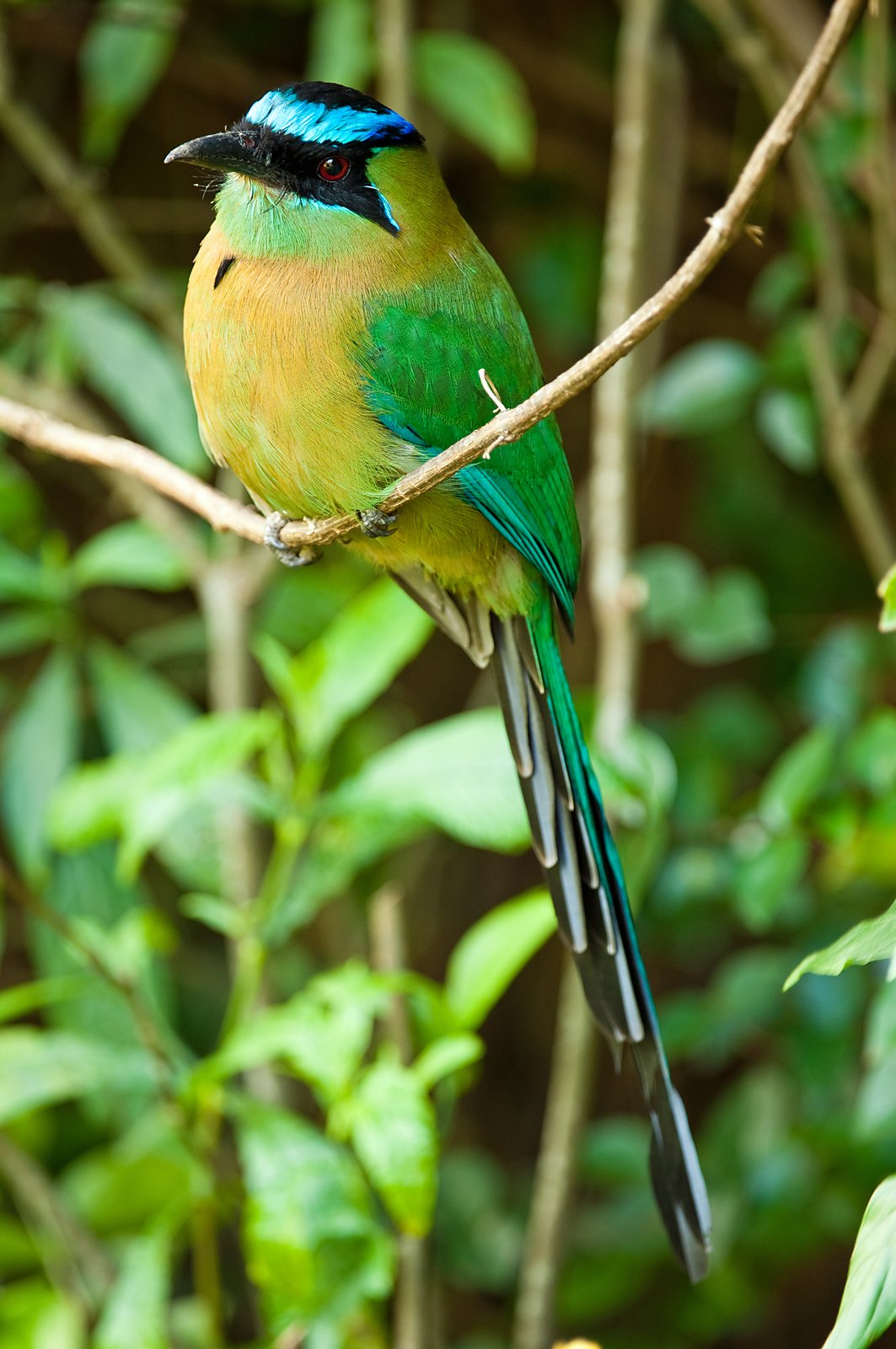
38–43 cm, more than half of it tail. The crown is black, surrounded by a broad blue ring or diadem, turquoise above the forehead and violet-blue on the hindcrown. A black mask runs through the red eye. The back, wings and tail are green to blue-green; the underparts are olive-green with a rufous tinge, more ochre on the belly. On the breast is a small black, blue-edged spot, sometimes two. The central tail feathers end in a blue, black-tipped racket on a short bare stretch of shaft. The sexes are alike.
Confusion species
Blue-capped Motmot Momotus coeruliceps (north-eastern Mexico into Veracruz) has an entirely blue crown without a black centre. Whooping Motmot Momotus subrufescens (from the Panama Canal eastwards) has the same head pattern but usually a narrower blue ring and distinctly more rufous underparts; the two are separated mainly by range and voice. Russet-crowned Motmot Momotus mexicanus has a rufous crown. Rufous Motmot Baryphthengus martii is larger, with an entirely rufous head and breast and no blue ring. Turquoise-browed Motmot Eumomota superciliosa has a green crown, a turquoise brow and a long bare section in the tail.
Habitat
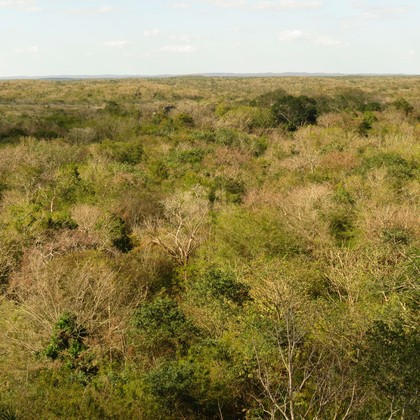
Humid and semi-deciduous forest, also seasonal forest on the Yucatán Peninsula, secondary forest, forest edges, gallery forest, shade coffee and cacao, and parks and gardens with tall trees; from sea level to about 2100 m in Costa Rica, locally into the lower parts of montane forest. It sits still for long periods in the shade, low to mid-level, swinging its tail like a pendulum. It eats large insects, spiders, small lizards and fruit, often snatched in a short sally from the ground or a branch. It nests in a self-dug tunnel in a bank, road cut or ditch wall.
Where the bird is most at home, classified by the vegetation units of Mexico and Central America.






Range and movements
In Mexico on the Gulf slope from central and southern Veracruz through northern Oaxaca, Tabasco and Chiapas and on the Yucatán Peninsula (Campeche, Yucatán, Quintana Roo). Further in Belize, Guatemala, El Salvador, Honduras, Nicaragua and Costa Rica, on both sides of the mountains. In Panama in the west and centre, in Chiriquí, Bocas del Toro, Veraguas, on the Azuero Peninsula and in Coclé to west of the Panama Canal, where Whooping Motmot takes over. Not present outside the guide area.
- Resident
- dark = core range, pale = thinly spread
How and when to look
Common in gardens and parks in and around San José and elsewhere in Costa Rica's Central Valley, at Monteverde, at Tikal and in Petén in Guatemala and in the Cayo District of Belize. When the hollow call is heard at dusk, the bird is often close by in the lower layer.
Conservation status
Least Concern. A common species that persists well in secondary forest, coffee plantations and gardens with trees.
Scientific name
Momotus lessonii | Lesson, 1842
Lesson described the species in 1842 and placed it straight away in the genus where it still stands. The genus Momotus was introduced in 1760 by Brisson. Momotus comes from 'momot', a corruption (Nieremberg, 1635) of an onomatopoeic Nahuatl (Aztec) word for a blue-capped tropical bird. lessonii honours the French naval surgeon and naturalist René Primevère Lesson (1794–1849). The specimen the first description was based on came from El Realejo, Nicaragua.