All species › Passerines › Finches, euphonias and allies › Lesser Goldfinch
Position in the tree Birds Aves › Birds with a flexible palate Neognathae › All other modern birds Neoaves › Landbirds Telluraves › Falcons, parrots and passerines Australaves › Falcons and passerines Eufalconimorphae › Parrots and passerines Psittacopasserae
Lesser Goldfinch | Spinus psaltria
Witbandsijs | Jilguero dominico
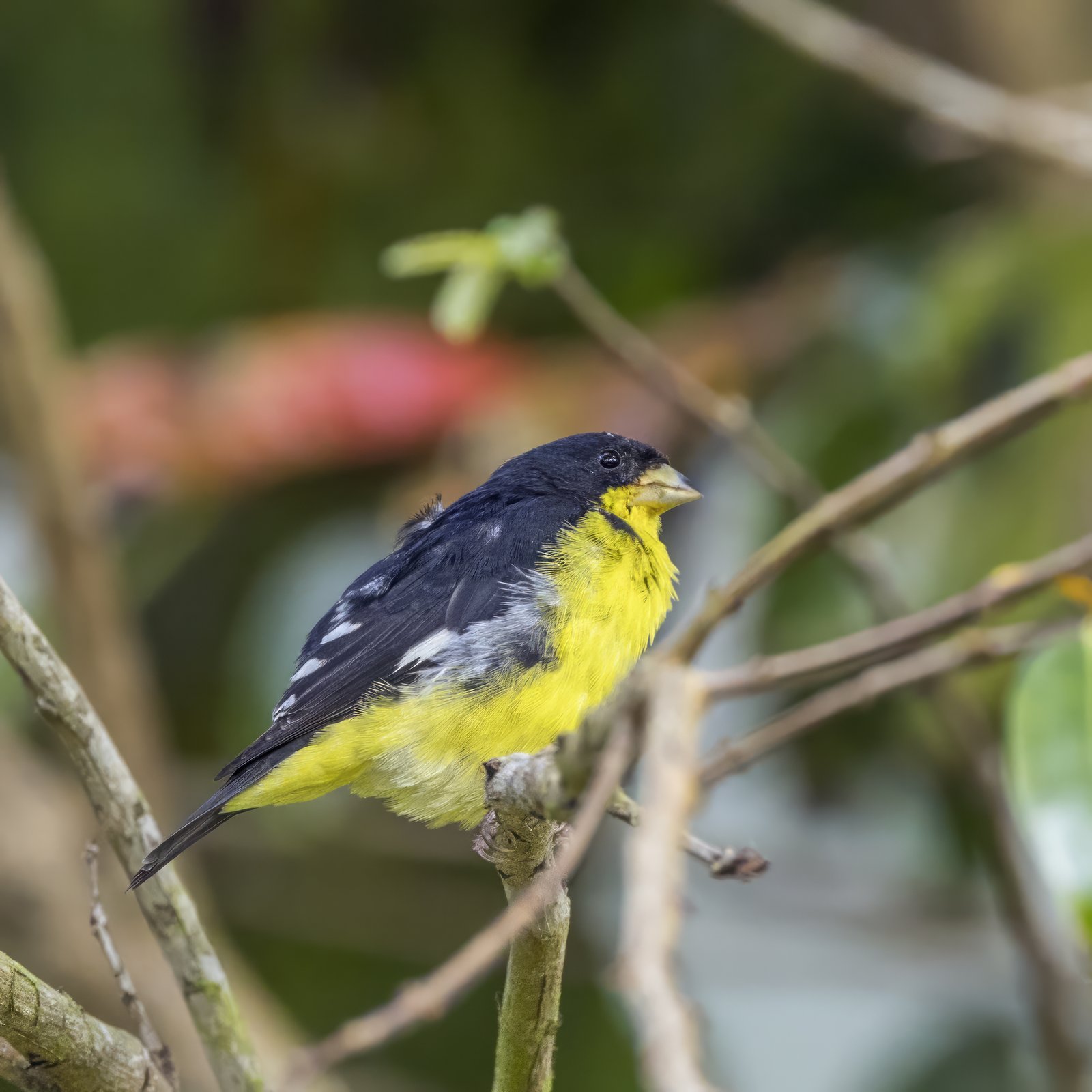
The Lesser Goldfinch is the smallest and most widespread finch of its genus in the guide area, a yellow-and-black bird of open, scrubby country, field edges and gardens. It occurs from the northern deserts to the highlands of Panama. Small flocks feed on thistles and other seeding herbs.
Voice
It calls a plaintive, falling tee-yee or tee-oo and a flat cheh. The song is a long, varied series of twitters, trills and whistles, often with imitations of the calls of other birds.
Recording: Manuel Grosselet — CC BY-NC-SA 4.0 · shortened to the first 60 s, mono · xeno-canto
Identification
9–11 cm. The male has a black cap, bright yellow underparts and a white patch at the base of the primaries; in almost all of Mexico and Central America the back is black, while in north-western Mexico green-backed males also occur. The tail has white at the base of the outer feathers. The female is olive-green above and yellow below, without a black cap, with a smaller white wing patch and pale wing bars. Bill short and dark.
Confusion species
Male Black-headed Siskin Spinus notatus has an entirely black head and throat and a yellow, not white, wing patch. Lawrence's Goldfinch Spinus lawrencei is mainly grey. American Goldfinch Spinus tristis in winter has white undertail coverts and broad pale wing bars; the breeding male is bright yellow with a black forehead.
Habitat
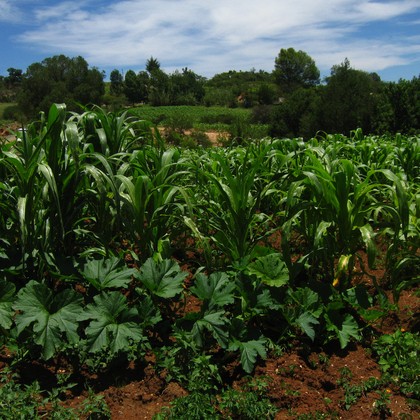
Open woodland, scrub, forest edges, dry forest, oak and pine-oak woodland, weedy fields, hedges, gardens and villages, from sea level to about 3000 m. It eats mainly seeds of herbs and thistles, also buds. Outside the breeding season in flocks, often near water.
Where the bird is most at home, classified by the vegetation units of Mexico and Central America.






Range and movements
From the south-western United States through nearly all of Mexico, except much of the lowlands of the Yucatán Peninsula, and through Central America to Panama, where it is local and occurs mainly in the west and centre. Outside the guide area in northern South America to Venezuela and Peru.
- Resident
- dark = core range, pale = thinly spread
How and when to look
Often found where weeds and thistles are in seed, along roadsides and field edges and in gardens; the plaintive call points out flocks that otherwise vanish into the greenery.
Conservation status
Not threatened (LC). Common and benefits from open, human-altered landscapes. Locally trapped for the cage-bird trade.
Scientific name
Spinus psaltria | (Say, 1822)
Say described the species in 1822 as Fringilla psaltria; because it was later moved to another genus, the author and year stand in brackets. The genus Spinus was introduced in 1816 by Koch. Spinus goes back to Ancient Greek spinos, a name for a small bird that can no longer be identified with certainty. psaltria is Greek for 'female harpist', after the melodious song. The specimen the first description was based on came from Arkansas River near Colorado Springs, Colorado (USA).